


2026 Forum Program
This page will be updated as the program evolves. Abstracts are searchable here; individual abstracts are linked to the first author in the program below.
Jump down to: Saturday | Sunday | Monday | Tuesday | Wednesday | Thursday
Friday 31 July — check-in for Baraboo field trip participants
4:00-7:00: Check-in for campus housing (Anderson Hall Atrium). For after-hours check-in, see your email for who to contact. For location, see: campusMap.pdf (Acrobat (PDF) 2.5MB Jul28 26)
Saturday 1 August - Baraboo field trip
7:30: Field trip breakfast (Anderson Hall 128) and check-in. Pick up your boxed lunch, turn in the College's Waiver of Liability form.
8:00: Field trip departs for overnight field trip to Baraboo, Wisconsin. Camping equipment required. Trip leaders: Willy Guenthner (UI-Urbana-Champaign) and Nicolas Roberts (Hamilton College).
2:00-6:00: Check-in to campus housing (Anderson Hall Atrium). For after-hours check-in, see your email for who to contact. For location, see: campusMap.pdf (Acrobat (PDF) 2.5MB Jul28 26)
12:30-5:30: Old-timey bands. In Northfield and looking for something to do? Check out the Vintage Band Festival in Central Park.
Sunday 2 August - Morton field trip and statistics workshop
7:30: Breakfast for field trip and workshop (Anderson Hall 128).
8:00: Field trip departs for Morton, MN. Pick up your boxed lunch; turn in the College's Waiver of Liability form. Trip leaders: Cam Davidson (Carleton College) and Alli Severson (MN Geologic Survey).
8:00-5:00 Workshop: Statistics tools for structural geologists (Anderson Hall 123). Lunch provided. Dinner on your own. Joshua Davis (Carleton College Math/Stats/CS) and Sarah Titus (Carleton College Geology)
2:00-6:00: Check-in to campus housing (Anderson Hall Atrium). For after-hours check-in, see your email for who to contact. For location, see: campusMap.pdf (Acrobat (PDF) 2.5MB Jul28 26)
12:30-5:30: Old-timey bands. In Northfield and looking for something to do? Check out the Vintage Band Festival in Central Park.
6:00: Baraboo and Morton field trips return to Northfield. Dinner on your own.
7:30-8:30: Optional: t-shirt printing in the Lilac Hill courtyard. Socializing is also encouraged. We can have another t-shirt printing session later, too, if you can't make it to this one. Note: I do have some extra t-shirts if you didn't get back to me on size/color and you didn't bring along your own shirt.
Location information for three plenary days:
Meals (except for Tuesday dinner) are in the Anderson Hall Atrium. Seating available in the atrium, in the geology classrooms, and outside in the Anderson amphitheater.
Talks are in Olin 149.
Posters and coffee breaks are in Anderson Hall Atrium.
Map of campus: campusMap.pdf (Acrobat (PDF) 2.5MB Jul28 26)
Map of Northfield dining options within walking distance of campus (with hours, where available): northfieldMap.pdf (Acrobat (PDF) 554kB Jul20 26)
Monday 3 August — Plenary Day 1
7:00-8:20 Breakfast in Anderson Hall Atrium
 Show menu
 Hide
HideWe will aim to stay approximately on time, but please forgive ± 10 min. Abstracts are searchable here.
8:30 Session 1 (Olin 149): Deformation in the upper crust (co-chaired by Joe Allen, Concord University and Arlo Weil, Bryn Mawr College)
8:30-8:40: Welcoming remarks in Olin lecture hall (Titus): Goals and history of SGT Forum, announcement, logistics
8:40-9:05: Folarin Kolawole: Fracture Clustering in the Brittle Crystalline Crust: Manifestations of Incipient Faulting
9:05-9:30: Andrew Zuza: Geologic Reconstructions Support Non-lithostatic Pressure in the Geologic Record
9:30-9:55: Amberly Kroha: Inferring Stress Directions from Naturally Deformed Granular Materials: Microstructural Analysis of Deformation Bands near the San Andreas Fault in Parkfield, California
9:55-10:20: Robert Welch: Characterizing Deformation in Fold-and-Thrust Belts over Tectonic to Human Timescales by Leveraging Dense Field, Geophysical, and Seismological Datasets
10:20-10:40: Poster lightning talks: fractures and other shallow structures (2 minutes per talk; 2 slides):
Daniel Laó-Dávila: Fracture Networks in the San Cristobal Canyon, Puerto Rico from High-Resolution Topography, GIS, and Aeromagnetic Analyses
Joseph Allen: Extensional Collapse and Growth Faulting in a Late Mississippian Incised Paleovalley in the Central Appalachian Basin
Montserrat De Allende Silva: Damage Zones in Ultramafic Rocks: Grain Size Reduction through Hydration Over Cataclasis
Noah Phillips: Dichotomous Damage Zones: Lithologic Controls on Fracture Densities Surrounding Late Faults at the Lac Des Iles Mine, ON, Canada
Colin Shaw: Artic REU Students map complex fault rupture, Ikertooq Shear Zone, West Greenland
Molly Egan: The Role of the Intermediate Stress Axis in forming Primary P-fracture Arrays, Cathedral Peak Granodiorite, California
Hannah Hackenmueller, Amelia Carson, Max Posner: How Does Lithology Impact Borehole Breakouts in Central California?
Carolyn Tewksbury-Christle: Nature and Timing of Enigmatic Banded Fault Fabrics in the Navajo Sandstone, Salt Valley, Utah
Carter Mayland: Can Deformation Bands Indicate Paleostress Orientations?
10:40: Coffee break and posters
12:00: Lunch in Anderson Hall Atrium
1:30 Session 2 (Olin 149): Rates and dates (chaired by Kendra Murrray, Idaho State University)
1:30-1:55: Caden Howlett: Long-term Kinematic and Erosional Record of the South-Central Andes and Implications for Mechanisms of Crustal Thickening, Chile and Argentina (34–35°S)
1:55-2:20: Tshering Sherpa: A Multi-chronometric Perspective on Timing and Rates of Fold-Thrust Belt Development during Himalayan Orogenesis: Insights from Eastern Nepal Himalaya
2:20-2:45: Victor Guevara: Rapid Crustal Heating during Exhumation of the Nanga Parbat Massif
2:45-3:10: William Guenthner: A Multiple Chronometer approach to the Deep-Time Thermochronology of Cratons
3:10-3:30: Poster lightning talks: Rates/dates and geophysics
Andrea E. Richardson: Exhumation and Cooling History of the Salmon River Suture Zone and Western Idaho Shear Zone
Nikhil Arolkar: The Northwestern Margin of the New England Avalon Terrane, Eastern Massachusetts: Nature and Ages of Deformation
Christopher Bailey: From Collision to Extension: The Timing of Exhumation, Uplift and Rifting in Virginia's Eastern Piedmont
Vivian Spiess: Reevaluating the Structural Evolution of the Beaver Dam Mountains, Utah; Evidence for Sevier Contraction Overprinted by Basin and Range Extension
Basil Tikoff: Strain Rates and Displacement Rates for Two- and Three-Dimensional Deformations
Kendra Murray: Towards More Rigorous Thermal History Modeling Practices
Eric Horsman: Field-Based Constraints on Rates of Dynamic Igneous Emplacement Processes in Subvolcanic Systems, Henry Mountains, Utah
Ellen Nelson: The Sage Hen Flat Pluton: Emplacement of a Pluton with Minimal Wall Rock Deformation
Peter Berganross: Discovering a Negative Anomaly: Gravity Survey of the Pine Bend Impact Structure
Jackie Harris: Is the Northern Hikurangi Plateau Well Hydrated? Insights from 2D Streamer Tomography and Reflection Imaging
3:30: Afternoon break and posters
6:00: Dinner in Anderson Atrium
7:00: Navigating Early Careers in Structural Geology and Tectonics (Scott Giorgis, SUNY-Geneseo): Meet in Anderson 123.
Jump back up to top
Tuesday 4 August — Plenary Day 2
We will aim to stay approximately on time, but please forgive ± 10 min. Abstracts are searchable here.
7:00-8:20 Breakfast in Anderson Atrium
8:30 Session 3 (Olin 149): Experiments of all sorts (chaired by Jacqueline Reber, Iowa State University)
8:30-8:40: Discussion of afternoon activities
8:40-9:05: P. Io Ioannidi (via Zoom): Rheology of the Lithosphere Across Scales: From Field Observations and Physical Experiments to Numerical Models
9:05-9:30: Julia Baumgarte: Effects of Fault Roughness and Geometry on Friction
9:30-9:55: Daniel Ortega-Arroyo: Diverse Slip Behaviors in Granitoid Fault Rocks Controlled by Local Heterogeneity
9:55-10:20: He Feng: How Shear Zones Get Started: Mechanical Heterogeneity, Bridge Zones, and Rock Weakening
10:20-10:40: Poster lightning talks: Experiments, geoscience education, and ductile deformation
Holly Hilbrant: Force Quantification Methods in Cohesive Photoelastic Granular Experiments
David Brink-Roby: Exploring the Controls on Fault Generation and Spacing within Duplexes and Imbricate Fans Using Numerical and Analog Models
Juliet Crider: Do Inverse Trishear Models of Deformed Geomorphic Surfaces Constrain the Geometry of the Active Strand of the Blind Seattle Thrust?
Arlo Weil: Four-Dimensional Structural Evolution of a Complex Fold-Fault System, Laramide Foreland, Wyoming
Heather Kirkpatrick: Benefits and Implementation of a Course-Embedded Undergraduate Research Experience
Rudi Osti: Investigating the Role of Fe-Ti Oxides on the Rheology of the Oceanic Crust
Ben Clarke: Timing, Kinematics, and Conditions of Deformation of the Towaliga Fault Zone (Alabama)
Hanna Tiitto: Deformation Processes in a Mid-Crustal Strike-Slip Shear Zone: Insights from the Archean Quetico Shear Zone, Superior Province, Canada
Drew Levy: How Does Heterogeneity Impact the Rheology of the Deep Seismogenic Zone?
Niya Davis: A Comparison Between Structure–From–Motion Photogrammetry and Field Measurements That Helps Identify Fluid Pathways Within Detachment Shear Zones
Stephen Marshak: Interpreting Enigmatic Mesoscopic Structures of the Baraboo Syncline (Picuris-Baraboo Orogen), Wisconsin
10:40: Coffee break and posters: Look for extra treats in Olin
12:00: Lunch in Anderson Atrium
1:30 Session 4 (Olin 149): Geoscience Education (co-chaired by Rory McFadden, SERC & Carolyn Tewksbury-Christie, Fort Lewis College)
1:30-1:50: Some logistics, and then Introduction to the Carleton Geothermal System (Rob Hansen, Carleton Facilities)
2:00-2:55: First activity - various locations.
3:00-3:55: Second activity - various locations.
4:10-5:05: Third activity - various locations.
Round-robin activities
Station A. Anderson 129
- Tour the energy station - Rob Hansen (Carleton Facilities)
- Carleton faculty discuss use of the geothermal system in teaching and research - Dan Maxbauer and Chloé Fandel
Station B. Anderson 121
- Spatial and temporal reasoning with Visible Geology web-based applications - Hannah Blatchford (East Michigan University) and Andrew Laskowski (Montana State University)
- Virtual field station - Ryan Petterson (Stanford University)
Station C. Ground state (in the basement of Anderson)
- Active learning with OnRamps - Phil Resor (Wesleyan University)
- Using a Makerspace + build your own simple shear apparatus (for faculty) - Sarah Titus (Carleton College): here is the assignment: cardDeckActivity.pdf (Acrobat (PDF) 26.2MB Aug4 26)
Station D. Anderson 123
- Science communication and art - Jacqueline Reber and Kim Moss (Iowa State University)
Station E. Olin 149
- Equity-centered teaching in SGT - Carolyn Tewksbury-Christle (Fort Lewis College)
- Quantitative skills in SGT - Kendra Murray (Idaho State University)
6:00-9:00 Off-site dinner at Imminent Brewing
Jump back up to top
Wednesday 5 August — Plenary Day 3
We will aim to stay approximately on time, but please forgive ± 10 min. Abstracts are searchable here.
7:00-8:20 Breakfast in Anderson Atrium
8:30 Session 5 (Olin 149): Large-scale tectonics (chaired by Folarin Kolawole, Columbia University):
8:30-8:55: Meritxell Colet: Contrasting Modes of Deformation in Cratonic vs Non-cratonic Lithosphere during Early-Stage Rifting
8:55-9:20: Veronica Prush: Integrating Structural, Stratigraphic, and Thermochronologic Datasets to Test Exhumation Models for the Fra Cristobal Range in South-Central New Mexico
9:20-9:45: Nicolas Roberts: The Birth and Evolution of Plate Boundary Systems: The Critical Role of Strain Rate
9:45-10:10: Alan Chapman: Mesozoic Orogenesis in the Klamath Mountains Province (Northern California–Southern Oregon, USA) Occurred by Tectonic Switching: Insights from Detrital Zircon U-Pb Geochronology of the Condrey Mountain Schist
10:10-10:30: Poster lightning talks: Large-scale tectonics and societal relevance
Nicholas Swanson-Hysell: Midcontinent Rift Extension Ceased and the Rift Inverted due to the Grenvillian Orogeny
Jonny Wu: Asymmetric Spreading formed Shatsky-Ojin-Hess conjugate (SOHCO) Oceanic Plateau that Subducted Under North America
Jason Wan: Mapping and Un-Subducting the Cocos Slab: Implications for the Tectonic History of Mexico and Central America
Peter Lindquist: Impact of Varying Degrees of Seafloor Alteration on the Metamorphic and Rheological Evolution of Mid-ocean Ridge Basalts
Stephen Marshak: The Uplift of the Ozark and Appalachian Foreland Cratonic Plateaus, USA
Corey Flynn: Relative Timing of Seismicity, Lithologic Host and Fluctuating Strain Rates in an Exhumed Lower Crustal Shear Zone; Western Churchill Province, Canada
Yvette Kuiper: The ~1.4 Ga Picuris Orogeny in the Central Colorado Front Range
Seth Kruckenberg: Quantifying Polyphase Lower Crustal Rheology: Constraints from Mount Hay Granulites (Central Australia)
Kyle Gallant: Mapping a Fossilized Geothermal System in the Fra Cristobal Range of South-central New Mexico
Ben Frieman: Challenges and Opportunities for Structural Geologists in the Critical Minerals Sector
10:30: Coffee break and posters
12:00: Lunch in Anderson Atrium
1:30 Session 6 (Olin 149): Societal relevance of SGT (chaired by Jonny Wu, University of Arizona)
1:30-1:55: David Oakley: Bayesian Balancing: Inverse Modeling of Fault-Related Folds for Seismic Hazard and Natural Resource Applications
1:55-2:20: Benjamin Surpless: Linking Structural Geology and Tectonics Research to the Future of Utility-scale Geothermal Energy
2:20-2:45: Amanda Hughes: Integrating Structural Observations and Models to Support Subsurface Applications: Case Studies from the Paradox Basin
2:45-3:00: Update from Wendy Panero, NSF Program officer at Structure and Physics of the Solid Earth
3:00-3:10: Description of breakout sessions (Titus)
3:10-3:30: Afternoon break
3:30-4:30: Breakout sessions (you can request other topics that you'd like to see discussed)
- AI in SGT - Juliet Crider (University of Washington) in Anderson 121
- Community resources in SGT - Phillip Resor (Wesleyan University) and Basil Tikoff (University of Wisconsin) in Olin 149
- Funding opportunities for SGT - Rory McFadden and Cailin Huyck Orr (Science Education Resource Center, SERC) in Anderson 123
- SGT students and the workforce - Eric Horsman (East Carolina University) in Anderson 129: workforceResources.pdf (Acrobat (PDF) 25kB Aug6 26)
4:30-5:00: Short reports from breakout sessions, final announcements
6:00: Dinner in Anderson Atrium
Jump back up to top
Thursday 6 August — North Shore field trip and digital futures workshop
![[creative commons]](/images/creativecommons_16.png)
7:30: Breakfast (Anderson 129) for field trip and workshop
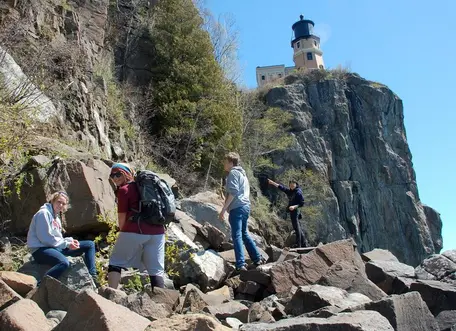
8:00: Field trip departs for overnight field trip to North Shore. Trip leaders: Cam Davidson (Carleton College) and Nicholas Swanson-Hysell (University of Minnesota).
8:00-4:00: Workshop: Imagining a digital future (Anderson 123). Lunch provided. Dinner on your own. Workshop leader: Basil Tikoff (University of Wisconsin).
Jump back up to top