


General schedule
Pre-meeting field trips and workshops
Friday 31 July: Optional check-in day
Campus housing will be open for early arrivals. [more info to come.]
Saturday 1 August: Optional two-day field trip
Please register in advance for this event.
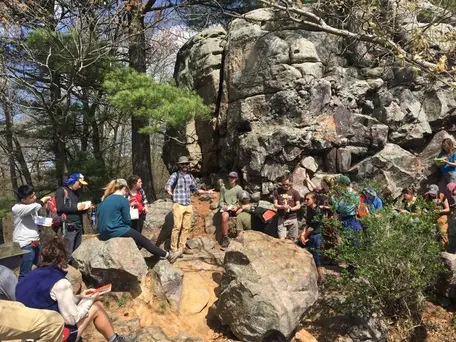
Field trip: Baraboo Hills, Wisconsin. Trip leaders: Willy Guenthner (UI-Urbana-Champaign) and Nicolas Roberts (Hamilton College). Limited to 22 participants.
The Baraboo Hills have been a seminal destination for generations of midwestern structural geologist. This two-day field trip will showcase classic outcrops (e.g., Van Hise Rock), and present new perspectives on topics such as the deep-time burial and erosion history of the hills, and formation of kink bands. This trip includes one night of camping and moderate hiking; one outcrop requires ~100 yards of steep (40% grade) uphill ascent. Participants are encouraged to supply their own camping gear, but equipment can also be borrowed from the college by arrangement. Depart 8 am from Northfield on August 1, return late to Northfield on August 2.
Sunday 2 August: Optional one-day field trip and workshops
Please register in advance for these events.
Field trip: Very old rocks in the Minnesota River valley. Trip leaders: Bereket Haileab (Carleton College) and Alli Severson (MN Geologic Survey). Limited to 22 participants.
This one-day field trip will focus mainly on the Montevideo and Morton tectonic blocks and the separating Yellow Medicine shear zone within the Minnesota River valley subprovince. This region represents some of the oldest crystalline basement rock in the world (including the 3.55 Ga Morton gneiss), and is located at the southernmost extent of the Archean Superior Province. For this field trip, we will stop at a variety of classic roadside outcrops along the Minnesota River valley to observe and discuss the key structural, geochronological, petrological, and geochemical variations within the Minnesota River valley that occurred before, during, and after the prominent ~2.6 Ga Sacred Heart orogeny.
This field trip will require minimal physical effort, from roadside stops to walking up to ~100 meters away from vehicles on uneven terrain. It can be hot in the Minnesota River valley, so come prepared with lots of water (extra water will be provided). Look out for invasive prickly pearcacti, too. Depart early from Northfield on August 2; return late on the same day.
Workshop: Statistics for Structural Geology. Led by: Joshua Davis (Carleton College Math/Stats) and Sarah Titus (Carleton College Geology).
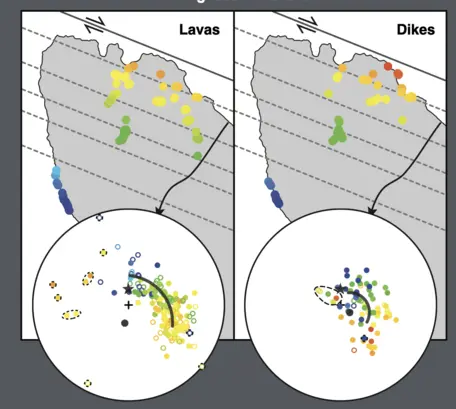
Data are precious, so you want to extract as much insight from them as possible. But you don't want to over-interpret random noise as signal. Statistics offers techniques for extracting insights and assessing their reliability. But geology involves a lot of geometric data types, whose statistics is not treated in typical statistics courses or software. This one-day course teaches you geology-specific statistics that can make your research better.
Workshop: Using StraboMicro. This all-day workshop will address how to use the new StraboMicro desktop application. The workshop will provide an overview of the StraboMicro application, as well as providing a digital dataset for users to explore. We will demonstrate how StraboMicro data be seen in the field application. We will spend most of the afternoon with a hands-on working session in which users start a new project, import data, and interact with the system. Part of the afternoon will be spent having participants work together, to simulate the possibility of working in groups that StraboMicro provides. Participants are highly encouraged to bring their own data (e.g., images (optical microscope, SE, BSE, EBSD etc,) and associated data (e.g., EBSD analyses, WDS analyses, etc.) for the working session although a dataset will be provided for those who do not have one ready. Funds are available to attend this workshop: $500 for faculty; $300 for graduate students.
Plenary sessions 3-5 August
The plenary sessions will evolve in response to participants as reflected in the abstracts you submit!
Monday 3 August: Talks, posters and discussion
Session 1: Large-scale tectonics
Lunch
Session 2: Deformation in the upper crust
Dinner
Evening: Discussion on early career development
Tuesday 4 August: Talks, posters and discussion
Session 3: Experiments of all sorts
Lunch
Session 4: Geoscience education activities
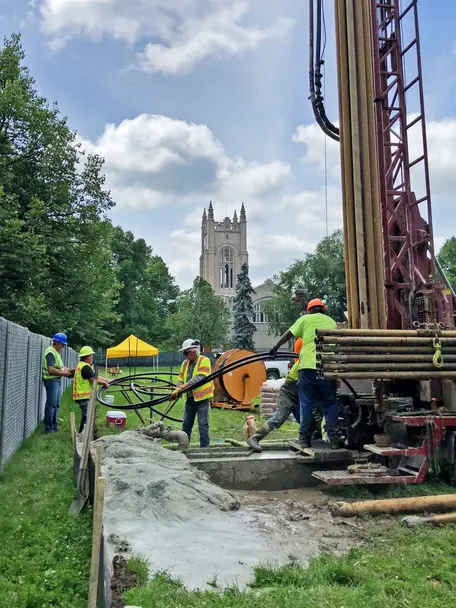
Tours of Carleton Geothermal system
Dinner
Wednesday 5 August: Talks, posters and discussion
Session 5: Rates and dates
Lunch
Session 6: Societal relevance of structural geology and tectonics
Dinner
Post-meeting field trip and workshop
Thursday 6 August - Friday 7 August: Optional two-day field trip, one-day workshop
Please register in advance for these events.
Field Trip: From Paleoproterozoic Contraction to Mesoproterozoic Extension: Tectonic Evolution of Northern Minnesota. Trip leaders: Cam Davidson (Carleton College) and Nick Swanson-Hysell (U of MN). Limited to 22 participants.
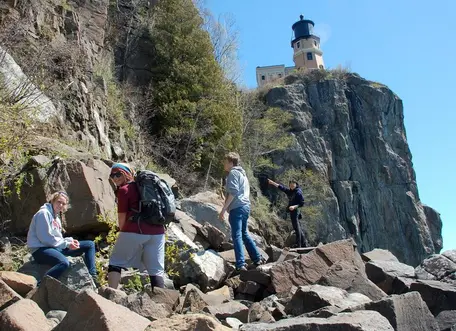
This two-day field trip examines the tectonic evolution of northern Minnesota. The first day will focuson Paleoproterozoic contractional deformation at Thomson Dam associated with Penokean orogenesis when Laurentia was assembling. The second day will be on spectacular exposures of Mesoproterozoic volcanic and intrusive rocks along the North Shore of Lake Superior from when the Midcontinent Rift almost split Laurentia apart. Stops involve short hikes over rocky terrain with modest elevation changes; while not technically difficult, participants should be comfortable walking on uneven rock exposures.
Depart 8 am from Northfield on August 6, return 8 pm to Northfield (with a stop enroute at airport-proximal hotels) on August 7.
Workshop: Imagining a digital future. StraboSpot is a digital data system that is designed for this community, and is becoming a standard for storing of digital data. We are at a point where we need feedback on the variety of possibilities that recording digital data provides for the community, including how we want to evaluate quality of data (QAQC - Quality Assessment and Quality Control). There are multiple activities planned for this all-day workshop, including evaluating memos and other tools designed for group workflows improves understanding or a field area. We would like to have small group discussions over next steps for StraboSpot, including: 1) What can StraboSpot implement to improve the quality of the data and one's trust in it; 2) Community standards for producing a doi for digital data sets; 3) How to cite that doi for a paper; 4) Discuss if we need/want to review digital data sets, and if so, under what conditions; and 5) How can the SG&T community take intellectual ownership of the StraboSpot system in the future. Funds are available to attend this workshop as we need your participation. This workshop is critical for our community's work in the future: We need you to help us imagine it! Funds are available to attend this workshop on Thursday 6 August: $500 for faculty; $300 for graduate students.