Program & Course Materials
Before the course
Pre-workshop Meetings
June 22-25 we will hold a series of pre-workshop meetings to help participants become more familiar with the near-surface geophysical methods before they see them in the field. Participants should attend (or watch the recording) for at least 1) their primary focus method and 2) GPS/GNSS. People are encouraged to attend all the sessions to learn more. Real-time attendance is recommended, but session recordings will be provided below for those who need to watch afterward.
- Ground Penetrating Radar (GPR) - Monday June 22 - 8 am HI, 10 am AK, 11 am PT, 12 pm MT, 1 pm CT, 2 pm ET
- Electrical Resistivity Tomography (ERT) - Tuesday June 23 - 8 am HI, 10 am AK, 11 am PT, 12 pm MT, 1 pm CT, 2 pm ET
- Seismic refraction - Wednesday June 24 - 10 am HI, 12 pm AK, 1 pm PT, 2 pm MT, 3 pm CT, 4 pm ET
- GPS/GNSS - Thursday June 25 - 10 am HI, 12 pm AK, 1 pm PT, 2 pm MT, 3 pm CT, 4 pm ET
During the course
The workshop will be held in the Geophysics Department on the Colorado School of Mines campus.
- Primary meeting room: East Classroom Building (ECB) 250
- Other breakout rooms will include: ECB 240, 220, 210
Participant Share Folder Primary workshop slides Implementation Planning Workspaces Full PDF of Workshop Guidebook (Acrobat (PDF) 7.9MB Jul4 26)
Tuesday July 7 - Introduction to the workshop and geophysics methods
- Breakfast - Available from 6:00 am at Hampton Inn for people staying at the hotel

Map of the Colorado School of Mines Geophysics Discovery Lab showing where various items are buried.
![[reuse info]](/images/information_16.png)
Provenance: Colorado School of Mines Geophysics Dept https://people.mines.edu/rkrahenb/geophysical-discovery-lab/
Reuse: If you wish to use this item outside this site in ways that exceed fair use (see http://fairuse.stanford.edu/) you must seek permission from its creator.
- 7:30 am - Shuttle departs from Hampton Inn entrance for Mines campus
- 8:00 am - Workshop start (ECB 250)
- 9:45 am - Break
- 10:00 am
- Teaching module investigation and discussion
- Introduction to Emlid GNSS/GPS instruments
- 11:30 pm - Lunch (on your own)
- 1:00 pm - Field time with instruments (Geophysics Discovery Lab - Kafadar Common)
- ~3:00 pm - Teams return inside for initial data processing work (breakout rooms)
- Take a 15-minute Break as your team comes back inside
- 4:30 pm - Planning for Day 2 - come back to rm 250
- 4:50 pm - Road check
- 5:00 pm - Adjourn
- 5:10 pm - Shuttle departs for Hampton Inn
- Dinner (on your own)
Wednesday July 8 - More practice with geophysics methods
- Breakfast - Available from 6:00 am at Hampton Inn for people staying at the hotel
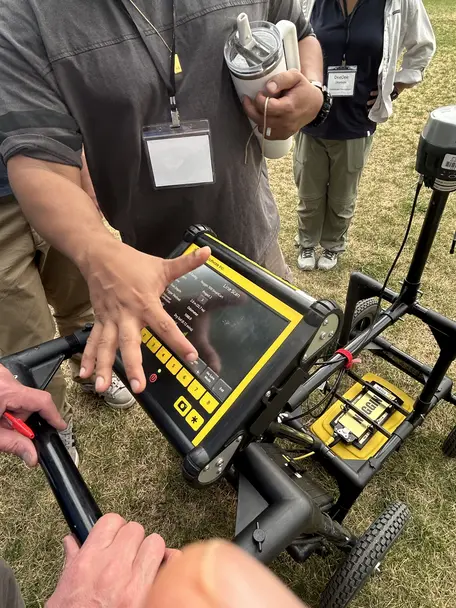
Workshop participants learn to operate a GPR.
![[creative commons]](/images/creativecommons_16.png)
Provenance: Beth Pratt-Sitaula, EarthScope
Reuse: This item is offered under a Creative Commons Attribution-NonCommercial-ShareAlike license http://creativecommons.org/licenses/by-nc-sa/3.0/ You may reuse this item for non-commercial purposes as long as you provide attribution and offer any derivative works under a similar license.
- 7:30 am - Shuttle departs from Hampton Inn entrance for Mines campus
- 8:00 am - Make plans for participant-led surveys (ECB 250)
- Before 8:30 am - move to instrument storage (ECB 240) to get instruments and head outside
- ~11:00 am - Teams return inside for initial data analysis (breakout rooms)
- ~12:00 pm - Lunch (on your own -- arrange times in your team and then return to data analysis)
- ~1:30 pm - Data analysis continued
- Before 3:30 pm - Prepare for report out at 3:45 pm - designate a "reporter" (or two) and plan a bit on what they will say for the group (images are fine but not required).
- Quick overview of what you did
- What went well?
- What didn't go as smoothly as hoped?
- What insights from today's experience will inform your teaching plans?
- 3:30 pm - Break
- 3:45 pm - Report-out on surveying experiences (ECB 250)
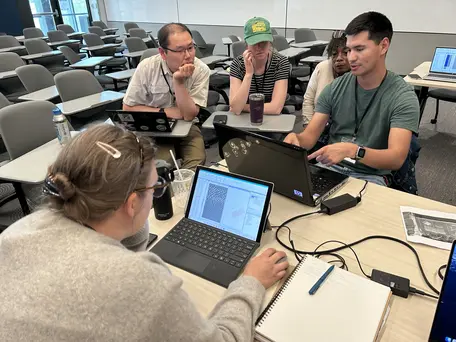
Participants learn data processing.
Provenance: Beth Pratt-Sitaula, EarthScope
Reuse: This item is offered under a Creative Commons Attribution-NonCommercial-ShareAlike license http://creativecommons.org/licenses/by-nc-sa/3.0/ You may reuse this item for non-commercial purposes as long as you provide attribution and offer any derivative works under a similar license.
- 4:30 pm - Initial planning for Day 3 teaching – including deciding teaching teams of ~3 people
- 4:50 pm - Road check & (very short) Teaching Ideas survey
- 5:00 pm - Adjourn
- 5:10 pm - Shuttle departs for Hampton Inn
- Dinner (on your own) - teams plan whether to meet for further planning before or after dinner
- Teams plan for how they will teach their method to others on Day 3
- Will be on Discovery Lab lawn
- Teams of ~3 will teach to ~6 others at a time
- Don't go overboard - you only have 1 hour of teaching time
- Decide what is most important to do
- Skip GPS
- Plan for keeping people occupied and making sure that everyone gets some chance to interact with the instrument
- Easel pad large stickies and markers will be available if you want to draw anything
Thursday July 9 - Teaching geophysics methods and implementation planning
- Breakfast - Available from 6:00 am at Hampton Inn for people staying at the hotel
- 7:30 am - Shuttle departs from Hampton Inn entrance for Mines campus
- 8:00 am - Final prep for field teaching (team decides where to meet - breakout rooms or basement store rooms)
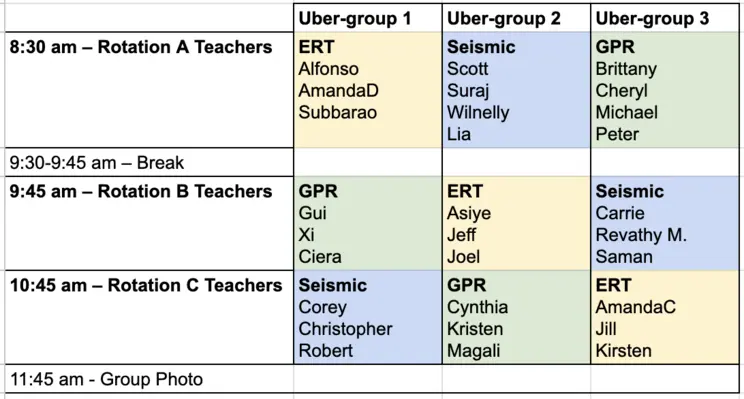
- Teaching rotation schedule
Provenance: Beth Pratt-Sitaula, EarthScope
Reuse: This item is offered under a Creative Commons Attribution-NonCommercial-ShareAlike license http://creativecommons.org/licenses/by-nc-sa/3.0/ You may reuse this item for non-commercial purposes as long as you provide attribution and offer any derivative works under a similar license.
- 8:30 am – Rotation A - teams teach others
- 9:30 am – Break (nip in for toilet break if needed and come right back)
- 9:45 am – Rotation B - teams teach others
- 10:45 am – Rotation C - teams teach others
- 11:45 am - GROUP PHOTO
- 12:00 pm - Lunch
- 1:30 pm - Teaching with geophysics methods
- Instructor stories from past participants
- Accessing instruments from EPIC
- EarthScope Geophysics Field Education - instructions for requesting instruments
- Workshop participants can have shipping fee waived for the first time they borrow an instrument -- GPS, GPR, seismic (low resources institutions can ask for shipping waivers in subsequent years too)
- Geophysics career options - Beth Pratt-Sitaula
- Teaching in the field - GETSI GNSS/GPS module field teaching tips - highly applicable for all methods
- Safe field experiences for all - see links in Resources section below
- 2:45 pm - Teaching implementation planning
- 3:15 pm - Break
- 3:30 pm - Implementation planning continued
- "Birds of a Feather" discussion groups (~45 min)
- Asiye Aziz Zanjani
Corey Miller
Jeff Clark
- Revathy Mozhikunnath Parameswaran
Suraj Bajgain
Xi Zhang
Wilnelly Ventura Valentin
- Alfonso Torres
Amanda Campbell
Jill Marshall
Robert M Welch
- Chris Schaney
Gui Aksit
Michael Hernandez
Pete Lippert
- Joel Singley
Saman Karimi
Cynthia Lawry Berkins
- Kristen Rahilly
Magali Barba-Sevilla
Scott Nowicki
Cheryl Gansecki
- Amanda Donaldson
Brittany Russo
Carrie Wright
Subbarao Yelisetti
- Lia Lajoie
Kirsten Arnell
Ciera King
- ~4:15 pm
- Whole group discussion (~30 min)
- Individual time to refine plans (~15 min)
- 5:00 pm - End of workshop survey
- 5:30 pm - Adjourn
- 5:40 pm - Shuttle departs for Hampton Inn
- Dinner (on your own)
Related Resources
- General resources
- Field accessibility
- Safe and supportive field/research experiences and group norms
- Field safety
- Example Code of Conducts
- Indigenous access consideration

 Show links for recordings and slide sets
 Hide
Hide