
Origins of the Universe baMEL
The Models
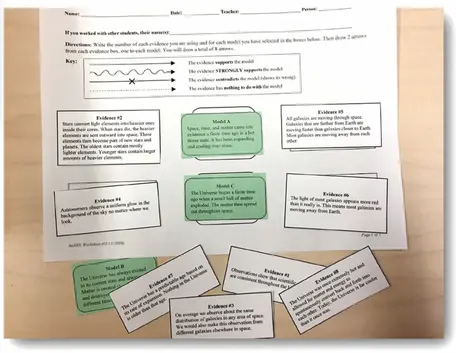
Model A: Space, time, and matter came into existence a finite time ago in a hot dense state. It has been expanding and cooling ever since.
Model B: The Universe has always existed in its current state and always will. Matter is created in some places and destroyed in other places at different times.
Model C: The Universe began a finite time ago when a small ball of matter exploded. The matter then spread out throughout space.
 Show me information about the models.
 Hide
HideStudent Handouts
![[creative commons]](/images/creativecommons_16.png)
- Origins baMEL Model Plausibility Ratings (Acrobat (PDF) 148kB Jul10 25)
- Origins baMEL - Model Cards (Acrobat (PDF) 71kB Jul31 24)
- Origins baMEL - Large Model Cards (Acrobat (PDF) 112kB Jul31 24)
- baMEL – Diagram (Acrobat (PDF) 183kB Jun26 25)
- Explanation Task (Acrobat (PDF) 52kB May6 24)
Lines of Evidence
 Evidence #7. Table 1. Ages of objects and events in the Universe.
Evidence #1: Scientists expect that the scientific principles we use on and around Earth also work elsewhere in the Universe. Observations of phenomena around the Universe show that this is true.
Evidence #2: Models of the Universe predict how much we should see of the lightest elements. Our observations of hydrogen, helium, and other light elements match these predictions.
Evidence #3: On average we observe about the same distribution of galaxies in any area of space. We would also make this observation from any other location in space.
Evidence #4: Astronomers observe a uniform glow in the background of the sky no matter where we look.
Evidence #5: Observations of the sky's background glow match predictions from models very well. This data tells us that the temperature of the Universe is about 2.7K.
Evidence #6: All galaxies are moving with space. Galaxies that are farther from Earth are moving faster than galaxies closer to Earth. Most galaxies are moving away from each other.
Evidence #7: The Universe has a predictable age based on its rate of expansion. Nothing in the Universe is older than that age.
Evidence #8: The Universe was once extremely hot and allowed for matter and energy to spontaneously convert back and forth into each other. Today, the Universe is far cooler than it once was.
Student Handouts
- Origins baMEL - Evidence Cards (Acrobat (PDF) 29kB Jul31 24)
- Origins baMEL - Large Evidence Cards (Acrobat (PDF) 28kB Jul31 24)
- Origins baMEL - Evidence Texts Color (Acrobat (PDF) 6.3MB Jul31 24)
- Origins baMEL - Evidence Texts BW (Acrobat (PDF) 3.7MB Jul31 24)
Virtual baMEL
The Google Drive folder below contains MEL resource documents in the Google formats. In order to maximize the flexibility of our activities, the MEL Project Team wanted to make more resources compatible with virtual settings. We have made our MEL scaffolds available in Google formats, so that they can be copied, modified, and uploaded more easily on a variety of platforms and devices. Please note that to access all the materials for each MEL scaffold, you will need a Google account. View the README file first.
- README First Instructions & FAQ (Acrobat (PDF) 70kB May24 21)
- Virtual Origins baMEL Resource Documents in Google Drive