
The Fossils pcMEL
The Models
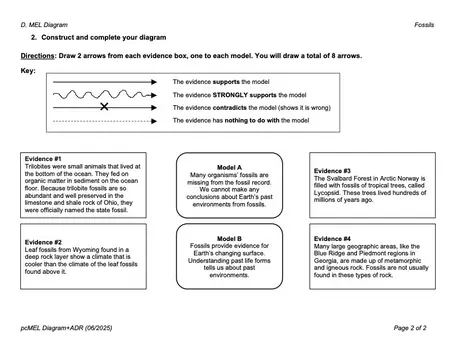
Model A: Many organisms' fossils are missing from the fossil record. We cannot make any conclusions about Earth's past environments from fossils.
Model B: Fossils provide evidence for Earth's changing surface. Understanding past life forms tells us about past environments.
 Show me information about the models.
 Hide
HideStudent Handouts
![[creative commons]](/images/creativecommons_16.png)
- Fossils pcMEL Model Plausibility Ratings (Acrobat (PDF) 119kB Dec1 25)
- Fossils MEL – Diagram (Acrobat (PDF) 184kB Jul10 25)
- Explanation Task (Acrobat (PDF) 52kB May6 24)
Lines of Evidence
 Evidence #2. Leaf margin analysis at Bighorn Basin, Wyoming. Credit: Wright Seneres based on Smithsonian (2009).
Evidence #1: Trilobites were small animals that lived at the bottom of the ocean. They fed on organic matter in sediment on the ocean floor. Because trilobite fossils are so abundant and well preserved in the limestone and shale rock of Ohio, they were officially named the state fossil.
Evidence #2: Leaf fossils from Wyoming found in a deep rock layer show a climate that is cooler than that of the fossils found above it.
Evidence #3: The Svalbard forest in Arctic Norway is filled with fossils of tropical trees, called Lycopsid. These trees lived hundreds of millions of years ago.
Evidence #4: Many large geographic areas, like the Blue Ridge and Piedmont regions in Georgia, are made up of metamorphic and igneous rock. Fossils are not usually found in these types of rock.
Student Handouts
- Fossils pcMEL - Evidence Texts Color (Acrobat (PDF) 1.7MB Jul6 24)
- Fossils pcMEL - Evidence Texts BW (Acrobat (PDF) 684kB Jul6 24)
Virtual pcMEL
The Google Drive folder below contains MEL resource documents in the Google formats. In order to maximize the flexibility of our activities, the MEL Project Team wanted to make more resources compatible with virtual settings. We have made our MEL scaffolds available in Google formats, so that they can be copied, modified, and uploaded more easily on a variety of platforms and devices. Please note that to access all the materials for each MEL scaffold, you will need a Google account. View the README file first.
- README First Instructions & FAQ (Acrobat (PDF) 70kB May24 21)
- Virtual Fossils pcMEL Resource Documents in Google Drive