
The Moon pcMEL
The Models
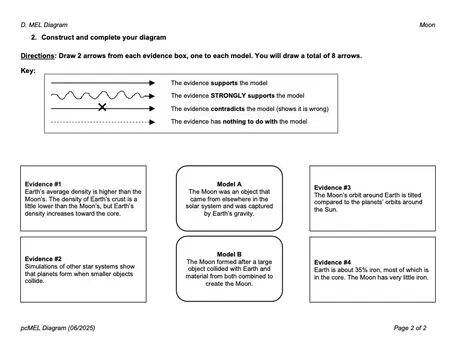
Model A: The Moon is an object that came from elsewhere in the solar system and was captured by Earth's gravity.
Model B: The Moon formed after a large object collided with Earth and material from both combined to create the moon.
 Show me information about the models.
 Hide
HideStudent Handouts
![[creative commons]](/images/creativecommons_16.png)
- Moon Model Plausibility Ratings (Acrobat (PDF) 164kB Jul10 25)
- Moon MEL – Diagram (Acrobat (PDF) 185kB Jul10 25)
- Explanation Task (Acrobat (PDF) 52kB May6 24)
Lines of Evidence
 Evidence #3. The Moon's orbital plane compared to Earth's orbital plane as viewed from the side. The figure is not to scale; parallel lines on the orbits ( // ) indicate breaks in the distance. The line through Earth indicates its rotational axis. Credit: Wright Seneres.
Evidence #1: Earth's average density is higher than the Moon's. The density of Earth's crust is a little lower than the Moon's, but Earth's density increases toward the core.
Evidence #2: Simulations of other star systems show that planets form when smaller objects collide.
Evidence #3: The Moon's orbit around Earth is tilted compared to the planets' orbits around the Sun.
Evidence #4: Earth is about 35% iron, most of which is in the core. The Moon has very little iron.
Student Handouts
- Moon pcMEL - Evidence Texts Color (Acrobat (PDF) 768kB Jul2 24)
- Moon pcMEL - Evidence Texts BW (Acrobat (PDF) 897kB Jul2 24)
Virtual MEL
*NOTE: The virtual materials below are from an older version of the activity than what is posted above.
The Google Drive folder below contains MEL resource documents in the Google formats. In order to maximize the flexibility of our activities, the MEL Project Team wanted to make more resources compatible with virtual settings. We have made our MEL scaffolds available in Google formats, so that they can be copied, modified, and uploaded more easily on a variety of platforms and devices. Please note that to access all the materials for each MEL scaffold, you will need a Google account. View the README file first.
- README First Instructions & FAQ (Acrobat (PDF) 70kB May24 21)
- Virtual Moon MEL Resource Documents in Google Drive