
Program
Please plan to arrive in Northfield in time for the 5:00pm start time on Sunday, October 18, 2015 and depart after 4:30 on Tuesday, October 20.

 Show Workshop Goals
 Hide
HideSunday, October 18
Afternoon: Participants arrive and check into hotel.
5:00 PM Welcoming remarks and icebreaker- Carleton College, Weitz Center, Larsen Room 236
- Cailin Orr, SERC Assistant Director, Carleton College
- Fernan Jaramillo - Associate Dean of the College, Professor of Biology, Carleton College
6:00-7:15 Dinner with cash-only bar
7:15-7:30 Introductions and goals of the workshop (PowerPoint 2007 (.pptx) 2.2MB Oct18 15) (Lisa Kempler- MATLAB Community Strategist, MathWorks)
7:30-8:00 Opening session
Hello Earth! A groundedintroduction to MATLAB (Acrobat (PDF) 3.7MB Oct19 15)
Frederik Simons, Princeton University
8:00 PM Discussion
Monday, October 19
6:00 AM Complimentary breakfast at the Northfield Country Inn
*All workshop activities will take place at Carleton College, Weitz Center, Larsen Room 236
8:30-9:00 Introduction and goals for the day (Cailin Orr, SERC)

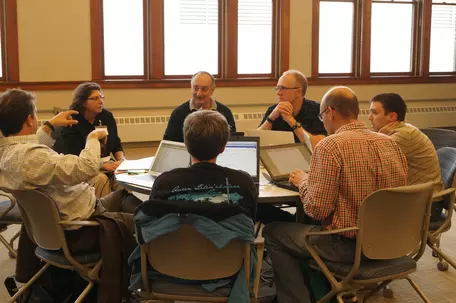
9:00-9:45 Discussion around the tables of how you use MATLAB in your teaching using the submitted activities and essays as examples. Seating will be assigned by theme.
- Group Reporting Pages (private workspace)
9:45-10:00 Coffee Break
10:00-11:00 Invited talk and questions (Introduction from Cailin Orr, SERC)
MATLAB in the undergraduate curriculum (Acrobat (PDF) 160kB Oct19 15)
Anantha Aiyyer, North Carolina State University
11:00-12:00 Panel discussion using MATLAB and data in the classroom (Moderators Carol Ormand and Cailin Orr, SERC)
Peter Adams, University of Florida
Time Series Analysis: Using Autocorrelation and Cross-correleation to Explore Links Between River Discharge and Regional ClimateJackie Caplan-Auerbach, Western Washington University
Using Real Data: Signal processing in seismologyVictor Padron, Normandale Community College
Making Math Relevant: Tracking Groundwater Pollution
12:00-12:15 Division into topical groups for after lunch work based on pre-workshop work
12:15-1:30 Lunch - Language and Dining Hall

1:15-2:30 Working groups: Background, adaptation, and skills needed to teach MATLAB to undergraduates
- Group Reporting Pages (private workspace)
2:30-2:45 Report out and synthesis (Led by Cailin/Carol/Kristin)
2:45-3:15 Strengthening your MATLAB knowledge - Part 1
- Reflect on what you have learned, how you will use this in your teaching and what in specific you still need to know more about
- Share and form groups
3:15-3:30 Coffee Break
3:30-4:40 Strengthening your MATLAB knowledge - Part 2
- Small groups work together and with an expert to address identified topics (Experts: Lisa Kempler and Loren Shure, Frederik Simons, Anantha Aiyyer, Mark Behn)
- Reporting Pages (private workspace)
4:45-5:30 MATLAB from an Insider (Loren Shure, MathWorks)
- Loren's script ( 485kB Oct19 15)
5:30-5:50 End of day remarks, organizing for dinner, individual reflection and roadcheck
7:00 Dinner on the town (see restaurant selection handout in folder)
After dinner - informal opportunities to socialize on the town
Tuesday, October 20
6:00 AM Complimentary breakfast at the Northfield Country Inn
8:30-8:45 Opening and agenda for the day (Cailin, SERC)
8:45-9:30 Invited talk and questions (Introduction from Lisa Kempler- MathWorks)
Introduction to MATLAB in research with students ( 35.6MB Oct20 15) PDF version (Acrobat (PDF) 16.1MB Oct20 15)
Mark Behn, Woods Hole Oceanographic Institution
9:30-9:40 Stretch and reflect
9:40-10:30: Panel Discussion: Challenges of teaching quantitative skills
Charley Bank, University of Toronto
Working in 3D: Visualizing outcrop patterns from strike/dip data using MATLABRisa Madoff, University of North Dakota-Main Campus
Using computer programming and math concepts: Introduction to MATLAB for GeomorphologyAndrew Fischer, University of Tasmania
Working with data sets: An Exploration of Ocean Color and Sea Surface Temperature
10:30-10:45 Strategies for Addressing Critical Challenges
- Introduce themes from Roadcheck and earlier discussions
- Reflect individually on critical challenges and needs
- Form groups

10:45-11:45 Strategies for Addressing Critical Challenges: small group worktime
- Group Reporting Pages (private workspace)
- Stating the Critical Challenge
- Underpinning synthesis of where we are
- What do we need to help us further
11:45-12:00 Whole group session to initiate synthesis
12:00-1:00 Lunch - Language and Dining Hall
1:00-2:00 Synthesis and next steps (Carol and Cailin)
- Group Synthesis Page (private workspace)
- Discuss synthesis document
- Next steps discussion
- Workshop Evaluation
2:00 PM Adjourn
Shuttles to airport