


Skills and dispositions for success in the geoscience workforce
Read more about what geoscience employers are looking for in... Knowledge | Skills | Dispositions
Knowledge
Geoscience knowledge is the range of concepts that potential employees are expected to be familiar with, or perhaps to have mastered. Possessing a geoscience bachelors degree is a proxy for the broad base of knowledge that employers are looking for in most entry-level jobs (Viskupic et al., 2026).
The ASBOG Fundamentals of Geology exam is another proxy for the broad knowledge expected of professional geologists. The exam covers content in eight domains, described in the ASBOG Content Domain Knowledge Bases. Most employers do not require entry-level applicants to have taken the Fundamentals of Geology exam, but they view it positively both for the content knowledge represented and awareness of professional qualifications (Viskupic et al., 2026).
Skills
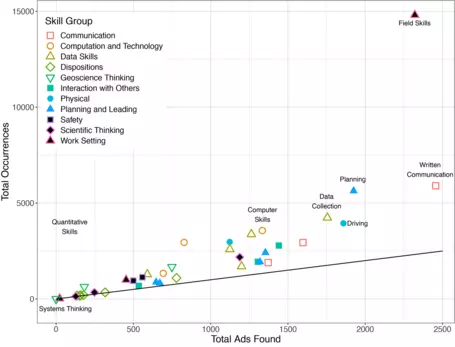
Skills are the range of tasks that employers expect new employees to be able to do. These can include general science skills, like analyzing data, and geoscience-specific skills, like collecting data in the field. In an analysis of over 3500 online job ads for bachelors-level geoscientists, Shafer et al. (2023) found that the most frequently mentioned skills (see figure) were:
![[reuse info]](/images/information_16.png)
- Written communication
- Field skills
- Planning
- Driving
- Data collection
- Oral communication
- Working as part of a team
- Project management
- Computer skills
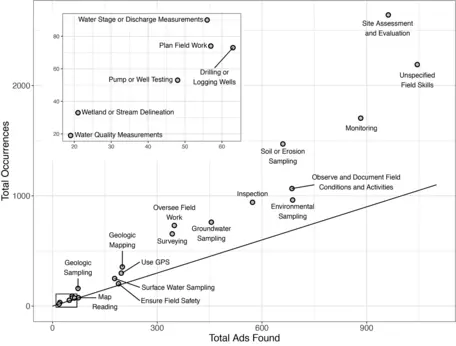
These results were strengthened through interviews with geoscience employers from across industry sectors who are involved in the recruiting, selection, and hiring of entry-level geoscientists. These employers confirmed the importance of field skills, communication, teamwork, and computer skills in hiring. Many of these employers also indicated that they expected or preferred to train new employees on specific technical skills and that they associated an undergraduate geoscience degree with the broad knowledge base and understanding of disciplinary language they were looking for (Viskupic et al., 2026).
Nyarko and Petcovic (2023) conducted focus group interviews about teamwork skills with 12 employers working in hydrogeology and environmental geology and identified three categories of teamwork skills: 1) skills related to specifying goals, interpreting team resources, and planning (transition skills); 2) metacognition, coordination, and mentoring (action skills); and 3) organization, emotional intelligence, and proactive communication (interpersonal skills). In addition, the authors identified a fourth category of skills related to ethics including trust, integrity, and humility (Nyarko & Petcovic, 2023). These interpersonal skills and skills related to ethics might also be categorized as dispositions.
Dispositions
Dispositions can be defined as internal attributes, attitudes, or values that motivate behavior. Other researchers who have explored workforce preparation have called these soft skills, personal attributes, or interpersonal skills. Based on prior data collection from employers through surveys (Heath 2003, 2005), interviews (Jones, 2010; Nyarko & Petcovic, 2023), and job advertisements (Shafer et al., 2023), Lagerwall et al. (2026) defined ten dispositions that are critical for success in the geoscience workforce (Table 1).
About a quarter of the job ads analyzed by Shafer et al. (2023) listed dispositions. However, previous work and interviewed employers all emphasize that collaboration, desire to learn, flexibility, and initiative are equally if not more important than other skills (Viskupic et al., 2026).
These dispositions are also valued in educational settings and are likely to be incorporated into geoscience courses and curricula (see Lagerwall et al., 2026 for some examples). Geoscience instructors can help students to recognize where and how these dispositions are being developed by explicitly naming them and emphasizing their value in the workforce. The Strategies web pages provide ideas for how to get started.
Table 1. Geoscience workforce dispositions defined by Lagerwall et al. (2026)
| Disposition | Description |
| Attention to detail | Meticulousness, thoroughness, and accuracy in all aspects of the work |
| Collaboration | Working well with others, with awareness of social and professional dynamics |
| Desire to learn | Readiness to acquire new skills and knowledge, openness to feedback and new ideas |
| Flexibility | Willingness to adapt to changing circumstances, work in a range of settings and with a range of individuals |
| Initiative | Self-drive and motivation, being proactive and working independently |
| Integrity | Demonstrating trustworthiness, personal honesty, and fairness |
| Organization | Managing time and tasks appropriately and efficiently |
| Positive attitude | Taking a positive approach to others and to work |
| Professionalism | Incorporating professional ethics and standards into all aspects of the work, including responsible conduct of research and ethical interactions with clients and colleagues |
| Work ethic | Willingness to invest the required effort to accomplish tasks and projects |
References
Heath, C.P.M. (2003). Geological, geophysical, and other technical and soft skills needed by geoscientists employed in the North American petroleum industry. AAPG Bulletin, 87(9), 1395–1410. https://doi.org/10.1306/04280303004
Heath, C.P.M. (2005). A comparison of the geoscientific, nontechnical, and soft skills needed by service-industry geoscientists with those required by oil-company geoscientists. AAPG Bulletin, 89(10), 1275–1292. https://doi.org/10.1306/03170504113
Jones, F. H. M. (2010). Survey of hiring practices in geoscience industries. https://open.library.ubc.ca/collections/52383/items/1.0052313
Lagerwall, K., Viskupic, K., Egger, A.E. (2026). Developing dispositions needed for the geoscience workforce in the undergraduate curriculum: a preliminary study and framework for instructors. Journal of Geoscience Education. https://doi.org/10.1080/10899995.2026.2658434
Nyarko, S.C., & Petcovic, H.L. (2023). Essential teamwork skills: Perspectives of environmental geoscience employers. Journal of Geoscience Education, 71(1), 20–32. https://doi.org/10.1080/10899995.2022.2044665
Shafer, G.W., Viskupic, K., & Egger, A.E. (2023). Critical workforce skills for bachelor-level geoscientists: An analysis of geoscience job advertisements. Geosphere, 19(2), 628-644. https://doi.org/10.1130/ges02581.1
Viskupic, K., Egger, A.E., Shafer, GW. (2026). Employer perspectives on hiring entry-level geoscientists: Essential knowledge, skills, dispositions, and their assessment. Journal of Geoscience Education, https://doi.org/10.1080/10899995.2026.2617379