
Fostering Feedback Loop Thinking
Overview
Feedback loops are systems in which an initial action triggers a chain of influences that either amplifies or counteracts the initial action. Feedback loops are important for understanding emergent system behavior across a range of STEM and liberal arts fields, including the stability that characterizes negative feedback loops (as in physiological regulation, ecological predator-prey balance, economic supply and demand, and climate stability), and the growth, collapse, and instability that result from positive feedback loops (as in compound interest, pandemic disease spread, climate change, nuclear chain reactions, and viral marketing).
Because feedback loops arepowerful elements of so many important systems, feedback loop thinking can empower students to tackle novel problems in unfamiliar contexts. Yet in much of undergraduate instruction, the feedback loop concept is used narrowly, merely to explain one phenomenon of importance in the course, such as the ice-albedo feedback loop that contributes to global climate change in an environmental science course. We developed a suite of mini-lessons that can be adopted/adapted for any course in which at least one feedback loop is currently being taught. The mini-lessons expand feedback loop thinking from the narrow context of one loop to a generalizable concept applicable across multiple disciplines.
Learning Goals for Feedback Loop Thinking
The focus of this website is on the transition from ignorance of feedback loops to a broad, useful, conceptual understanding that we call "feedback loop thinking." Feedback loop thinking will help all learners, regardless of career path, make sense of complex situations they encounter in their personal and professional lives. For students who go on to specialize in disciplines that use systems dynamics, these learning goals will lay the foundation for more sophisticated study of systems, including the use of systems modeling software. More specifically, feedback loop thinking means:
- Students will become aware that feedback loops are a common phenomenon across natural and human-built systems, and will develop the habit of mind of looking for feedback loops in their personal and professional lives.
- Students will gain an understanding of how positive feedback loops can generate growth or decay and how negative feedback loops can generate stable or oscillating behavior.
- Students will recognize feedback loops when they are encountered in familiar and unfamiliar contexts, even when they are not explicitly labelled as such,
- Students will be able to create causal loop diagrams of unfamiliar systems, and reason with those diagrams to generate explanations or predictions,
- Students will use feedback loop thinking to propose system modifications that will strengthen loops with desirable outcomes and disrupt loops with undesirable outcomes.
Feedback Loop Instructional Activities
FEEDBACK LOOP SORTING
The Feedback Loop Sorting activity is designed to capture student understanding of feedback loops as a general causal pattern that can occur in various contexts throughout nature and in human-made systems. Students are presented with 12 narratives that represent positive feedback (reinforcing) loops, negative feedback (balancing) loops, and non-feedback loops with examples of all three types having desirable or undesirable outcomes. Students sort the narratives into a 3 x 2 matrix (3 loop types x 2 outcome types) or, if using the activity as a part of an online class, to choose from a multiple-choice selection of responses that contain all possible combinations of loop type and outcome type. The goal of the activity is to have students be able to distinguish between positive and negative feedback loops and desirable and undesirable outcomes. Successful sorting requires students to identify loops in narratives about different topics with dissimilar narrative structures.

![[creative commons]](/images/creativecommons_16.png)
FIND and MAP THE LOOP IN POPULAR MEDIA
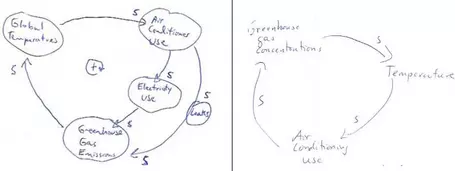
This activity is designed to build students' capacity to spot and analyze feedback loops that they encounter in real life, outside of school. Students read an instructor-provided article from the popular media that is relevant to the course content, and includes a feedback loop. They create a graphic model (causal loop diagram) that depicts the working of the feedback loop in the article. Finally, they write a narrative that describes how the feedback loop works and the impact of the loop on the larger system within which the loop is embedded. We provide a rubric for scoring student products, some suitable readings, and materials for instructing students on how to construct loop diagrams.
CAUSAL LOOP DIAGRAMMING
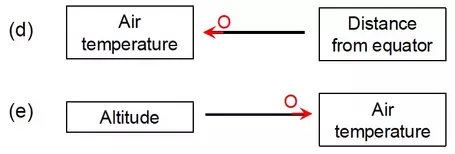
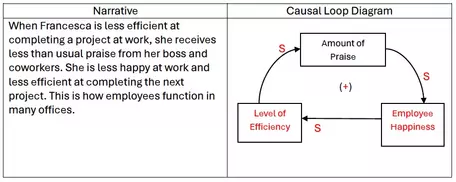
This student activity provides introductory practice in the use of Causal Loop Diagrams (CLDs) for positive and negative feedback loops. For each question in the main activity, students are provided with a narrative description of a feedback loop accompanied by a partially-completed CLD. Their task is to complete the CLD and the narrative. Challenge level ramps up from the beginning to end of the activity: from completed examples, through highly-scaffolded instances, to slightly-scaffolded instances. We also provide an optional warm-up activity in which students reason about single links one at a time before tackling multi-link CLDs.
 Show caption
 Hide
Hide
MUTUAL ALIGNMENT
This assignment requires students to use analogical reasoning to identify the key attributes, the causal structure, that make a feedback loop positive (by amplifying/accelerating the effect) or negative (by moderating/dampening the effect).
INTERVENING IN THE SYSTEM
Teaching students to identify leverage points within a system empowers them to think critically about the root causes of any type of systemic problem and probe more deeply into feedback loop thinking. By engaging in a structured writing assignment that asks them to analyze a single positive feedback loop - a vicious cycle critical to learning in your course - students are challenged to move beyond surface-level solutions and explore deeper, more transformative interventions. This type of task develops essential higher-order thinking skills such as systems thinking and strategic problem-solving, as well as develop persuasive argument writing skills.
Students must not only dissect the structure and dynamics of a feedback loop but also construct well-reasoned, evidence-based arguments for meaningful change, incorporating both scholarly sources and Meadows' (1999) hierarchy of leverage points. In doing so, they learn to navigate complex information flows, apply theoretical frameworks to real-world issues, and advocate for change with intellectual rigor and creativity. This approach equips students with the mindset and tools to become thoughtful change agents in their academic and civic lives.
FEEDBACK LOOPS IN THE FIELD
The Feedback Loops in the Field activity is an opportunity for students to apply both content knowledge and understanding of feedback loops in a setting outside of the classroom. The activity is intended to be largely self-guided and takes place in a selected field setting (e.g. an urban park). The activity includes 1) an ungraded "pre-test" to assess prior knowledge, 2) one-page reading for feedback loop self-education, 3) student observation of feedback loops in the field, and 4) reflection on the activity and feedback loop learning.
Feedback Loop Presentations
- Visualizing invisible causal systems: Using causal loop diagrams to create, improve, and convey mental models of feedback loops. Presented by Kim Kastens at the 2025 Gordon Research Conference on Visualization in Science and Education.
- Kastens_GRC_VSE_2025_Final.pdf (Acrobat (PDF) 7.4MB Jul29 25)
- Kastens_GRC_VSE_2025_Final.pptx (PowerPoint 2007 (.pptx) 46.8MB Jul29 25)
- Cognitive analysis of a systems thinking assignment: Find & map the feedback loop in popular media articles. Presented by Kim Kastens at the 2025 International System Dynamics Conference.
- KastensShipley_ISDC2025_2aug2025.pdf (Acrobat (PDF) 1.6MB Aug11 25)
- KastensShipley_ISDC2025_Final.pptx (PowerPoint 2007 (.pptx) 5.6MB Aug11 25)
Feedback Loop Substack
"Loops behind the News," written by Kim Kastens and Tim Shipley, provides essays about systems that are underlain by feedback loops, picking up on topics or issues that are current in the news or broader zeitgeist. The essays can be read on a web browser or can be received by email subscription; either way, access is free.
Feedback Loop Papers
Cognitive Analysis of a Systems Thinking Educational Assignment: Find & Map the Feedback Loop in Popular Media Articles (Acrobat (PDF) 870kB Jun19 25)
International Systems Dynamics Conference 2025: Kim A. Kastens & Thomas F. Shipley
Structured Abstract: Introduction to the problem: Systems thinking draws on complex cognitive processes. Many instructors of systems thinking and systems dynamics lack expertise in cognitively-informed pedagogy, and thus may be misunderstanding their students' struggles or missing opportunities to build their students' strengths.
Approach to the work: Cognitive task analysis is the process of examining how learners process information and build understanding while completing an instructional activity. We have analyzed an assignment in which students identify a feedback loop in a reading from popular media, draw a causal loop diagram, write a narrative that describes how the loop works, and articulate the impact of the loop on the larger system within which the loop is embedded.
Results: The activity exercises analogical reasoning when identifying the loop in the reading passage, causal reasoning to create the A → B links of the diagram, facility with switching between parts and wholes at all steps of the assignment, use of external visualizations to relieve load on working memory and make essential aspects of the loop more salient, and use of sophisticated linguistic structures to convey conditionality while writing the narrative.
Discussion: Our learning goal for this assignment is that students will be able to recognize, analyze, and explain feedback loops wherever they may encounter them in their personal and professional lives. Our motivation in explicating the cognitive processes required to reach this learning goal is that instructors will be better equipped to craft effective lessons, diagnose their students' difficulties, and recognize their students' cognitive accomplishments along their learning trajectory.
Developing and Field-testing a Rubric for Evaluating Students' Causal Loop Diagrams
International Systems Dynamics Conference 2024: Kim A. Kastens, Wayne Wakeland & Thomas F. Shipley
Abstract: We have developed and field tested an educational rubric for instructors who are using causal loop diagrams (CLD) in undergraduate science and social science courses. Given a student's CLD and accompanying explanatory narrative, the rubric describes three levels of performance quality on the following dimensions: (1a) Nodes on the CLD, (2a) Links/arrows on the CLD, (2b) Narrative description of causal links, (2c) Connection of links to the real-world system, (3a) Diagram depiction of feedback loop, and (3b) Understanding of impact of this loop on the broader system within which it is embedded. The field test involved four geoscientists and 17 undergraduate psychology students, who watched an instructional video about how to make CLDs, read loop-containing narratives from the popular media, sketched a CLD, and wrote an accompanying explanatory narrative. Among the scientist-participants the weakest performance was on rubric element (3b). Among the undergraduate participants, notably poor performance was on rubric element (2c). Note that both these areas of poor performances lay in making the analogical mapping between modeled system and real-world system. In response to field test findings, we clarified and strengthened some elements of the rubric and accompanying instructional video.
How does the Human Mind Think and Learn about Feedback Loops?
Systems Dynamics Society Conference 2023: Kim A. Kastens & Thomas F. Shipley
Abstract: This paper considers how concepts and approaches from cognitive and learning sciences might shed light on how humans think and learn about feedback loops. Cognitive biases that might interfere with one's ability to accurately form individual causal links include tendencies to perceive covariation that is direct rather than inverse, to overweight information about presence rather than absence, to weight a plausible mechanism over empirical evidence, and to fail to account for what other influences might matter. Cognitive limitations that might compromise one's ability to merge individual links into a closed loop include working memory limitations, tendency to see sequences as linear chains, tendency to look for explanations of phenomena at the level of components, and difficulty comprehending exponential growth. On the more optimistic side, cognitive affordances that make feedback loop thinking possible include analogical reasoning, language and categorization, ability to create runnable mental models, and distributed cognition. The paper concludes that the realm of how humans think and learn with and about feedback loops is ripe for further cognitive, learning science, and neuroscience research, and suggests research questions that have the potential to both advance systems education practice and elucidate under-researched capabilities of the mind.
An instrument to quantify how well students can recognize feedback loops in narratives and its use for evaluating pedagogical strategies (Acrobat (PDF) 292kB Feb20 25)
Systems Dynamics Society Conference 2022: Kim A. Kastens, Thomas F. Shipley, Rebekah Banerjee, Alexandra Davatzes & Logan Brenner
Problem Statement: The first step in applying one's knowledge of feedback loop dynamics to a novel situation is to recognize that the situation that one is confronting is a feedback loop--even though the superficial attributes may be far different from feedback loop(s) previously encountered. We sought to design an instrument to assess a Learning Goal that "learners can recognize feedback loops when they encounter them in familiar and unfamiliar context," comparable to the "Identifying Feedback" construct in the systems thinking assessment frameworks of Stave & Hopper (2007) and Plate & Monroe (2014) and the "causal loop inclusion" attribute of Plate (2010). Additional criteria were that the instrument had to be quick to administer and score, produce quantitative scores that could be compared between instructional settings, and be useable in any discipline where at least one feedback loop was being taught.
Feedback Loop Workshops and Webinars
Although these workshops have passed, many of the teaching materials are still available on the associated SERC websites.
Wrapping your Head around Environmental Problems by Leveraging Feedback Loop Thinking
Earth Educators Rendezvous 2024: Kim Kastens, Logan Brenner, Alexandra Davatzes & Thomas Shipley
On Day 1, participants developed an expansive sense of the power of the feedback loop concept for explaining phenomena across both natural and human-made systems, and considered how the attributes of the human mind both enable and challenge feedback loop thinking. On Day 2, participants practiced teachable strategies for detecting feedback loops in the media, in lived experience, and in the field, and experienced how classroom use of causal loop diagrams can empower students to depict and explain the system of influences by which positive feedback loops cause growth or collapse and negative feedback loops cause stability or oscillation. On Day 3, participants practiced ways to have students use feedback loop thinking and leverage point strategies to evaluate and propose interventions into problems that the students think are important, and planned for how to introduce or strengthen feedback loop thinking in their own courses.
Thinking and Teaching about Feedback Loops
NAGT 2022: Kim Kastens & Thomas Shipley
Positive feedback loops are familiar to most Earth and environmental scientists as amplifiers of global climate change -but did you realize that this same causal structure drives hostility between nations, pandemic spread, and viral marketing? Negative feedback loops may be familiar as regulators of predator/prey systems, but did you realize that the same causal structure also controls body temperature, composition of blood, and water level in your toilet? Workshop participants learned ways to help their students understand feedback systems in the geosciences and then go beyond the course content to use feedback loop thinking to solve problems and understand the world.
Teaching and Learning About Feedback Loops
Earth Educators Rendezvous 2021: Kim Kastens, Thomas Shipley, Alexandra Davatzes & Kelcey Wallens-Logan
Participants in this workshop explored cognitive and practical obstacles to teaching and learning about FLs and practiced three different teaching strategies for building students' facility with FLs: kinesthetic learning, mutual alignment analogy, and use of static and dynamic visualizations. Each teaching strategy had its underlying rationale explained, then was demonstrated, tried out by the workshop participants, and reflected upon in small group discussions. Examples spanned life sciences, earth sciences, and social sciences. Working in breakout groups clustered by topic or audience, participants drafted a student activity using one of the three strategies.
Acknowledgments
This work was made possible by funding through NSF grants, "Supporting Feedback Loop Learning in Natural and Social Science Courses," awarded to Kim Kastens at the Lamont–Doherty Earth Observatory (Award: 2141939), Thomas Shipley (PI) and Alexandra Davatzes (Co-PI) at Temple University (Award: 2142010), and Logan Brenner at Barnard College (Award: 2141982).
We would also like to acknowledge Mansi Shah's work implementing feedback loop thinking into neuroscience classrooms and our advisory board memebers: Dedre Gentner, Steve Roderick, and Jennifer Rosales.