
Workshop Program
Please plan to arrive in Northfield in time for the 5:00pm start time on Sunday, October 26th, 2025.
All workshop activities take place in the Weitz Center for Creativity Larson Meeting Room (236), unless otherwise noted below.
Sunday, October 26th
Participants arrive and check into their hotel (Fairfield Inn & Suites). Transportation to the workshop location is available for participants who requested walking accommodation.
2:00 – 4:00 PM (Optional) One-on-one Mentoring Sessions with Conveners (Weitz 236)
- Schedule an appointment or drop by to get curriculum coaching from workshop experts or to complete your pre-work.
- Coffee and snacks available
5:00 – 6:00 PM Welcoming Remarks, Introductions, and Icebreaker (Weitz 236) — Cailin Huyck Orr, Science Education Resource Center, Carleton College
- Welcome Presentation (PowerPoint 2007 (.pptx) 2.8MB Oct26 25)
6:00 – 6:30 PM Keynote (Weitz 236) — Lisa Kempler, MathWorks
- Keynote Talk (Acrobat (PDF) 4.7MB Oct27 25)
6:30 – 7:15 PM Dinner
7:15 – 8:00 PM Convener Panel (Weitz 236) — facilitated by Dan Burleson, UT Dallas
- Dessert and coffee available
8:00 PM Networking
Monday, October 27th
Breakfast at your hotel or in town. Transportation to Weitz is available for participants who requested walking accommodation.
8:30 – 8:45 AM Introduction and Goals for the Day (Weitz 236)
Quick tech check
- Internet access: Eduroam or Carleton's guest network
- Log-in to find the workshop workspace and your personal workspace
- Instructions for editing workspaces
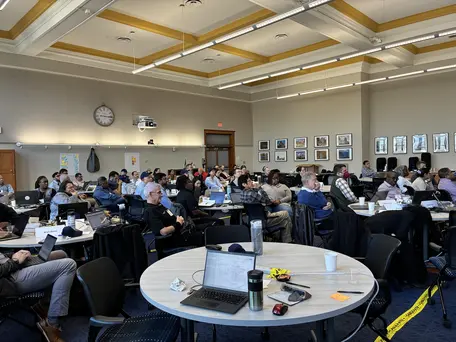
8:45 – 10:15 AM Invited Talks: Session 1 (Weitz 236) — facilitated by Kelly Roos, Bradley University
- Richard Blackmon — A Flipped, Active-Learning Model for Teaching MATLAB in Engineering Computing (PowerPoint 2007 (.pptx) 13.7MB Oct27 25)
- Luis Vicente — Innovation in Pattern Recognition: 24 Years of MATLAB and the Transition to Live Scripts – Teaching Computational Thinking with MATLAB (PowerPoint 2007 (.pptx) 16.1MB Oct26 25)
- Edwin Marte — Randomizing Quizzes: The Canvas MATLAB Grader Combo (PowerPoint 2007 (.pptx) 9.2MB Oct27 25)
- Oluwami Dosunmu-Ogunbi — Evolving MATLAB Instruction: Reflections from Traditional and Mastery-Based Teaching (PowerPoint 2007 (.pptx) 125.3MB Oct24 25)
- Dan Burleson — Course and Curricular Change through a shared understanding of Computational Thinking (PowerPoint 2007 (.pptx) 16.2MB Oct27 25)
During talks, participants are encouraged to record their impressions on: (in personal workspaces)
- Teaching strategies you've used worth keeping
- New approaches from the educator talks to consider for your courses
- Surprises or new learnings
- Unsolved teaching and learning challenges
Table Discussions (25 minutes)
- Share briefly learnings from the talks: Approaches that work, new ideas, unsolved challenges
- Each table crafts a sample computational learning outcome/goal for two course types:
- Broad intro to engineering computing/programming course
- Engineering- or Science-focused course with computation serving a supporting role
- Monday table notes pages
Group Report Out (10 minutes)
- A representative from multiple tables reports on 1-2 notable learnings from their table, one from each course type
10:15 – 10:30 AM Break
10:30 – 11:45 AM Learning Goals (Weitz 236 and additional spaces) — facilitated by Benjamin Bratton, Vanderbilt University
Presentation on learning goals (10 minutes) — Mitchell Bender-Awalt, Science Education Resource Center at Carleton College
- Learning Goals.pptx (PowerPoint 2007 (.pptx) 132kB Oct27 25)
- Setting learning goals leads to better alignment between activities and student learning.
Introduction to Affinity Groups (5 minutes) — Lisa Kempler, MathWorks
Affinity working group discussions (40 minutes)
- Available rooms: Weitz 131 (seats 15), 136 (seats 20)
- Discuss:
- Desirable learning outcomes in general vs. computation courses (and which are easier and harder to achieve)
- Specific learning outcomes for a course you teach
Individual Work (5 minutes)
- Draft 1-2 learning outcomes for one of your courses or teaching activity in your personal workspace.
Group report out (15 minutes)
- Return to Weitz 236 at 11:30 to report working group discussion results to the full group. (Consider showcasing 1 participant's learning outcomes).
11:45 AM – 1:00 PM Lunch (LDC Dining Hall)
- We will walk as a group from Weitz to the LDC. Transportation is available for participants who requested walking accommodation.
- We will go through the check-in and food lines, then gather to eat in reserved rooms at the back of the main hall.
- If you want coffee after lunch, please take it with you from the dining hall.
1:00 – 1:45 PM MATLAB Teaching Tools (Weitz 236) — Ram Krishnamurthy and Laura Keen, MathWorks
- MathWorks Master Toolkit for Engineering Educators (Acrobat (PDF) 1.4MB Oct27 25)
- GitHub with files from the presentation
1:45 – 2:15 PM Practice with Live Scripts, MATLAB Online, and GenAI (Weitz 236)
2:30 – 2:40 PM Break
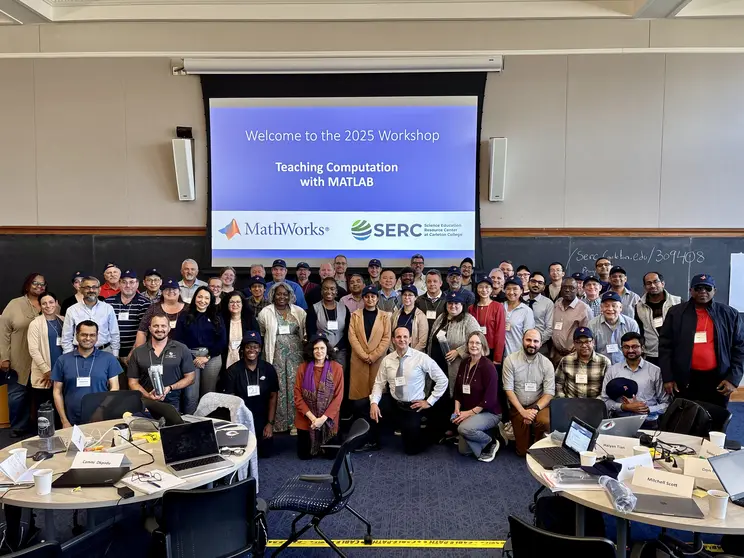
- 2:40 PM – Photo in the main workshop room
- Refreshements and snacks available
2:45 – 3:30 PM Invited Talks: Session 2 (Weitz 236) — facilitated by Michele McColgan, Siena College
Presentations
- Darren Maczka — Foundational Computation Skills in the Face of Generative AI (PowerPoint 2007 (.pptx) 27.5MB Oct27 25)
- Bobby Hodgkinson — Incorporating Generative AI in entry level programming (PowerPoint 2007 (.pptx) 4MB Oct21 25)
- James Boyle — Teaching Computation in the Laboratory using dq/dt = (PowerPoint 2007 (.pptx) 4.9MB Oct27 25)
- Jacqueline Henderson — What a Surprise: Addressing Educational Trials Through Self Paced Matlab Structure (PowerPoint 2007 (.pptx) 2.5MB Oct27 25)
- Ruby Mehrubeoglu — AI in Engineering and Science Applications (PowerPoint 2007 (.pptx) 1.9MB Oct27 25)
During talks, participants are encouraged to record their impressions on: (in personal workspaces)
- Teaching strategies you've used related to GenAI
- New GenAI approaches from the educator talks to consider for your courses
- Surprises or new learnings about GenAI in courses
- Unsolved teaching and learning challenges
3:30 – 4:00 PM Affinity Group Discussions: Assessment of Learning Outcomes (Weitz 236)
- Groups will discuss techniques, strategies, and challenges for assessment and also identify assessment challenges.
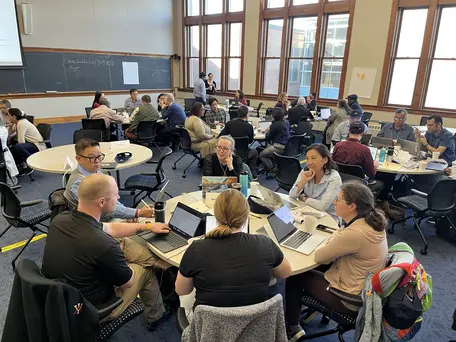
- Participants are encouraged to use their workspace page to keep notes and work on assessment in their course or activity.
- Affinity working group discussions
- What approaches and tools do you use to assess student performance and learning?
- Are these approaches effective?
- What challenges do you have assessing student performance relative to your planned learning outcomes?
- What techniques and tools can you adopt to help?
- What approaches and tools do you use to assess student performance and learning?
- Individual Work
- Spend the final minutes of the session thinking about an assessment plan for a course or teaching activity. Use your personal workspace page to keep notes.
4:00 – 4:15 PM Effective Teaching Activities, Peer Review, and Curriculum Development at the Workshop (Weitz 236) — Dan Burleson, UT Dallas
- Upgrading Your Teaching (PowerPoint 2007 (.pptx) 2MB Oct27 25)
4:15 – 5:30 PM Working Groups: Teaching Activity Development (Weitz 236 and additional spaces)
- Make a contract: Spend a few minutes in your working groups sharing your specific plans for your curriculum development
- Work individually to develop your ideas, working towards creating a plan and a presentable curriculum module/teaching activity on Tuesday morning.
- Use your personal workspace page for notes and resources.
- Consider how you will transfer your ideas to a structured format for sharing: Live Script, Teaching Activity, other deliverable
- Rooms available: Weitz 131 (seats 15), 136 (seats 20), and 231 (seats 24)
5:40 – 6:00 PM Group Reflection and Roadcheck (Weitz 236) — Cailin Huyck Orr and Mitchell Bender-Awalt, Science Education Resource Center at Carleton College
- Information on reimbursement for stipend recipients
- If you do not already have a W-9 or W-8 BEN on file with Carleton, be on the lookout for an e-mail from the Business Office.
- Example email from the Carleton College Business Office (Acrobat (PDF) 1.2MB Oct27 25)
- Tomorrow
- Tomorrow's program
- Shuttle for participants who requested a ride will leave the hotel at 8:15 AM.
- Luggage van will leave hotel at 8:15 AM. We will bring your bags to the Weitz room.
- Shuttle to the airport will leave at the conclusion of the workshop at 2 PM. This is the only shuttle.
- Leaving Wednesday? Connect with others if you want to coordinate travel to the airport.
- Road check
- Dinner is at 6:30 so you can walk from here or by way of the hotel.
6:30 PM Dinner The Grand Event Center: 316 Washington St, Northfield, MN 55057
Evening Networking
Tuesday, October 28th
Breakfast at your hotel or in town and presumably, hotel check-out. Shuttles will be available for carrying luggage from the hotel to Weitz. Transportation to Weitz is available for participants who requested walking accommodation.
8:30 – 8:45 AM Roadcheck Summary (Weitz 236) — Lisa Kempler, MathWorks and Cailin Huyck Orr, Science Education Resource Center at Carleton College
- More information on Rubrics can be found on this page about Assessment
- See examples from Princess Imoukhuede and Andrew Fischer on the page above.
- Lisa's suggestions about learning more in MATLAB (PowerPoint 2007 (.pptx) 1.8MB Oct28 25)
- MATLAB CoPilot webinar from September, 2025. It is 25 minutes long. Lisa's suggestion is to use it as a self-study, and follow along and pause while you complete each step on your own machine.
8:45 – 9:00 AM Overview of the Day (Weitz 236) — Dan Burleson, UT Dallas
9:00 –10:15 AM Individual Preparation: Teaching Activity Development and Completion (Weitz 236 and additional spaces)
- Use this time to complete your teaching activities.
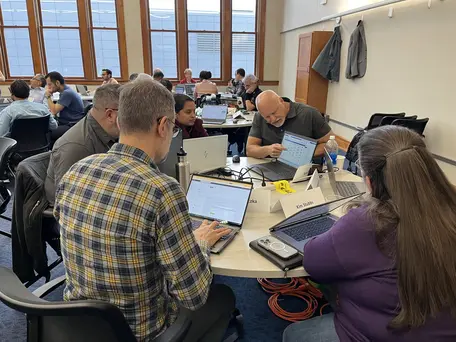
- Adding code to your activity page? Here are some ways to do it:
- Serckit provides code highlighting for many languages (including Matlab). Note that this requires editing your activity page in HTML mode.
- Serckit also supports mathematics display using LaTeX or AsciiMath notation.
- Adding code to your activity page? Here are some ways to do it:
- Participants should prepare to present their curriculum plans in an easy to follow format -- live script, slide, teaching activity, etc. -- for sharing with your group.
- Ask for help, get tools questions answered, test your code.
- Rooms available: Weitz 131 (seats 15), 132 (seats 36), and 136 (seats 20)
10:15 – 10:30 AM Break
- Participants who received workshop stipends should take a few minutes to complete a W-9 or W-8BEN when contacted by the Carleton Business Office. Follow the instructions on Submitting Reimbursement and Receiving your Stipend.
10:30 – 11:45 AM Working Groups: Teaching Activity Sharing and Feedback (Weitz 236 and additional spaces) — Lisa Kempler, MathWorks
- Working group participants will meet to review their curriculum/teaching activities and get feedback and ideas from their peers.
- A subset of participants will present - 5 minutes to present, 10 minutes of feedback/discussion.
- Rooms available: Weitz 131 (seats 15), 132 (seats 36), and 136 (seats 20)
11:45 AM – 12:00 PM Working Group Report-Out (Weitz 236) - Dan
- Select 3-4 presenters from the working groups to share with the workshop
- Affinity group highlights/report out page
12:00 –1:00 PM Lunch + Teaching Activity Wander (Weitz 236)
- Participants with activities to share will display them at their tables for discussion with fellow participants.
- Boxed lunch provided.
1:00 – 2:00 PM Workshop Synthesis and Next Steps (Weitz 236) Cailin
- Thinking about your own experience since Sunday evening:
- What's one way your teaching has changed or evolved?
- What is something you've learned?
- What will you bring back to your department, program or institution?
- Notes for this session - Mitchell is the notetaker
- End of workshop evaluation
2:00 PM Shuttle to Airport (main entrance of Weitz at 3rd Street E and College Street S)
![[creative commons]](/images/creativecommons_16.png)