Program
Monday
8:30 Introductions and icebreaker
9:00 Envisioning your introductory course - Presentation and gallery tour
What has gotten in the way of you being able to implement your vision?
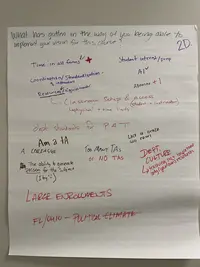
poster 1 notes
![[creative commons]](/images/creativecommons_16.png)
Provenance: Natalie Bursztyn, James Madison University
Reuse: This item is offered under a Creative Commons Attribution-NonCommercial-ShareAlike license http://creativecommons.org/licenses/by-nc-sa/3.0/ You may reuse this item for non-commercial purposes as long as you provide attribution and offer any derivative works under a similar license.

poster 2 notes
Provenance: Natalie Bursztyn, James Madison University
Reuse: This item is offered under a Creative Commons Attribution-NonCommercial-ShareAlike license http://creativecommons.org/licenses/by-nc-sa/3.0/ You may reuse this item for non-commercial purposes as long as you provide attribution and offer any derivative works under a similar license.

theme poster
Provenance: Natalie Bursztyn, James Madison University
Reuse: This item is offered under a Creative Commons Attribution-NonCommercial-ShareAlike license http://creativecommons.org/licenses/by-nc-sa/3.0/ You may reuse this item for non-commercial purposes as long as you provide attribution and offer any derivative works under a similar license.
Mostly feel these are not in our control to change...
- Department/university culture: does your department value teaching? Promotion and tenure requirements, your teaching load
- Students: Class size, students' motivation and competing priorities, use of AI
- Time: Grading, planning, mental space to sit and plan for change, resources (both materials and support)
- Logistics: Enrollment (class size and demographics), physical layout of the room, classroom technology, time slot for class, resources (TAs, other support), assessment reporting, content requirements
How do different groups of students experience your course differently?

poster 1
Provenance: Natalie Bursztyn, James Madison University
Reuse: This item is offered under a Creative Commons Attribution-NonCommercial-ShareAlike license http://creativecommons.org/licenses/by-nc-sa/3.0/ You may reuse this item for non-commercial purposes as long as you provide attribution and offer any derivative works under a similar license.

poster 2
Provenance: Natalie Bursztyn, James Madison University
Reuse: This item is offered under a Creative Commons Attribution-NonCommercial-ShareAlike license http://creativecommons.org/licenses/by-nc-sa/3.0/ You may reuse this item for non-commercial purposes as long as you provide attribution and offer any derivative works under a similar license.
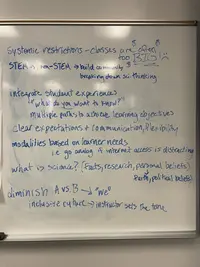
themes
Provenance: Natalie Bursztyn, James Madison University
Reuse: This item is offered under a Creative Commons Attribution-NonCommercial-ShareAlike license http://creativecommons.org/licenses/by-nc-sa/3.0/ You may reuse this item for non-commercial purposes as long as you provide attribution and offer any derivative works under a similar license.
- STEM vs. non-STEM students: having a "science mentality" -
- address by building community and breaking down scientific thinking;
- integrate what students are actually interested in
- Multiple paths to achieving learning objectives
- Have clear expectations and communication, flexibility, make use of universal design
- Should we use technology at all? (Go analog if internet is distracting)
- Describing what science is
- Inclusive tone and structure to avoid isolating different belief systems
Who are your students and what are their goals?

poster 1
Provenance: Natalie Bursztyn, James Madison University
Reuse: This item is offered under a Creative Commons Attribution-NonCommercial-ShareAlike license http://creativecommons.org/licenses/by-nc-sa/3.0/ You may reuse this item for non-commercial purposes as long as you provide attribution and offer any derivative works under a similar license.
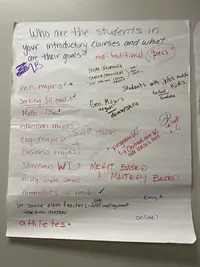
poster 2
Provenance: Natalie Bursztyn, James Madison University
Reuse: This item is offered under a Creative Commons Attribution-NonCommercial-ShareAlike license http://creativecommons.org/licenses/by-nc-sa/3.0/ You may reuse this item for non-commercial purposes as long as you provide attribution and offer any derivative works under a similar license.

themes
Provenance: Natalie Bursztyn, James Madison University
Reuse: This item is offered under a Creative Commons Attribution-NonCommercial-ShareAlike license http://creativecommons.org/licenses/by-nc-sa/3.0/ You may reuse this item for non-commercial purposes as long as you provide attribution and offer any derivative works under a similar license.
- Diversity of students! International, comfort with science, age,
- One-time science students, fear of science and fear of failure
- Goals:
- Fulfilling/surviving the science requirement
- Fear of failure
- Have fun (geology is fun!)
- Leverage culture and background
- Be math-positive!
- Different options to fulfill
What might be getting in the way of student learning?

poster 1
Provenance: Natalie Bursztyn, James Madison University
Reuse: This item is offered under a Creative Commons Attribution-NonCommercial-ShareAlike license http://creativecommons.org/licenses/by-nc-sa/3.0/ You may reuse this item for non-commercial purposes as long as you provide attribution and offer any derivative works under a similar license.

poster 2
Provenance: Natalie Bursztyn, James Madison University
Reuse: This item is offered under a Creative Commons Attribution-NonCommercial-ShareAlike license http://creativecommons.org/licenses/by-nc-sa/3.0/ You may reuse this item for non-commercial purposes as long as you provide attribution and offer any derivative works under a similar license.

themes
Provenance: Natalie Bursztyn, James Madison University
Reuse: This item is offered under a Creative Commons Attribution-NonCommercial-ShareAlike license http://creativecommons.org/licenses/by-nc-sa/3.0/ You may reuse this item for non-commercial purposes as long as you provide attribution and offer any derivative works under a similar license.
- "Checking the box" mentality --> provide context for what they are learning
- Mental health issues --> provide resources
- Distraction by tech --> Get them using it productively
- Time management --> adjusting workload, being clear about expectations
- Phones distractions
- Imposter syndrome --> build sense of belonging
- Math competency/anxiety --> breaking down the process, giving advice and support
10:00 Break
10:15 Facilitating discussions for learning
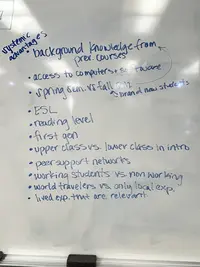
Provenance: Angela Daneshmand, Santiago Canyon College
Reuse: This item is offered under a Creative Commons Attribution-NonCommercial-ShareAlike license http://creativecommons.org/licenses/by-nc-sa/3.0/ You may reuse this item for non-commercial purposes as long as you provide attribution and offer any derivative works under a similar license.
Provenance: Angela Daneshmand, Santiago Canyon College
Reuse: This item is offered under a Creative Commons Attribution-NonCommercial-ShareAlike license http://creativecommons.org/licenses/by-nc-sa/3.0/ You may reuse this item for non-commercial purposes as long as you provide attribution and offer any derivative works under a similar license.

Provenance: Angela Daneshmand, Santiago Canyon College
Reuse: This item is offered under a Creative Commons Attribution-NonCommercial-ShareAlike license http://creativecommons.org/licenses/by-nc-sa/3.0/ You may reuse this item for non-commercial purposes as long as you provide attribution and offer any derivative works under a similar license.
11:25 Road check
11:30 Adjourn for the day
Homework: Complete the equity reflection, which we will discuss in the morning, and bring a syllabus to work with tomorrow
Optional
Lunchtime action planning with Natalie and Angela! (Coker 104)
Tuesday
8:30 Road check review and plan for the day
8:45 Creating an equitable learning environment, starting with the syllabus
Equity-Focused Teaching Strategies Reflection.pdf (Acrobat (PDF) 268kB Jul21 26)
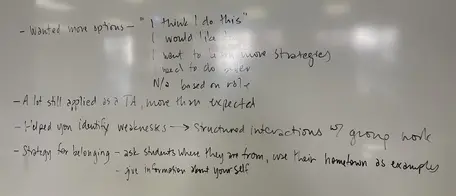
equitable hmwk discussion
Provenance: Natalie Bursztyn, James Madison University
Reuse: This item is offered under a Creative Commons Attribution-NonCommercial-ShareAlike license http://creativecommons.org/licenses/by-nc-sa/3.0/ You may reuse this item for non-commercial purposes as long as you provide attribution and offer any derivative works under a similar license.
Late policy syllabus example (Natalie)
Assessment breakdown
- in-class activities 25%
- unit reflections 15%
- celebrations of knowledge 60%
Ungraded in-class activities and unit synthesis reflections: The traditional system of grading has been recognized to exacerbate inequalities and is not the best reflection of one's understanding of the material. Because of this, I will assess your daily in-class activities by participation and effort only, not correctness. Every day in class we will work on something to practice or apply course concepts. You must submit your work for these activities on Canvas to earn credit for your efforts each class day. So long as you submit your work on time, you will earn full credit for your attempt. Because some absences are inevitable, I will drop the 5 lowest scores at the end of the semester. This means that you can have 5 absences with no penalty for missed in-class activities. Late submissions will earn half credit.
Celebrations of knowledge: You will be assessed on how well you have achieved the course learning outcomes. For each course topic I have provided a "bite-sized" learning objective and each of these is mapped to the bigger course learning outcomes. Our in-class activities are designed to address the "bite-sized" learning objectives and the unit reflections address the bigger course learning outcomes. To prepare for the celebrations of knowledge, begin by reviewing your work and my feedback from the in-class activities and unit reflections! An action plan would be to identify how which of these assignments best map to the study guide. I am more than happy to help you figure this out during my office hours or over e-mail.
10:00 Break
10:15 Strategies for implementation
11:20 Workshop evaluation
11:30 Adjourn
Optional
4:30 - 5:45 Action planning with Natalie and Anne! (Coker 104)
Resources
Teaching with Investigation and Design in Science
Teaching materials
Developing your practice (resources for creating a more equitable learning environment)
Journal articles
Castle, S. D., Byrd, W. C., Koester, B. P., Pearson, M. I., Bonem, E., Caporale, N., Cwik, S., Denaro, K., Fiorini, S., Li, Y., Mead, C., Rypkema, H., Sweeder, R. D., Valdivia Medinaceli, M. B., Whitcomb, K. M., Brownell, S. E., Levesque-Bristol, C., Molinaro, M., Singh, C.,...Matz, R. L. (2024). Systemic advantage has a meaningful relationship with grade outcomes in students' early STEM courses at six research universities. International Journal of STEM Education, 11(1), 14. https://doi.org/10.1186/s40594-024-00474-7
Palmer, M. S., Bach, D. J., & Streifer, A. C. (2014). Measuring the Promise: A Learning-Focused Syllabus Rubric. To Improve the Academy, 33(1), 14-36. https://doi.org/https://doi.org/10.1002/tia2.20004
Richmann, C., Kurinec, C., & Millsap, M. (2020). Syllabus language, teaching style, and instructor self-perception: Toward congruence. International Journal for the Scholarship of Teaching and Learning, 14(2), 4. Syllabus Language Teaching Style and Instructor Self-Perception-1.pdf (Acrobat (PDF) 561kB Jul21 26)
Windschitl, M., Thompson, J., & Braaten, M. (2018). Ambitious science teaching. Harvard Education Press. ISBN: 978-1-68253-163-1
General resources
National Academies of Sciences Engineering and Medicine (NASEM). (2025). Transforming Undergraduate STEM Education: Supporting Equitable and Effective Teaching. The National Academies Press. https://doi.org/10.17226/28268
University of Michigan Center for Research on Learning and Teaching. (2021). Equity-Focused Teaching. Retrieved December 13 from https://crlt.umich.edu/equity-focused-teaching/principles-strategies-resources (the reflection we did was adapted from this)
Professors at Play playbooks on integrating play into your classroom
Cultivating Growth: Alternative grading strategies speed dating: Wednesday1:30pm-4:00pm Coker 102
Angela Daneshmand's Syllabus Canva Template Link (if you'd like to see templates for my other courses, please send me an email)!
Scientist Spotlight Templates-
- Corkboard Template
- Newsletter Template


 Show common themes from gallery tour
 Hide
Hide