
Designing a learner-centered syllabus
Although the role of an introductory course is often perceived as an introduction to the content of a discipline, we envision it as an introduction to an identity and an opportunity to cultivate and nurture that identity through participation in the practices of a discipline. Recognizing that new identity starts with the syllabus: a learner-centered syllabus invites students into your course and helps them envision what they will experience. In a learner-centered syllabus, you:
- Set a positive, respectful, and inviting tone.
- Make learning goals a central, organizing element.
- Provide transparency and structure.
You can read more about how to do each of these things below. You can also assess your own syllabus using the Learning-Focused Syllabus Rubric created by Michael Palmer, Dorothe Bach, & Adriana Streifer at the University of Virginia, Center for Teaching Excellence, which inspired this work.
Set a positive, respectful, and inviting tone
Setting a positive, respectful, and inviting tone in your syllabus fosters students' motivation and their sense of belonging in the course. You can do this by:
- Using personal pronouns (you, we, I) rather than "the students". Start with your learning outcomes! Phrasing learning outcomes to say, "By the end of this course, you will be able to..." empowers students, and helps them visualize themselves at the end of the course with the knowledge and skills they have gained.
- Focusing on learning and opportunities rather than punitive measures. Describe the things students can do to be successful rather than how they will be penalized. Policies for participation, late work, etc., can be explained in language that allows for students' lives outside of your course.
- Describing your expectations for a respectful learning environment and how you can work together to create that environment. Describing respect as a mutual endeavor (again, using personal pronouns) gives students agency and helps them recognize their role as a community member.
- Describing what students can expect from you and providing avenues for communication. You undoubtedly have expectations for students, and you should let them know what they can expect from you in return. It's OK to be strict with deadlines if your goal is to give them rapid feedback, for example, and your deadline is timed accordingly. What can students expect when they reach out to you outside of class time?
The tone of the syllabus permeates the whole document. A good test is to ask a friend or a student who is not in your class to read the document and tell you how it makes them feel when they read it. Does it make them excited? Anxious? Do they feel like there are a lot of rules to remember? Is it clear what they would need to do to succeed in the course? Those reactions can help you know if you've set a positive and inviting tone.
Make learning goals a central, organizing element
Most institutions require learning outcomes for courses, and most require those learning outcomes to be articulated in the syllabus. Rather than just listing them, however, you can do more to help students see how the work they will do in the course will help them achieve the learning outcomes. You can make the learning goals and outcomes central to the organization of your syllabus by:
Articulating an overarching course goal that provides a vision
What is your vision for what students will get out of your course? What is the thing you really want them to carry forward into their future? You can think about these as big ideas or enduring understandings. Big ideas are ambitious, they connect and organize facts and skills, they have great transfer value across subjects and into life beyond school. Big ideas inspire you and your students. Putting this overarching goal at the beginning of the syllabus helps motivate them to keep reading.
 Show Examples of overarching course goals from TIDeS courses
 Hide
HideArticulating a handful of course-level learning outcomes that span cognitive and affective levels
Course-level learning outcomes describe what you want students to do, know, and feel by the end of the course. Instructors in introductory courses may feel that introductory courses should focus on lower-order cognitive processes, like recalling and describing. But students are capable of—and motivated by—higher-order cognitive tasks in which they apply their knowledge and skills through analysis, evaluation, and synthesis.
In addition, introductory courses are a great place to include affective outcomes, which can be focused on reflecting, valuing, appreciating, or behaving. Including affective outcomes can help students develop their identity as a scientist and reflect on their learning in the course.
Showing how your activities and assessments align with the learning outcomes
The syllabus is your opportunity to show students how the work they will do in the course will help them achieve the learning outcomes. This means going beyond listing the assessments and their percentage of the final grade to describing your expectations for assignments, activities, projects, exams, and any other work, and how they will help you assess students' progress.
The relative weighting of assessments should reflect your course-level outcomes, allowing for multiple low-stakes, formative assessments.
Provide transparency and structure
Providing a well-articulated structure for your course in the syllabus makes it a document that both you and students will want to refer to frequently to support the learning process throughout the course. Refer to this schedule and the document frequently to support students in using it productively. When you are transparent about your intentions and expectations, it is easier to be flexible when changes need to be made, particularly in the scheduling.
You can create a structure that supports learning by:
Including a complete schedule
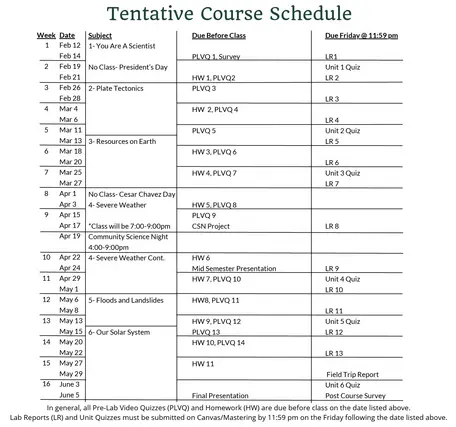
A complete schedule is more than a list of topics by week: it shows topics and activities that will be covered in class, when assignments are due, when you will give students feedback, when major assessments will take place, and other major events that impact the course (holidays, university events). Building a course schedule in a table is one way to help students see how due dates align with topics. Grouping topics and activities into larger units can help students see the overall structure and arc of the course.
![[creative commons]](/images/creativecommons_16.png)
Providing explanations that support your design choices
Being transparent about your design choices means explaining how the course structure helps student achieve the learning goals.
Organizing the syllabus into sections that make it easy to navigate
The syllabus can be a lengthy document when you combine all the information you want to share with the required statements from your institution and ways for students to find support. You can help students navigate this information-rich document with clear and consistent headings that help organize a printed document and are correctly formatted for screen readers and navigation through a table of contents in the digital document.