
Representing the diversity of scientists
- Being explicit about the existence of limiting stereotypes about who scientists are and what they do;
- Considering all scientists as whole people who are part of communities and have interests, motivations, and challenges in their lives;
- Providing opportunities for students to learn about and reflect on a broad range of modern scientists and the work they do;
- Taking care to include scientists who represent diverse personal, social, and cultural identities.
The TIDeS materials incorporate repeated reflection assignments, which we call scientist spotlights, that make use of this approach. You can adopt these assignments as they are, or take a similar approach to modify them for your course. Read on to learn more about scientist spotlight assignments and sources for scientist profiles.
Scientist spotlight assignments
How do scientist spotlights work?
Scientist spotlight assignments introduce students to counter-stereotypical scientists whose work is directly related to the course content. In an out-of-class assignment, students read about or watch a video of a scientist, and then address a few reflective prompts that they submit before class or use to prepare for a class discussion. The prompts are typically open-ended, without a particular right answer, and include questions like:
- What did you find most interesting?
- How does this make you think about what kinds of people do science?
- How does this influence your thinking about the practice of science?
One goal of asking questions like these is to be explicit about drawing out stereotypes of who scientists are and the kind of work that they do and actively counteracting those stereotypes. Another goal is to cultivate students' curiosity and prompt them to make a connection with the scientist or find something relatable. Ultimately, these assignments can lead students to build their own identities as scientists in addition to expanding their perception of scientists and science in general (see the research base for references).
Assignments like these have been shown to be effective in shifting students perceptions of scientists away from stereotypes.
Scientist spotlights in the TIDeS materials
Earth science
![[creative commons]](/images/creativecommons_16.png)
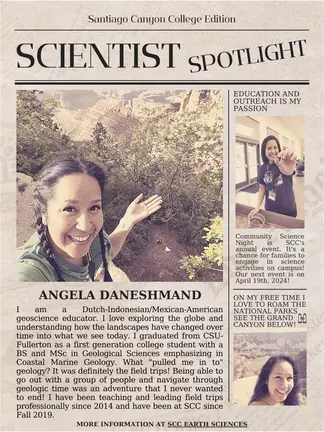
In the final scientist spotlight activity, students create a spotlight about themselves as part of a larger project. Their spotlight (see example) becomes part of a team-based proposal presentation.
Physical science
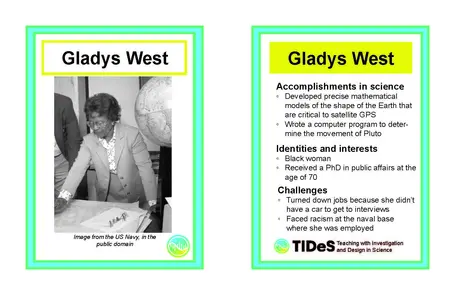
The repeated spotlight activities culminate in a final assignment in which students create a "trading card" version of a scientist spotlight about themselves, listing their accomplishments in science (focusing on the course), their identities and interests, and their challenges.
Sources for scientist profiles
There are many collections of scientist profiles that can be used in spotlight assignments. Not all collections are designed to address stereotypes and help students relate to the scientists who are profiled, however. The collections we link to here are designed specifically to broaden the perception of scientists and the work they do.
Newspapers, journals, and disciplinary organizations are also good sources for scientist profiles.
Freely available profile collections
The Scientists Spotlight Initiative holds over 1000 scientist spotlights that you can search by disciplinary core ideas - the broad content area of the scientists' work. The focus is on young scientists across all fields.
Visionlearning has several Profiles in Science, which tell the stories of scientists' lives and work with a focus on Hispanic scientists across all disciplines.
The Secret Lives of Scientists and Engineers is a series of videos from the PBS show NOVA highlighting scientists and engineers with a secret.
Profile collections available with paid subscriptions
Working scientist career profiles from Nature
Profiles in Science from the New York Times