
Developing Your Practice
Strategies that promote learning in introductory courses
Creating an equitable learning environment in your introductory course that focuses on investigation and design might involve incorporating teaching strategies that are unfamiliar to you. Here, we provide resources to support you in developing new strategies for your teaching practice that promote deep learning for all students.
- Facilitating discussions for learning
- Representing the diversity of scientists
- Incorporating readings that lead to discussion
- Designing your syllabus as a learner-centered guide
In addition, you can explore References and the research base that underlies these practices.
Enacting principles for equitable and effective teaching
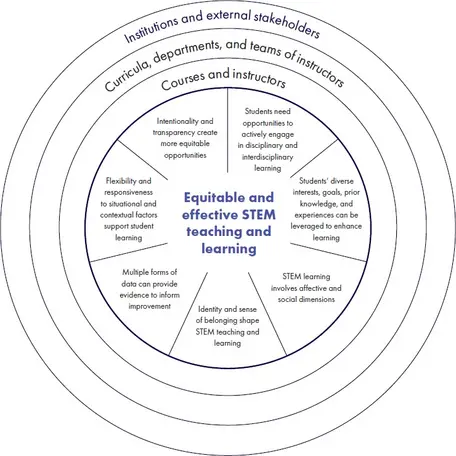
Graphic depiction of the principles for equitable and effective teaching, modified from Figure 4-1 (NASEM, 2025).![[creative commons]](/images/creativecommons_16.png)
- Students need opportunities to actively engage in disciplinary learning
- Students' diverse interests, goals, prior knowledge, and experiences can be leveraged to enhance learning
- STEM learning involves affective and social dimensions
- Identity and sense of belonging shape STEM teaching and learning
- Multiple forms of data can provide evidence to inform improvement
- Flexibility and responsiveness to situational and contextual factors support student learning
- Intentionality and transparency create more equitable opportunities
The TIDeS materials incorporate these principles into introductory courses, which might be the first opportunity that students have to engage in disciplinary learning and can have a broad impact on their long-term interest in science.