

Undergrad Research in the Field
By Ed Hansen, Hope College, Dave Mogk, Montana State University, Bozeman and Patrick Burkhart, Slippery Rock University
Scope of Field Research
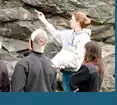
Field research means going out into the natural environment in order to make observations and measurements designed to answer questions about our planet (Mogk and Goodwin, in press). The features of interest are diverse, including such things as rock outcrops, sedimentary deposits, soils, lakes, streams, oceans, aquifers, and the atmosphere. Field research examines the raw materials of nature. Field research can range from relatively brief excursions to collect observations and samples in support of projects carried out primarily on campus to full scale field campaigns in which the students spend most of their time in the field, often in remote localities. They can also range from projects that involve a single student working with a mentor to projects that involve large group of students and multiple mentors. There is also a tremendous diversity of field localities ranging from rock outcroppings to research flights. A few examples covering just a small portion of this wide variety are given below.
 Show caption
 Hide
HideCase studies
- Peat Bogs of Allegan County: A Field-Based Research Project Involving College and High School Students - Contributed by Ed Hansen on behalf of Suzanne DeVries-Zimmerman, Hope College
- International, Undergraduate, Field Research on A Shoestring: Mapping Metamorphic Geology in Halland, Province, Southwest Sweden - Contributed by Ed Hansen, Hope College
- Evolution of the Precambrian Rocks of Yellowstone National Park and Surrounding Areas--an NSF/REU Project - Contributed by Dave Mogk, Montana State University, Bozeman
- Research Experiences in a Mineralogy Class - Contributed by Dave Mogk, Montana State University, Bozeman
- Undergraduate research students investigate dune processes and change at a Lake Michigan site (Case study from 2007-2008 field season) - Contributed by Ed Hansen on behalf of Deanna Van Dijk, Hope College
- Field Research in an Undergraduate Field Camp - Contributed by David Gonzales, Fort Lewis College
- View a poster of a research expedition from Slippery Rock University to examine Holocene landscapes in the White River Badlands, in 2005 - Contributed by Patrick Burkhart, Slippery Rock University

Educational Benefits of Field Experiences
A large number of educational benefits may result from field experiences. Some of these benefits include (Mogk, 2011; Mogk and Goodwin, in press):
- Affective benefits: if the field experience is positive, it can be a strong motivator to further study, inspiring awe, wonder and curiosity as well as instilling self confidence. (Learn more about the Affective Domain.)
- Embodiment: the physical interaction with the world around them can help the student's brain build conceptual models of that world.
- Mastery of content: a number of studies, including Huntington et al. (2001) and Elkins and Elkins (2007), have demonstrated significant gains in understanding of geological concepts by students engaged in field work.
- Forging a professional identity: in their fieldwork, students are often exposed to the traditions, methods and ways of thinking characteristic of the geosciences thereby strengthening their understanding of and identification with these fields.
- Constructing inscriptions: inscriptions are simplified representations of nature that emphasize the salient details for a particular research question. In the field, students are confronted with nature "in the raw" with all of its complexity and ambiguity. During their field work, students can begin to learn the skills needed to construct inscriptions as they make their own decisions about what to observe and how to represent and interpret these representations.
- Metacognitive benefits: field work requires students to become more aware of the processes by which they construct their knowledge as they must analyze their approaches to field tasks, monitor their own progress and modify their actions as they encounter new and often unexpected developments. (Learn more about Metacognition.)
There is a large body of work on maximizing the educational benefits of field research. Although much of this does not explicitly refer to research, many of the principles apply. Links to some of these are listed below.
- Field Geology Education, Historical Perspectives and Modern Approaches, edited by Steve Whitmeyer, David Mogk, and Eric Pyle. GSA Special Paper 461. Includes 26 articles on teaching in the field, including 5 articles on Original Research in Field Education.
- Bibliography of References on Teaching in the Field compiled by David Mogk for the Synthesis of Research on Thinking and Learning in the Geosciences project; contains 124 references..
- Steve Whitmeyer and David Mogk (2009) Geoscience Field Education: A Recent Resurgence, Eos, Vol. 90, No. 43, 385"396.
- Contributions from the 2004 GSA session on Using Field Observations and Field Experiences to Teach Geoscience.
Nuts and Bolts of Field Projects
Qualities of Good Field Research
An undergraduate field research project must have all of the characteristics of a good field project in general. Thus, it should be built around a well-conceived plan to test a specific hypothesis or set of hypotheses, but should be flexible enough to accommodate new, unexpected observations. Field notes should be detailed and organized with observations clearly distinguished from interpretations. Observations should be carefully keyed into their geographical locations either by marking them carefully on a base map or using GPS coordinates. Field photographs and samples should be carefully documented. In addition to these general qualities, an undergraduate research project should also follow good educational practices. There should be clear learning goals and strategies designed to achieve them. The goals should include not only the acquisition of technical skills but also the development of those habits of mind that characterize a good field scientist and the strategies should be based on our understandings of how students learn.
Planning and Preparation
The more carefully we prepare for an undergraduate field research problem the more likely it is to be a success To some extent, research questions should be open ended and it is often desirable to have the student participate in the definition of his or her projects. However, there are usually overarching goals to the research projects, limited amounts of time, and specific technologies available to the researchers. All of these put limits on the research questions the students can ask and answer. Before the field work begins, the mentor should have a clear vision of the scope of the project and the expectations for the research students. It is important that these are also made clear to the students. The faculty mentor should be as familiar as possible with the field area. This generally means visiting the area before the project begins. Logistics should be worked out beforehand with as little as possible left to chance. The faculty mentor should have contingency plans. These should include plans for mishaps such as accidents, illness and inclement weather. However, they should also include alternate research plans. The research plans that seemed good and straightforward in our offices often prove to be flawed or impractical in the field. What will you do if access to a key area turns out to be more difficult than expected or key samples prove to be impossible to collect? What will you do if you find that your original time table was much too ambitious? What will you do if you discover that the field relationships you thought would test your working hypothesis will yield an ambiguous answer? It is important to ask yourself questions like these and to start the field work not only with a plan B, but also with a plan C, D, and E. Some suggestions for preparing the research students for the field experience are given in the section on orientation below.
Logistics
Logistics almost always take up more time and energy than we expect, and this is especially true for field research in "remote" localities in which we are responsible not only for logistics in the field but also for housing and feeding the students outside of it. Whenever possible, it is important to share this burden, some of which, with proper supervision, can be shifted to the students themselves.
Managing Groups of Students in the Field
Orientation: Some orientation to field work in general and the field area in particular is usually necessary. As Dave Mogk points out in his discussion of "novelty space" in his 1997 essay on Field Notes and also in the 2011 GSA Field Trip Guidebook (Get Ready, Get Set,Go....On a Field Trip), students do not perform well when they are disoriented by the newness of their surroundings, unclear about the geologic setting, unsure of what they should do, or worried about their safety or comfort. As one mentor who has supervised students in field projects has put it:
"Two mistakes really brought home to me the importance of easing students into field work physically, mentally, and emotionally. The first happened on my first field projects with students. On the first day we hiked up a high steep ridge and walked about ten miles while making observations and collecting samples. At the end of the day all of the students were exhausted and one of them had developed blisters that were so bad they kept him out of the field for the next three days. The second happened on my first international field project with students. On our first day I left a student at an outcrop and asked her to do structural measurements on a set of small folds. When I returned about an hour later she had done almost nothing and was on the verge of tears. She was a good student who had gotten an A in structural geology and liked the subject (in fact she later specialized in structure in graduate school). She had done similar measurements on her field trips in structural geology. However at that moment she was just overwhelmed by the newness of everything: unfamiliar rocks in an unfamiliar country. Now I generally take the first few days of a field project to ease the students into it. We start slowly; we walk around looking at and discussing the outcrops, they orient themselves on the map, we practice as a group the techniques they will later be applying on their own."
When possible, the orientation should probably begin before the students reach the field area. For example, they can read and discuss papers on the geology of the area or can review basic texts like The Manual of Field Geology or The Geology of High Grade Gneiss Terrains. They can also practice the technical skills they will be using once they start their research
Supervision of field work: The wide range of undergraduate field research projects means that there is a variety of approaches to supervising students in the field. In some cases, for example a senior thesis with a field area close to campus, the student may work almost completely independently with an occasional spot check by the faculty mentor. In other projects, the mentor may work side by side with the students throughout the entire time they are in the field. If the mentor is responsible for a large group of students, supervision can be particularly challenging. Having the students work in research teams allows for a kind of "peer supervision" and can take some of the burden off the mentor. There are other advantages to these teams. In remote localities it can be safer for the students to work together. Working in a team helps alleviate loneliness and is often more fun than working alone. Students who work in teams can troubleshoot problems together and discuss both observations and interpretations. Even if students are working on individual projects, they can still work in teams. In this case, they can alternate the roles of research supervisor and field assistant depending on whose project they are working on at the time. This approach can expose the students to a wider range of research problems and techniques than they would be exposed to if they were concentrating only on their own project. Weighing against all of these advantages are a number of potential problems. For a research team to work, the students must get along. They should be relatively evenly balanced so that one student does not end up always taking the lead while another one fades into the background. While they should enjoy themselves, it is also important to avoid situations in which socializing gets in the way of work. Forming effective research teams is one of the more important tasks facing a research mentor. Some research mentors choose students for field projects who have demonstrated that they work together well in class or laboratory exercises. However, this is not always possible, particularly in cases (like REU or Keck Consortium projects) where neither the mentor nor the research students know each other before the research begins. As the faculty mentor gets to know the students in the orientation period, they should be thinking about which students are likely to be able to work together in viable research teams. Having students work in temporary teams on short-term tasks early in the research project is one way to testing potential research teams.
Behavioral issues: Most students seem to value the opportunity to do field work and are unlikely to put the opportunity in jeopardy by misbehaving. However, behavioral problems do arise. The same principles apply to misbehavior during field research projects as apply to misbehavior during field trips. There should be clear behavioral guidelines that include the policies to be followed in case these guidelines are violated. These should include the option of terminating the student's research experience. This may include sending them home at their expense if the research involves living off campus. Be observant and proactive: try to catch and correct problems early, before they build up to the point that it is necessary to send the student packing. Recall that the students serve as ambassadors for your program, your institution and, if the project is overseas, your country. Be aware of the impression the students are making and try to ensure that it is not a bad one. Also try to be sensitive to how misbehavior is affecting the other students. Sexual harassment, ethnic harassment, bullying of students who are different, flagrant drug or alcohol abuse, and dangerous behaviors (such as carrying concealed weapons) can poison the atmosphere for all students. This not only ruins the experience for the students, but student complaints about these things to their parents or the home can have seriously negative consequences for the faculty member in charge. Finally, it should go without saying, but the person in charge should set a good example by obeying rules he or she sets down. For example, if you do not want the students to drink then forgo that glass of beer or wine at dinner.
Safety and Liability: Prevention and preparation are the best ways to cope with the risks inherent in field work. A good overview on this subject is given in Barbara and David Tewksbury's guide: Playing It Safe: Recognizing and Managing Risk When Working With Students in the Field. Requiring students to read and sign safety forms before going into the field has rapidly become standard procedure. The site Field Trip Safety Forms has several examples of forms that, although designed for class field trips, could easily be adapted to a variety of field based research projects.
Bibliography and References
Boyle A., Maguire, S., Martin, A., Milsom, C., Nash R., Rawlinson, S., Turner, A., Wurthmann, S. and Conchie, S.,2007 Field work is good: the student perception and the affective domain: Journal of Geography in Higher Education, v. 31 p 299-317
Elkins, J. T., and Elkins, N. M. L., 2007, Teaching geology in the field: significant geoscience concept gains in entirely field-based introductory geology courses: Journal of Geoscience Education, v. 55, p 126-132.
Huntoon, J.E., Bluth, G.J.S., and Kennedy, W. A., 2001, Measuring the effects of a research-based field experience on undergraduates and K-12 teachers: Journal of Geoscience Education, v. 49, no. 3, p. 235-248
Mogk, D.W., 2011 Get Ready, Get Set, Go....On a Field Trip, Geological Society of America Field Guides, v. 24, p. 477-482.
Mogk, D. W., and Goodwin, C., in press, Learning in the Field: Synthesis of Research on Thinking & Learning in the Geosciences, Geological Society of America Special Papers.
Whitmeyer, S.J., Mogk, D.W. and Pyle, E.J. (eds) (2009) Field Geology Education: Historical Perspectives and Modern Approaches. Geological Society of America Special Paper 461.