
Earth Orbital Mechanics and Solar Irradiance: Part I - Theoretical Model
Summary
 Collapse
Learning Goals
A. Primary goal is to have students gain experience programming a set of theoretical equations (representing a physical process) for the purposes of understanding, quantitative analysis and visualization of the process.
B. An important goal is to reinforce content taught in lecture; specifically, solar irradiance is the primary source of energy for the Earth system and orbital mechanics is the fundamental cause of variation in this external energy source on daily and seasonal time scales.
C. Additional lecture content reinforced during the computer programming laboratory activity:
1. terms and definitions associated with solar radiation and orbital mechanics, e.g., irradiance, eccentricity, zenith angle, declination angle,
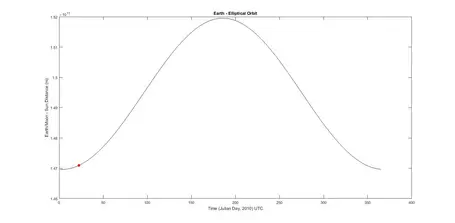
2. the Earth/Moon system orbital trajectory about the Sun is elliptical, with the closest point of approach (perihelion) occurring in January,
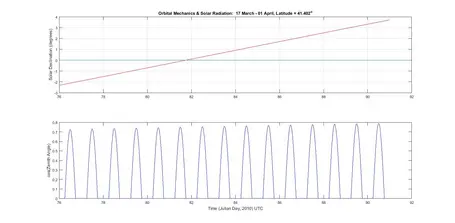
3. variation in solar declination angle is the fundamental cause of seasonal variation on Earth,
4. solar declination angle and Earth/Sun distance only depend on time (i.e., orbital position); whereas, the solar irradiance at a specific location on Earth depends on time and latitude.
D. Students learn numerical simulation of theoretical models can be a useful tool to investigate the influence of various physical quantities on a system, such as declination and zenith angles.
Context for Use
This activity is taught in the laboratory component for a sophomore-level meteorology course with class sizes up to 20 students. The pre-requisite for this class is only a college freshman-level introductory meteorology course. Students have not yet taken a computer science course. Overall, the laboratory structure for the course includes three modules: (1) introduction to scientific computer programming in MATLAB, (2) outdoor, hands-on experiments in meteorology and (3) web-based activities associated with meteorology.
This is the first activity in a set of two (i.e., Part I of II). It introduces students to programming and visualization of theoretical equations using MATLAB; occurring during approximately the 4th week of the course. During the previous first three weeks, students become familiar with the MATLAB desktop environment, two-dimensional plotting, array and matrix operations and some programming skills such as for loops and conditional statements. This first activity is a simple calculation, then visualization of Earth/Moon orbital mechanics with the Sun, reinforcing lecture topics such as solar declination angle, solar zenith angle and solar irradiance.
During the first 20 minutes of the laboratory period the instructor reviews a 2-page handout document (attached) and discusses guidelines for and the structure of MATLAB programs with the students. Each group of two students has the remainder of the laboratory period (90 minutes) and the following week to complete the assignment. The instructor circulates during this part of the period providing guidance and answering questions. The deadline to submit all deliverables (see assignment and assessment) is the beginning of the subsequent laboratory period.
Description and Teaching Materials
This activity is the first part of a two-part, three week-long assignment in a sophomore-level analytical meteorology course.
An important focus of the laboratory component for the analytical meteorology course is introducing students to scientific computer programming in MATLAB. The first three weeks of laboratory sessions are used to teach MATLAB basics. During this period, we review several early chapters in the textbook "Essential MATLAB for Scientists and Engineers" B. Hahn and D. Valentine (see the resources list).
The Part I activity described here introduces students to basic computer programming methods in MATLAB. It does so by demonstrating the theoretical model for the Earth/Moon system orbiting the Sun and the resultant solar irradiance at the top of the atmosphere for any latitude. These equations can be found in many sources, but those from Chapter 2 in "Meteorology for Scientists and Engineers" R. Stull are used (see resources list). The primary science goal is to teach that the fundamental source of energy for the Earth system is based on a deterministic process and to demonstrate the temporal and spatial variability of this process.
This Part I computing experiment is stand-alone and so can be used in a variety of science and engineering courses. For example, model results are incorporated into a hands-on outdoor experiment which assesses the efficiency of solar panels. A second application is calculation of atmospheric "heating rates" in a subsequent course on atmospheric thermodynamics. A third application occurs in a climate course where the eccentricity and declination angle terms in the orbital mechanics equations are modified consistent with the Milankovitch's proposed cycles.
Teaching Activity Assignment and Guidelines (Acrobat (PDF) 153kB Oct7 25)
Student Handout Questions for Earth Orbit MATLAB Programming (Acrobat (PDF) 144kB Oct7 25)
2025 Teaching Activity M-file (Matlab File 4kB Oct7 25)
![[creative commons]](/images/creativecommons_16.png)
Teaching Notes and Tips
To make the students familiar with using the orbital mechanics equations BEFORE coding them in MATLAB, it is suggested students be given a quantitative paper-and-pencil homework assignment as part of the lecture component of the course. This allows a significant portion of the programming to be completed efficiently during the laboratory session when the instructor is available to answer questions as the students write code.
It should be stressed to the students they must get their programs to function and deliverable graphics completed during the week-long period between laboratory sessions.
Detailed comments relevant to programming:
- Students are not given an instructor-provided partial M-file to use when writing this program; instead, they are given written formatting guidelines to follow which encourages them to organize their code into sections thereby helping them formulate and solve the problem as well as facilitating their debugging of syntax and logic errors.
- Students should be reminded angles have units of radians in MATLAB calculations.
Assessment
For this MATLAB programming activity students are given a list of Deliverables (attached). Completion of these deliverables ensures students meet the goals for the activity. The deliverables for the activity include submittal of:
1. an M-file script for each group of two students [Learning Goals A and D].
2. three two-dimensional, time-series graphics, properly annotated with titles and axis labels [Learning Goals A, B, C.2, C.4 and D].
3. individual hand-written answers to questions posed in a one-page handout [Learning Goals C.1, C.3 and C.4].
The hand-written questionnaire (attached) are manually graded, with scores based on points for each answer. The instructor has access to and runs the M-file script from each student group – this script must function properly and produce the figures (attached) provided by each student group.
References and Resources
This is Part I of a two-part activity wherein students program the theoretical equations for solar irradiance at the top of the atmosphere for any location on Earth at all times of the year.
Textbook: "Meteorology for Scientists and Engineers", 2nd Edition; R. Stull, ISBN-13 978-0534372149, Chapter 2 Radiation – this textbook chapter has the orbital mechanics equations.
Textbook: "Essential MATLAB for Scientists and Engineers", Fifth Edition, Chapters 1, 2 and 6; B. Hahn and D. Valentine, ISBN-13 978-0123943989