Initial Publication Date: August 20, 2014
DOIThis page currently has no DOI, but you may request a DOI be assigned. |
Cite thisCalculating the Margin: Practice Problems
Problem 1:
Last week Fred studied for 2 hours and scored an 80 on his Economics quiz. This week, Fred studied for 3 hours and scored an 85. Calculate the marginal benefit of Fred's 3rd hour of studying.
From the 2nd to the 3rd hour of studying, Fred's grade increased from an 80 to an 85. His marginal increase in score is:
- change in score = 85 - 80 = 5
- change in hours studied = 3 – 2 = 1
- marginal benefit of an hour studying = 5 ÷ 1 = 5
The marginal benefit is 5 points. This means that studying for the 3rd hour added 5 additional points to Fred's quiz score.
Problem 2:
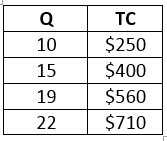
The table presents information on the total cost of producing various quantities of handbags. What is the marginal cost of producing one more handbag when production increases from 10 to 15 handbags? From 15 to 19 handbags? From 19 to 22 handbags?
![[creative commons]](/images/creativecommons_16.png)
Provenance: Michelle Sheran, University of North Carolina at Greensboro
Reuse: This item is offered under a Creative Commons Attribution-NonCommercial-ShareAlike license http://creativecommons.org/licenses/by-nc-sa/3.0/ You may reuse this item for non-commercial purposes as long as you provide attribution and offer any derivative works under a similar license.
From Quantity = 10 to Quantity = 15, Total Cost (TC) increases from $250 to $400. Marginal cost is therefore:
- change in total cost = $400 - $250 = $150
- change in quantity = 15 – 10 = 5
- marginal cost = $150 ÷ 5 = $30
From Q = 15 to Q = 19, TC increases from $400 to $560. Marginal cost is therefore:
- change in total cost = $560 - $400 = $160
- change in quanity= 19 – 15 = 4
- marginal cost = $160 ÷ 4 = $40
From Q = 19 to Q = 22, TC increases from $560 to $710. Marginal is therefore:
- change in total cost = $710 - $560 = $150
- change in quanity = 22 – 19 = 3
- marginal cost = $150 ÷ 3 = $50
Problem 3:
Sarah and Joe compare their paychecks. Each has worked overtime so that Sarah's pay increased from $3000 to $3300 and Joe's income went from $1000 to $1300. Sarah's income tax withholding increased from $300 to $345 while Joe's income tax withholding increased from $50 to $80. What is the marginal tax rate for Sarah and for Joe?
For Sarah, the overtime work has increased her taxes to $345 from $300 and her pay to $3300 from $3000.
- change in tax = $345 - $300 = $45
- change in pay = $3300 - $3000 = $300
- Marginal tax rate = $45 / $ 300 x 100 = 15%
For Joe the overtime work has increased his taxes to $80 from $50 and his pay to $1300 from $1000.
- change in tax = $80 - $50 = $30
- change in pay = $1300 - $1000 = $300
- Marginal tax rate = $30 / $ 300 x 100 = 10%
Even though both Sarah and Joe had the same $300 pay increase, Sarah pays a higher marginal tax rate (15%) than Joe (10%).
Problem 4:
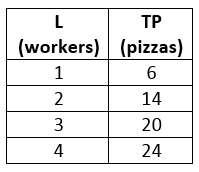
The amount of pizza produced per hour by Mama Jo's Pizza is a function of how many workers Mama Jo's employs. The table presents Mama Jo's total product schedule, or a list of the number of pizzas produced, called total product (TP), for various quantities of workers, called labor (L). Calculate the marginal product of each additional worker, called the marginal product of labor (MPL).
Provenance: Michelle Sheran, University of North Carolina at Greensboro
Reuse: This item is offered under a Creative Commons Attribution-NonCommercial-ShareAlike license http://creativecommons.org/licenses/by-nc-sa/3.0/ You may reuse this item for non-commercial purposes as long as you provide attribution and offer any derivative works under a similar license.
From L = 1 to L = 2, TP increases from 6 to 14. MPL is therefore:
- ∆TP = 14 - 6 = 8
- ∆L = 2 – 1 = 1
- MPL = 8 ÷ 1 = 8
From L = 2 to L = 3, TP increases from 14 to 20. MPL is therefore:
- ∆TP = 20 - 14 = 6
- ∆L = 2 – 1 = 1
- MPL = 6 ÷ 1 = 6
From L = 3 to L = 4, TP increases from 20 to 24. MPL is therefore:
- ∆TP = 24 - 20 = 4
- ∆L = 2 – 1 = 1
- MPL = 4 ÷ 1 = 4
Problem 5:
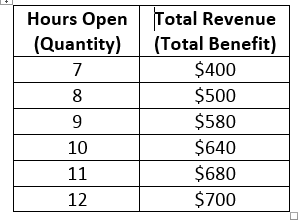
The manager of an ice cream store is deciding how many hours to stay open during the summer months. The table shows the total revenue the store will generate for various hours it is open per day. Each hour the store stays open adds $50 to the store's cost. How many hours per day should the manager decide to stay open?
Provenance: Michelle Sheran, University of North Carolina at Greensboro
Reuse: This item is offered under a Creative Commons Attribution-NonCommercial-ShareAlike license http://creativecommons.org/licenses/by-nc-sa/3.0/ You may reuse this item for non-commercial purposes as long as you provide attribution and offer any derivative works under a similar license.
-
First calculate the marginal benefit of staying open for each additional hour. Each additional hour the ice cream store stays open generates additional revenue, called marginal revenue, where marginal revenue = change in total revenue ÷ change in quantity.
For example, from the 7th to the 8th hour, total revenue increases from $400 to $500. The marginal revenue of the 8th hour is therefore:
- change in total revenue = $500 - $400 = $100
- change in quanity = 8 – 7 = 1
- marginal revenue = $100 ÷ 1 = $100
-
Next calculate the marginal cost of staying open for each additional hour. Here, that is a constant $50. Each additional hour the store stays open increases the store's total cost by $50.
-
Finally, compare marginal benefit and marginal cost to make the optimal (best) decision.
The manager should choose to stay open for 10 hours per day. The 10th hour adds more to the store's total revenue ($60) than to its costs ($50). But the 11th hour adds less to the store's total revenue ($40) than to its costs ($50).
Problem 6:
After a one-time income tax decrease of $1000 per household, government economists measure the following changes in consumption and savings for the typical household. What is the marginal propensity to consume and the marginal propensity to save for this typical household?
|
Disposable income
|
Consumption
|
Savings
|
|
Before tax decrease
|
$40,000
|
$38,000
|
$2,000
|
|
After tax decrease
|
$41,000
|
$38,750
|
$2,250
|
First look at the marginal propensity to consume:
- change in consumption = $38,750 - $38,000 = $750
- change in in income = $41,000 - $40,000 = $1,000
- Marginal propensity to consume = ($750 / $1000) x 100 = 75%
Then lookk at the marginal propensity to save:
- change in savings = $2,250 - $2,000 = $250
- change in ncome = $41,000 - $40,000 = $1,000
- marginal propensity to consume = ($250 / $1000) x 100 = 25%
Alternately, we can find the marginal propensity to save by subtracting the marginal propensity to consume from 100%, i.e.: 100% - 75% = 25%

 Show Problem 1 Solution
 Hide
Hide