
Georgia Southern University
Summary
College-level promotion and tenure policy revisions were approved by faculty vote in the Georgia Southern (GS) University College of Science and Mathematics (COSM) in spring 2022. The guidelines for the evaluation of teaching were developed using insight gained from a survey of the faculty; discussions with the departments, leadership and Faculty Governance Committee in the College; and evidence-based strategies as outlined in peer-reviewed articles and teaching evaluation policies from other universities and organizations. The recommended guidelines aimed to account for the range of perspectives and backgrounds of students and faculty, and varied teaching and learning styles. The document-revision period spanned fall 2021 to spring 2022. However, foundational work and discussions regarding this process began in 2018. At the time of this writing (fall 2024), the College is gearing up to do another round of policy revisions.
Institution Type: Doctoral: High Research
MSI: No
Policy Level: School or College
Policy Status Ratified in 2022 but a revision is planned for the new future.
Keywords: reflection, maximize student learning, student-centered
Overview
![[creative commons]](/images/creativecommons_16.png)
With the goal of rewarding and incentivizing evidence-based practices that promote efficacy and fairness, revision of the promotion and tenure evaluation guidelines for teaching and other areas targeted:
- Aligning the evaluation, promotion and tenure requirements with that of a strong R2 Institution
- Ensuring that the evaluation, promotion, and tenure guidelines reflect best practices for the retention, promotion, and tenure of faculty
- Promote fairness in evaluations at all levels of review, and at all faculty ranks
- Communicate high expectations based on realistic and attainable goals
- Explicit articulation and transparency with respect to performance expectations
- Developing processes that foster a college culture that actively embraces, celebrates, considers and respects the various backgrounds, contributions and perspectives in our college community
- Developing a college rubric with broadly defined performance expectations that can be used to guide the development of department-level evaluation rubrics
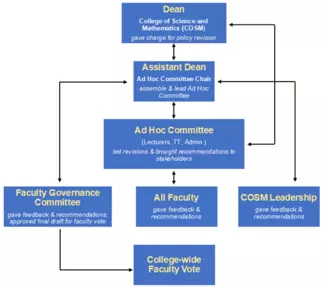
To do the above, the Dean tasked an Assistant Dean with assembling and leading an Ad Hoc Committee to guide the College through a year-long revision of the policies and the development of rubrics for evaluation. The committee's recommendations were informed by faculty feedback (survey and town halls with departments), evidence-based strategies outlined in the peer-reviewed literature, publicly-available policy and evaluation documents from aspirational institutions and other educational entities, and the institution's and state university system's guidelines.
Theme 1: Align policy change with what matters
STIMULUS: The need for the policy revision stemmed from major events that occurred over the past ten years: (1) In 2018, separate universities, ~60 miles apart, were merged to form the "new" Georgia Southern (GS) University. Work on bringing the newly formed multi-campus institution under unified policies was stalled by the COVID pandemic. (2) Prior to the merger, the larger of the two institutions began to focus on strengthening its R2 standing and, post-merger, the "new" institution retained this goal (It is now looking toward R1.). (3) The state university system to which GS belongs revised faculty evaluation policies. GS and its academic units needed to bring their promotion and tenure guidelines into alignment with the updated university system policies. Specifically, for contributions that are directly or indirectly related to teaching, the state guidelines called for excellence in teaching, evidence of professional development, and a new criterion for student success.
With the establishment of a "new" university, changing priorities and requirements to support a strong research agenda, and delays due to COVID-19, by 2021, a revision that clearly outlined work expectations and evaluation criteria in a single unified College policy was very much needed. This need for the revision was also an opportunity for the College to work toward enhancing its evaluation practices.
ENGAGING STAKEHOLDERS: With a charge that the process should include input from stakeholders and that rubrics should be developed for each area of faculty work (teaching, service, research), the College Dean appointed an Assistant Dean to lead a policy revision Ad Hoc Committee. The involvement of various stakeholders was important because the revision would be enriched by perspectives that represented the range of interests and experiences among the faculty. The Committee consisted of Lecturers, Tenure-track faculty members and Administrators, at early- and mid-career stages from the university's major campuses (Armstrong-Savannah and Statesboro). Members were recommended by the Chairs. For some Ad Hoc Committee members, their Chairs adjusted workload to account for the time and effort that the Committee would require.
The Committee worked to engage the wider College community. Throughout the revision process, they solicited input from faculty, Administrators, Associate Deans, the Dean, and the College's Faculty Governance Committee. Engaging with faculty occurred through a college-wide survey and through department meetings. The survey was designed to capture faculty perspectives on workload and on evaluation criteria for three areas (teaching, research and service). It was administered via email to the entire college over 1.5 weeks. To encourage survey completion, reminders were sent by Committee members to their respective units, and by the college. The final response rate was 42%. The department meetings were held at the beginning of spring 2022, the midpoint in the revision timeline. In those meetings, initial revision recommendations were critiqued by attendees. The Committee lead (the Assistant Dean) also met separately with College leaders (Directors, Chairs, Deans) and the Faculty Governance Committee at different times to talk through their feedback on drafts. Finally, meetings were held with just the Dean and the Committee members to give progress updates and to discuss the Committee's ideas and working drafts. There were two Committee meetings with the Dean, one in the fall and another in the spring. Separate from meetings with stakeholders, the Committee itself had standing bi-weekly meetings.
Per the College's policy, a majority vote in favor of the final recommendation was secured by the College's Faculty Governance Committee before the revisions were moved to a college-wide vote. The revision was passed by a majority faculty vote in May 2022.
OUTCOME: The updated guidelines helped to unify College units in their interpretation and execution of faculty evaluations and workload distribution, and provided enhanced clarity for promotion and tenure expectations and evaluation processes. Additionally, units used the updated College manual to guide their departmental-level policy revisions. For teaching, a rubric in the manual provides broad illustrations of effective teaching strategies in and beyond the classroom (details below).
Theme 2: Be strategic about policy content
At its core, GS is a student-centered institution and, as the institution works on strengthening research productivity, the College (COSM) and the university have intentionally retained the student-focus in faculty hiring and promotion and tenure practices. For example, most COSM departments still give recognition to the mentorship of undergraduate researchers in the promotion and tenure evaluations.
TEACHING EVALUATION RUBRIC: To ensure that readers could easily understand the COSM document without knowledge of terminology used in the scholarship of teaching and learning, the Committee made an effort to minimize the use of scholarly jargon. Instead, with the teaching evaluation rubric, Committee members focused on illustrating what teaching efficacy could look like for faculty at our institution. In the development of the rubric, to encourage faculty in this effort, the Committee used examples that reflected what faculty across the College were already doing to various extents. The Committee also used insight gained from a college-wide faculty survey, the research literature, and education resources (Pre-K through Grade 16). Pre-K-16 literature has a wealth of information on rubrics for teaching evaluation.
The rubric is meant to serve as a guide to bring about better consistency between faculty and the various College units in what can be recognized as evidence of effective teaching. It illustrates both traditional (classroom) and non-traditional contributions according to four ways in which COSM faculty typically engage with teaching: "Classroom Teaching", "Teaching Outside of the Classroom", "Development of Teaching Skills", and "Development of Course/Course Materials". Within each of these categories, the rubric provided broad examples of activities that could earn ratings of "Does Not Meet Expectations" (lowest rating), "Needs Improvement", "Meets Expectations", "Exceeds Expectation", and "Exemplary" (highest rating). Importantly, the guidelines for the rubric discouraged faculty from trying to fulfill all categories but instead to focus on a few as applicable to their specific circumstances.
SOURCES OF EVIDENCE: University policies have long dictated that student ratings of instruction (SRI) must be considered in faculty's teaching evaluation, but should not be the sole basis on which evaluations are made. The policies also require that faculty reflect on their SRIs for annual, mid-appointment and promotion/tenure reviews. Revised College guidelines build on university requirements and explicitly state that evaluation of teaching "will take into consideration the quality of the teaching activities and students' learning; faculty's self-reflection on teaching activities and accomplishments; peer-observation(s) of instruction (peer teaching evaluation/review); students' perception as reflected in the student ratings of instructions (SRI) as well as additional sources that faculty may use; and other evidence that faculty may provide."
The "peer-observation of instruction" is optional. However, with the revisions, the College manual strongly recommends that junior faculty members do more than one peer-observation of instruction staggered over multiple years to demonstrate growth. Additionally, the state's university system requires that faculty members are assessed for contributions to student success, and engagement in professional development. As such, other sources of evidence may include professional development activities for enhancing instructional quality.
Theme 3: Make policy change someone's job
LEADS FOR POLICY REVISION: It was important that the College of Science & Mathematics (COSM) Ad Hoc Committee reflected the faculty body. As such, the Committee had representatives at different career stages from (a) the two major campuses, (b) administration (a Chair and the Assistant Dean), and from (c) the permanent tenure-track and non-tenure track lines. Members of the Committee spanned all ranks and all departments (at least two faculty per department). The Committee was divided into sub-teams for the areas of teaching, scholarship, and service.
INCLUDING THE COLLEGE COMMUNITY IN POLICY CHANGE: The Ad Hoc Committee took a multipronged approach to leading the revision process: Members of the Committee sub-teams reflected on existing and past practices in their respective units, read the literature on best practices for faculty evaluation, reviewed the state and University guidelines, and solicited input from the College community. Some members also attended workshops on faculty evaluation. To draft college-level rubrics for evaluating each domain of faculty work and to refine the guidelines, the sub-teams then pulled on information from their learning, their own experiences, guidelines from departments that had already established protocols based on best practices, and faculty feedback.
Major revisions to the college policies need to be approved by majority vote. As such, it was essential that the college community be engaged at key points in the process. Before making any recommendations for revisions, the college-wide survey was used to capture faculty's perception of the value that should be placed on different aspects of teaching, service and research. During the revision process, the Committee or representatives of the committee met with the following persons or groups to solicit input:
- College Dean (start, mid-point, near-end, and constant communication throughout as questions arose or through bi-weekly updates with the Assistant Dean)
- College Leadership (Dean, Assoc. Deans, Chairs/Directors) (mid-point, near-end)
- College Governance Committee (mid-point, near-end, approval for moving the updated document to a college-wide vote)
- Each Department (mid-point to discuss proposed changes)
- Entire College (final revisions sent out for vote)
All of the above interactions were essentially for ensuring that, as much as humanly and practically possible, faculty across the college recognized that their input was important and seriously considered during the process.
Theme 4: Approach policy change as a process
TIMELINE & PROCESS: The time period for the revision was one academic year, fall 2021 to spring 2022:
Mid-August to Mid-September:
- The Dean met with the Committee Chair to discuss the goals of the revision, a proposed timeline, and the literature and policy documents from other institutions. The Dean also provided guidance on how to approach the process so that faculty across the college were (and felt) engaged in the process.
- Preparation included the Committee Chair (Assistant Dean) (a) studying the literature and pulling documents from peer and aspirational institutions; (b) selecting and cataloging a few key documents from "a" and highlighting one document that looked like the best model to follow.
- Recommendations were solicited for Committee members from Chairs/Directors. Recommended faculty were from different ranks and tracks.
- Committee members were asked to choose the area on which they would like to focus (service, teaching or research) and subgroups were created to tackle the respective area in-depth.
Mid to End of September:
- During the first Ad Hoc Committee meeting (a) the Committee Chair gave an overview of the goals and proposed timeline; (b) the Committee Chair facilitated a discussion in which members shared how each campus did promotion and tenure reviews in each department prior to the merger (having this discussion was extremely important); (c) the full group created the framework of the initial college survey; (d) the Committee chair provided links to cataloged resources.
- The second full Committee meeting two weeks later focused on (a) an overview of key institutional and University System of Georgia policies; (b) finalizing the survey with draft shared ~ one week prior; (c) creating the timeline and goals for subcommittees.
October
- Subcommittees met twice during the month of October after receiving survey responses consolidated by the Committee Chair and developed proposals for research, teaching and service rubrics.
- Sub-teams met in between the full group meetings to work on their rubrics.
November to Early December
- Initial recommendations were presented to stakeholders, including (a) Dean (full Committee), (b) Dean's Council (Committee Chair), (c) Faculty Governance Committee (Committee Chair).
- The third full Committee meeting occurred in December. The Committee reviewed feedback from stakeholders, discussed revisions to rubrics and developed an outline for the department presentations for the following semester.
Mid-January to Early February
- The Committee Chair met with each department and did a presentation (with slides that included literature references) on the rationale for the revisions and the actual rubric recommendations. Feedback was obtained via discussions at the sessions and an open-ended feedback form.
- At the end of January, the fourth full committee meeting discussed next steps in the revision process, which included developing recommendations for other aspects of the policies and procedures. Each subgroup took on specific tasks.
February to Early March
- Throughout February, sub-teams met to develop final recommendations and drafts for their respective tasks for the second part of revisions.
- In late February/early March, the fifth full Committee meeting was with the Dean to review the sub-team's recommendations for the second part of the revisions.
March to Mid-April
- The committee worked remotely to develop a full draft of the policy document.
- In early April, the full draft was shared with the (a) Faculty Governance Committee and (b) College Leadership.
- Once a majority "in favor" vote from the Faculty Governance Committee was received in late April, the College sent out (a) the revision draft, (b) a document describing the revisions and the rationale for those revisions, and (b) a ballot for voting. The ballot included a section for comments. (The revised document was passed by majority vote.)
SUPPORTING FACULTY & EVALUATORS: To support faculty and evaluators in adapting to the revised College guidelines, and to support a culture of effective teaching, various activities covering teaching techniques, evaluation strategies, and crafting teaching narratives have been made available to faculty. Significantly, engaging in such activities can be counted toward the evaluation category for professional development. Activities include/have included:
- An annual year-long mentorship program for new and early career faculty
- Annual college-level P&T session for early career faculty to provide insight into the P&T process
- Lunch & Learns on teaching and learning assessment techniques
- Separate sessions for faculty and for their supervisors covering strategies for using the rubric
- Guest speakers on topics directly related to teaching efficacy and student success.
References
American Association of University Professors, & United Educators Insurance Risk Retention Group, Inc. (2000). Good practice in tenure evaluation: Advice for tenured faculty, department chairs, and academic administrators. American Council on Education.
Davies, S. W., Putnam, H. M., Ainsworth, T., Baum, J. K., Bove, C. B., Crosby, S. C.,...Bates, A. E. (2021). Promoting inclusive metrics of success and impact to dismantle a discriminatory reward system in science. PLOS Biology, 19(6), e3001282. https://doi.org/10.1371/journal.pbio.3001282
Dennin, M., Schultz, Z. D., Feig, A., Finkelstein, N., Greenhoot, A. F., Hildreth, M.,...Miller, E. R. (2017). Aligning Practice to Policies: Changing the Culture to Recognize and Reward Teaching at Research Universities. CBE Life Sci Educ, 16(4). https://doi.org/10.1187/cbe.17-02-0032
Indiana University-Purdue University-Indianapolis Campus, School of Science Promotion and Tenure Guidelines (no longer available)
Comment? Start the discussion about Georgia Southern University