


Rare & Special Books in the Geosciences
The University of South Carolina is home to the Irvin Department of Rare Books and Special Collections, which is committed to preserving the materials in its collections and making them accessible to students, scholars and the wider community. Thirteen books published between 1634 and 1903 will be available for EER participants to peruse. These books represent some of the most fundamental, pioneering, and landmark theories and texts of the geosciences and Earth history. Many of these, including "On the Origin of Species," are first editions, exceedingly rare, and come from a mix of authors and topics well known to the scientific community, like Marie Curie, Charles Lyell, and Friedrich Mohs. Others celebrate the geology of South Carolina, including a textbook by Joseph LeConte, past president of GSA and geology professor of USC (also a namesake of one of USC's buildings).
![[creative commons]](/images/creativecommons_16.png)
Reuse: This item is offered under a Creative Commons Attribution-NonCommercial-ShareAlike license http://creativecommons.org/licenses/by-nc-sa/3.0/ You may reuse this item for non-commercial purposes as long as you provide attribution and offer any derivative works under a similar license.
Reuse: This item is offered under a Creative Commons Attribution-NonCommercial-ShareAlike license http://creativecommons.org/licenses/by-nc-sa/3.0/ You may reuse this item for non-commercial purposes as long as you provide attribution and offer any derivative works under a similar license.
Meet at the registration table to walk over for a 30-minute guided introduction to the collection followed by optional free time to explore! Due to space limitations, we will cap this at the first 15 people to show up. However, the books will be on display throughout the week in the Smith Reading Room (open 10am-3pm Monday through Thursday) in case you miss out!
Link to the recording from the Monday 12 - 1 pm librarian guided tour which can be downloaded here.
Books on Display (including descriptions and importance)
 Elements of geology; a text-book for colleges and for the general reader, by Joseph LeConte (1878).
 Hide
HideElements of geology; a text-book for colleges and for the general reader, by Joseph LeConte (1878).
Publisher: D. Appleton and Company, New York.
A comprehensive guide to the study of geology first published in 1877, this book was intended for both students and general readers who were interested in learning about the science of geology. It covers a wide range of topics, including the history of the Earth (before absolute dating was available), the structure of rocks, the formation of mountains, the study of fossils, and the processes that shape the Earth's surface.
Joseph LeConte was a physician, geologist, and professor at South Carolina College (now the University of South Carolina) during the Civil War. In 1868, he accepted an offer of a professorship at the newly established University of California (Berkeley), and was appointed the first professor of geology and natural history and botany at the university, a post which he held until his death. Scientifically, LeConte is noted for his writings on theistic evolution and his exploration and preservation of the Sierra Nevada of California. He first visited Yosemite Valley in 1870, where he became friends with John Muir and started exploring the Sierra. He became concerned that resource exploitation (such as sheep-herding) would ruin the Sierra, so he co-founded the Sierra Club with Muir and others in 1892. Due to concerns regarding his views on race, eugenics, and his advocacy for white supremacy, many buildings at UC Berkeley and other locations in California have been renamed.
Sources:
https://parnassusbooks.net/book/9781344980111
https://en.wikipedia.org/wiki/Joseph_LeConte
Journal of researches into the natural history and geology of the countries visited during the voyage of H.M.S. Beagle round the world: under the command of Capt. Fitz Roy, R.N., by Charles Darwin (1845).
2nd ed., corr., with additions. Publisher: J. Murray, London
Darwin's Journal of Researches, now known as Voyage of the Beagle, was his first book. As Darwin later recalled in his autobiography, 'The voyage of the Beagle has been by far the most important event in my life and has determined my whole career'. The Voyage of the Beagle was the third volume of The Narrative of the Voyages of H.M. Ships Adventure and Beagle, the other volumes of which were written or edited by the commanders of the ships. Due to the popularity of Darwin's account, the publisher reissued it later in 1839 as Darwin's Journal of Researches, and the revised second edition published in 1845 also used this title. A republication of the book in 1905 introduced the title The Voyage of the Beagle, by which it is now best known.
Through vivid descriptions of his travels and detailed observations of biology, geology, and anthropology, Darwin records the experiences and discoveries that would shape his revolutionary thinking, written at a time when Western Europeans were exploring and charting the whole world. Darwin's notes made during the voyage include comments hinting at his changing views on the fixity of species. On his return, he wrote the book based on these notes, at a time when he was first developing his theories of evolution through common descent and natural selection. The book includes some suggestions of his ideas, particularly in the second edition of 1845. "The five years [of Darwin's voyage on the Beagle] were the most important event in Darwin's intellectual life and in the history of biological science. Darwin sailed with no formal training. He returned a hard-headed man of science... The experiences of his five years in the Beagle, how he dealt with them, and what they led to, built up into a process of epoch-making importance in the history of thought" (PMM).
Sources:
https://www.gutenberg.org/ebooks/3704
https://en.wikipedia.org/wiki/The_Voyage_of_the_Beagle
Michaelis Mercati Samminiatensis Metallotheca opus posthumum: auctoritate, & munificentiâ Clementis Undecimi Pontificis Maximi e ̀tenebris in lucem eductum, by Michele Mercati (1719). Translation from Latin (DeepL.com): Michael of Saminiate's Metallotheca: A Posthumous Work, Brought from Darkness into Light by the Authority and Generosity of Clement the Eleventh, Supreme Pontiff.
Published posthumously 1717, updated 1719, with contributors Pietro Assalti, Giovanni Maria Lancisi, and Giovanni Maria Salvioni, under Pope Clement XI.
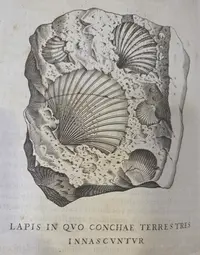
Michele Mercati was the Director of the Vatican's Botanical Gardens, and his Metallotheca's illustrated catalog of the Vatican mineralogical and specimen collection is "a pioneering endeavor in the organized display of scientific specimens" (Siraisi, Rome Reborn, p. 194). A landmark treatise in the history of mineralogy and metallurgy, the Metallotheca is of great importance in the history of the establishment of collections of scientific specimens and the development of museums, describing what was among the first organized mineralogical museums ever established, in the Vatican. Noteworthy for excellence of style and clarity, Metallotheca is considerably more than a treatise on minerals and metals. It provided a uniform generic classification for all the known minerals and fossils and also introduced a "remarkable discourse on the variations of the surface and subsurface of the earth caused by long epochs of geological evolution."
Mercati's book, although only half-finished at the author's death in 1593, was only printed for the first time under the editorship of the great physician Giovanni Maria Lancisi [1654-1720]. The volume is splendidly produced and illustrated with 150 fine engravings of rocks, minerals, fossils, and corals, all rendered in marvelous detail from the Vatican mineralogical collection. These remarkable illustrations make this work one of the most precious publications of the Renaissance in terms of iconography. The illustrations of glossopetrae (fossilized sharks' teeth) and the head of a shark (Lamia) are of particular importance, as the original plates for the engravings, unpublished but available to artists and scientists, were used by Nicolaus Steno in his "Canis carcariae dissectum caput" (1667). "The collection reflects the state of knowledge extant at the time and therefore includes objects of presumed magical or medicinal virtue as well as those which are correctly identified and described. The plates can scarcely be equaled for fidelity to originals and the exquisite care employed in their engraving and printing" (Sinkankas).
Sources:
https://mineralogicalrecord.com/new_biobibliography/mercati-michele/
https://www.liberantiquus.com/pages/books/5406/michele-museums-minerals-fossils-mercati/metallotheca-opus-posthumum-auctoritate-munificentia-clementis-undecimi-pontificis-maximi-e
On the origin of species by means of natural selection, or, The preservation of favoured races in the struggle for life, by Charles Darwin (1859).
Publisher: J. Murray, London. First edition, first issue.
On the Origin of Species, Charles Darwin's master work, was published on November 24, 1859. This book is a seminal work in scientific literature and a landmark work foundational to evolutionary biology. Darwin's Origin elaborated the proposition that species slowly evolve from common ancestors through the mechanism of natural selection. His book contains a wealth of evidence that the diversity of life arose through a branching pattern of evolution and common descent — evidence which he had accumulated on the voyage of the Beagle in the 1830s and expanded through research, correspondence, and experiments after his return.
The book was written for non-specialist readers and attracted widespread interest upon its publication. Darwin was already highly regarded as a scientist, so his findings were taken seriously and the evidence he presented generated scientific, philosophical, and religious discussion. Within two decades, there was widespread scientific agreement that evolution, with a branching pattern of common descent, had occurred, but scientists were slow to give natural selection the significance that Darwin thought appropriate. With the development of the modern evolutionary synthesis in the 1930s and 1940s, Darwin's concept of evolutionary adaptation through natural selection became central to modern evolutionary theory, and it has now become the unifying concept of the life sciences.
Sources:
https://www.raptisrarebooks.com/product/on-the-origin-of-species-charles-darwin-first-edition-rare-cloth/?srsltid=AfmBOookErApjzcIAmqk8qQjAu07UniV5oz5tn2bhCbyIRTOW0wdXv9z
https://en.wikipedia.org/wiki/On_the_Origin_of_Species
Principles of geology; being an attempt to explain the former changes of the earth's surface, by reference to causes now in operation, by Sir Charles Lyell (1830-1833).
Publisher: J. Murray, London.
In 1830–33, Charles Lyell laid the foundations of evolutionary biology with Principles of Geology, a pioneering three-volume book that has been called the most important scientific book ever written. Most notably, Lyell challenged the commonly-held belief in "catastrophism," that is, that the Earth as it appears today was mostly formed through quick, sudden geological "catastrophes," such as the Biblical flood of Noah's Ark. Instead, Principles of Geology suggested that geological processes mostly work through innumerable slow changes over millennia. Lyell used geological evidence to determine that the Earth was older than 6,000 years, and championed the ideas of geologist James Hutton (Theory of the Earth, 1795), who formulated one of the fundamental principles of modern geology – uniformitarianism. This proposed that natural processes always operate according to the same laws, allowing us to understand how features of the Earth's surface were produced by physical, chemical, and biological processes over long periods of time. The central argument in Principles was that "the present is the key to the past": that geological remains from the distant past could, and should, be explained by reference to geological processes now in operation and thus directly observable. Lyell's theory of uniformitarianism had impacts that continue to resonate in the scientific community today. Most notably, this work was read by the 22-year-old Charles Darwin while he was aboard the H.M.S. Beagle, and the influence of Lyell's theory of slow change over millennia is evident in Darwin's theory of evolution outlined in The Origin of Species.
Recherches sur les ossemens fossiles: où l'on rétablit les caractères de plusieurs animaux dont les révolutions du globe ont détruit les espèces, by Georges Cuvier (1821-1824). Translation: "Research on the fossil bones of quadrupeds, or the characteristics of several animal species that the revolutions of the globe appear to have destroyed are restored."
2nd Ed. Publisher: G. Dufour et E. d'Ocagne, Paris.
The "Researches sur les ossemens fossils" volume set by Georges Cuvier demonstrated the reality of extinction through detailed examination of fossils, and is a cornerstone work in paleontology, biology, and geology. As professor of comparative anatomy at the Museum of Natural History in Paris, Cuvier had access to rich and varied collections for his research. He used his skills in anatomical dissection and biological drawing to produce the 5 volumes of "Research on the fossil bones of quadrupeds", marking the advent of vertebrate paleontology. By comparing fossil finds with the skeletons of living species, Cuvier established extinction as a fact and argued that species could have been wiped out by natural cataclysms or "revolutions" in the earth's history. His studies of elephant anatomy, for example, differentiated between the living species of African and Indian elephants, and showed that fossil mammoths were distinct from both. In these texts he also demonstrated that the age of the earth was greater than six thousand years, and did much to establish the fields of comparative anatomy and paleontology.
Sources:
https://www.whipplelib.hps.cam.ac.uk/special/exhibitions-and-displays/exploring-deep-history/cuvier
https://www.christies.com/en/lot/lot-4315260
https://www.lornebair.com/pages/books/57403/cuvier-eorges/recherches-sur-les-ossemens-fossiles-ou-lon-retablit-les-caracteres-de-plusieurs-animaux-dont-les
Recherches sur les substances radioactives, by Marie Curie (1903).
Publisher: Gauthier-Villars, Paris.
A landmark scientific book, "Recherches sur les substances radioactives" presents Marie Curie's extensive research on radioactive substances, particularly focusing on uranium and the newly identified element radium. Curie's thesis documents the studies in radioactivity that culminated in her discovery of radium and polonium, achievements for which she was awarded part of the 1903 Nobel Prize for physics, and the 1911 Nobel Prize for chemistry. The text is aimed at a scholarly audience and contributes significantly to the field of radiochemistry. At the start of the work, Curie introduces her research, which began over four years prior, motivated by the intriguing discovery of uranium radiation by Henri Becquerel. She discusses the collaborative efforts with her husband, Pierre Curie, in studying radioactive properties and emphasizes the establishment of radium as a new, highly radioactive element. The early chapters outline the significance of various experiments conducted, the methodologies employed to study radioactivity, and the continual evolution of scientific understanding surrounding radioactive substances as more researchers engaged with the topic following their discoveries.
Marie Curie defended her doctoral thesis on radioactive substances at Université de la Sorbonne in Paris on 25 June 1903 – becoming the first woman in France to receive a doctoral degree. The examination committee expressed the opinion that Curie's findings, including the determination of radium's atomic weight, represented the greatest scientific contribution ever made in a doctoral thesis. Among the committee's three members were two future Nobel Laureates: Gabriel Lippmann (Physics 1908) and Henri Moissan (Chemistry 1906).
Sources:
https://www.gutenberg.org/ebooks/43233
https://en.wikipedia.org/wiki/Marie_Curie
https://www.instagram.com/p/DaAQRxyEmpG/ (@NobelPrize official Instagram)
Report on the geology of South Carolina, by Michael Tuomey (1848).
Printed and published for the state, by A. S. Johnston, Columbia, S.C.
Over 150 years ago, Michael Tuomey completed his "Report on the Geology of South Carolina," the result of four years of arduous labor. It is a comprehensive survey of the state's geology, mineral resources and natural history, including a catalog of state fauna. The report is the first detailed and comprehensive geological description of the entire state, including a geological map that shows the distribution of Coastal Plain and Piedmont-Blue Ridge units, and is an important early contribution to the geology of the southeastern U.S. Units depicted include metamorphic (Carolina slate, Bel Air belts, gneissic Kiokee belt, Kings Mountain mica slate belt) and granitic and basaltic intrusive rocks (Newberry, Columbia, and Liberty Hill granites, Newberry County intrusives, Ogden gabbros, and diabase dikes occurring from Virginia to Alabama). Michael Tuomey's report is truly a benchmark publication, as 60 years passed before the next statewide survey was done. Upon completing the report, he left South Carolina to become director of the Alabama Geological Survey.
Source: https://www.usgs.gov/publications/michael-tuomeys-1848-geological-survey-south-carolina
Strata identified by organized fossils: containing prints on colored paper of the most characteristic specimens in each stratum, by William Smith (1816-1819).
Publishing: Printed by W. Arding, London; and sold by the author.
William Smith (1769-1839) has been described by his contemporaries as the "father of English Stratigraphy". Early on, Smith made three original observations from which his life's work and much of classical geology subsequently derived. The first was that strata appeared to be stacked "like so many slices of buttered bread"; second, that they followed a definite order of succession; and third, that a distinctive assemblage of fossils characterized distinct strata in the succession. The recognition of a definite order of succession, i.e. a Geologic Column, would lead to the concept of Geologic Time, with Smith's work in showing how this was to be done crucial in the development of this novel science.
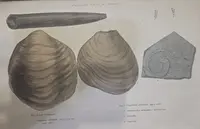
"Strata Identified by Organized Fossils, containing prints on colored paper of the most characteristic specimens in each stratum" is one of two publications Smith produced that illustrates his discovery of the correlation of particular groups of fossil types with different geological strata. These treatises provided both a catalog and an explanation of his theories when he was forced to sell his collection to the British Museum between 1815-1818. Originally issued in four parts (of a projected seven), each a sheet folded into quarters to make 8 text pages for a total of 19 copperplate engravings. Each plate displayed the fossils characteristic of a stratum embedded in the rock matrix as they might appear in the field, and each fossil group is printed on a differently colored paper intended to match the shades of the respective geological strata depicted. Illustrated plates were engraved and hand-watercolored by the great natural history artist and mineralogist James Sowerby (1757-1822). Because of its rarity, few geologists have ever seen this work. Only 250 copies were printed and the National Union Catalog lists only ten copies in American libraries.
Each stratum and its position in the succession was described individually — the soils developed upon it, the sub-soil, its properties, hydrology and what we would now consider its petrography, its general geographic position and characteristic topographic expression, etc. Both of the treatises helped pave the way for the development of modern geology and evolutionary theory. But Smith's work went beyond the mere illustration of fossils. With the strata identified, anyone would be able to compare the plates with fossils collected in the field and immediately identify the strata from which they came, and thus their place in the orderly succession of the strata.
Sources:
https://www.geolsoc.org.uk/the-library/online-exhibitions/william-strata-smith/aftermath-of-the-map/strata-identified-by-organized-fossils/?srsltid=AfmBOoq0XtjocK5Gu0Yh7RTGg3YY4tRtw5mHgGcj9-ctjdVghTfw0Vxs
https://ceps.unh.edu/earth-sciences/william-smiths-strata-identified-organized-fossils
https://www.christies.com/en/lot/lot-1340005
Publisher: W. and C. Tait, Edinburgh While a full professor of mineralogy at the University of Vienna, Frederich Mohs was assigned curator of the Austrian Imperial Mineralogical Collection, and was commissioned with the establishment of a museum in Vienna. As part of this task, he started classifying minerals by their physical characteristics instead of their chemical composition as had been done traditionally, having been inspired by Carl Linnaeus's method of botanical classification which was based on external characteristics. Mohs prioritized accessible external characteristics such as color, form, brilliance, hardness, and specific gravity, rather than internal chemical characteristics that were limited by the analytical chemical methods of the time. Mohs drew these interrelated characteristics into a new comprehensive system, and his catalog contained descriptions of each individual specimen, totaling 1,654 pages. Envisioning the catalog as both a practical tool and a theoretical treatise, he subtitled it Uber die oryktognostische Klassifikation, nebst Versuch eines auf blosse aussere Kennzeichen gegriindeten Mineralsystems (A system based entirely on external characteristics, described and made useful as a handbook of oryctognosy with the addition of many explanatory notes and necessary corrections appropriate to the current state of mineralogy) [Vienna, 1804]. Intended as a "guide for beginners," the work made Mohs famous immediately. Mohs further developed his method of mineral classification in the updated volume, Die Charaktere der Klassen, Ordnungen, Geschlechter, und Arten der naturhistorischen Mineral-Systems (The Characters of the Classes, Orders, Genera, and Species or, The Characteristic of the Natural History System of Mineralogy. Intended to Enable Student of Discriminate Minerals on Principles Similar to Those of Botany and Zoology), published in 1820. https://www.sciencehistory.org/education/scientific-biographies/friedrich-mohs/ The characters of the classes, orders, genera, and species; or, The characteristic of the natural history system of mineralogy. Intended to enable students of discriminate minerals on principles similar to those of botany and zoology, by Friedrich Mohs (1820).
Sources:
https://en.wikipedia.org/wiki/Friedrich_Mohs
Publisher: Taylor and Francis, London. Heinrich Wilhelm Dove was a Prussian physicist and meteorologist who wrote over 300 papers and helped launch the science of global climate study, as his primary meteorological focus was in climatology, a field pioneered by Alexander von Humboldt. He wrote about the movement of tropical cyclones and the theory of rotation, the effects of climate on plant growth, earth's magnetism and electricity, binaural beats and many other subjects. It was Heinrich Dove who in 1828 observed that tropical cyclones rotate counterclockwise in the Northern Hemisphere, but clockwise in the Southern. He also had an important influence on the science of meteorology and was considered by some to be a pioneer in this field. Source: https://www.abebooks.com/first-edition/Distribution-Heat-over-Surface-Globe-Taylor/31293128954/bdThe distribution of heat over the surface of the globe: illustrated by isothermal, thermic isabnormal, and other curves of temperature, by Heinrich Wilhelm Dove (1853).
Originally published in 1601, printed by Adam Islip. The first full English translation of Pliny's Naturalis Historia was by Philemon Holland (1552-1637), the greatest translator of the Elizabethan age. The 'Natural History' of Pliny the Elder is more than a natural history; it is considered by many historians to be the first Encyclopedia. The famous story of Pliny's death while trying to observe the eruption of Vesuvius at closer quarters than was prudent is often, and justly, cited as an example of his curiosity and devotion to furthering knowledge. He was a compiler rather than an original thinker, and the importance of this book depends more on his exhaustive reading (he quotes over four hundred authorities, Greek and Latin) than on his original work. When he died, the 'Natural History' (the sole extant work out of one hundred and two volumes) was still incomplete. It comprises thirty-seven books dealing with mathematics and physics, geography and astronomy, medicine and zoology, anthropology and physiology, philosophy and history, agriculture and mineralogy, arts and letters. One of the largest single works to have survived from the Roman Empire, it was intended to cover the entire field of ancient knowledge, based on the best authorities available to Pliny. It remains a standard work for the Roman period and the advances in technology and understanding of natural phenomena at the time. Sources: https://www.robzangerrarebooks.com/pages/books/84/gaius-secundus-plinius-pliny-gaius-secundus-philemon-holland-23-79-ce/the-historie-of-the-world-commonly-called-the-naturall-historie-of-i-c-plinius-secundus-translated The historie of the world: commonly called, The naturall historie of C. Plinius Secundus, by Pliny the Elder (1634).
https://www.abebooks.com/first-edition/HISTORIE-WORLD-Commonly-called-naturall-Plinius/31057384364/bd
Publisher: Harper & Brothers, New York. Mathew Fontaine Maury was an American oceanographer and naval officer, serving the United States and then joining the Confederacy during the American Civil War. Considered a founder of modern oceanography, he wrote extensively on the subject, and his book, The Physical Geography of the Sea, was the first comprehensive work on oceanography to be published and is now regarded as the first textbook of modern oceanography. It includes a general discussion about coastlines, tides, currents, and other phases of the ocean and its life. Early in life as a Lieutenant in the U.S. Navy, Maury published his Wind and Current Chart of the North Atlantic, which showed sailors how to utilize the ocean's currents and winds to their advantage, thereby drastically reducing the length of voyages. Maury's uniform system of recording synoptic oceanographic data was adopted by navies and merchant marines around the world and was used to develop charts for all the major trade routes. Source: https://en.wikipedia.org/wiki/Matthew_Fontaine_MauryThe Physical Geography of the Sea, by Matthew Fontaine Maury (1855).