
Campus Living Laboratory
 This material was originally created for
Starting Point:Introductory Geology
This material was originally created for
Starting Point:Introductory Geology and is replicated here as part of the SERC Pedagogic Service.
and updated by Suzanne Savanick Hansen and Caroline Savage, Princeton University
All campuses have links to climate through rainfall landing on the campus grounds. All campuses have links to surface water as water lands on impervious buildings and parking lots. People travel to the campus by automobile and bus, which add greenhouse gases to the atmosphere.
You can also check out Historical Geology by Mike Phillips and Tait Chirinje's Brownfields or Superfund Case Study activities, which use a campus-based learning approach.

 Show credits
 Hide
Hide "As commonly practiced, education has little to do with its specific setting or locality. The typical campus is mostly regarded as a place where learning occurs but is, itself, believed to be the source of no useful learning. It is intended, rather, to be convenient, efficient, or aesthetically pleasing, but not instructional. It neither requires nor facilitates competence or mindfulness. By that standard, the same education could happen as well in California or in Kazakhstan, or on Mars, for that matter." (Orr 1993)
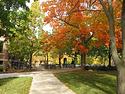
Every campus has a geoscience and sustainability context.
All campuses have links to climate through rainfall landing on the campus grounds. All campuses have links to surface water as water lands on impervious buildings and parking lots. People travel to the campus by automobile and bus, which add greenhouse gases to the atmosphere.
Education at most institutions does not link to the local context, yet the actual buildings and grounds can be studied, analyzed and even manipulated for research and education.
What is a campus living laboratory?
A living laboratory uses the campus buildings and grounds as teaching tools. A campus can be a used as a teaching tool in all of the parts of the geoscience umbrella, from the most specific geology class to the broadest introductory environmental studies class. Learn more about campus-based learning in the geosciences
Why use the campus as a living laboratory?
Campus living laboratory projects can provide hands-on, real-world projects that link to service-learning and civic engagement programs. Living laboratory education can also be accomplished even without a field trip budget or transportation. Learn more about why campus-based learning is effectiveHow to use the campus as a living laboratory?
For specific tips on how to get started, find resources and people, contribute back to the community and keep campus research records, Learn more about how to use campus-based learningExamples of campus living laboratories
See specific examples of how to incorporate campus-based learning in to geoscience courses.You can also check out Historical Geology by Mike Phillips and Tait Chirinje's Brownfields or Superfund Case Study activities, which use a campus-based learning approach.