
E-CURE Steps and Flow Charts
Read the steps below and view or print the flow chart of steps for your selected option:
 Show EvaluateUR-CURE Standard flow chart
 Hide
Hide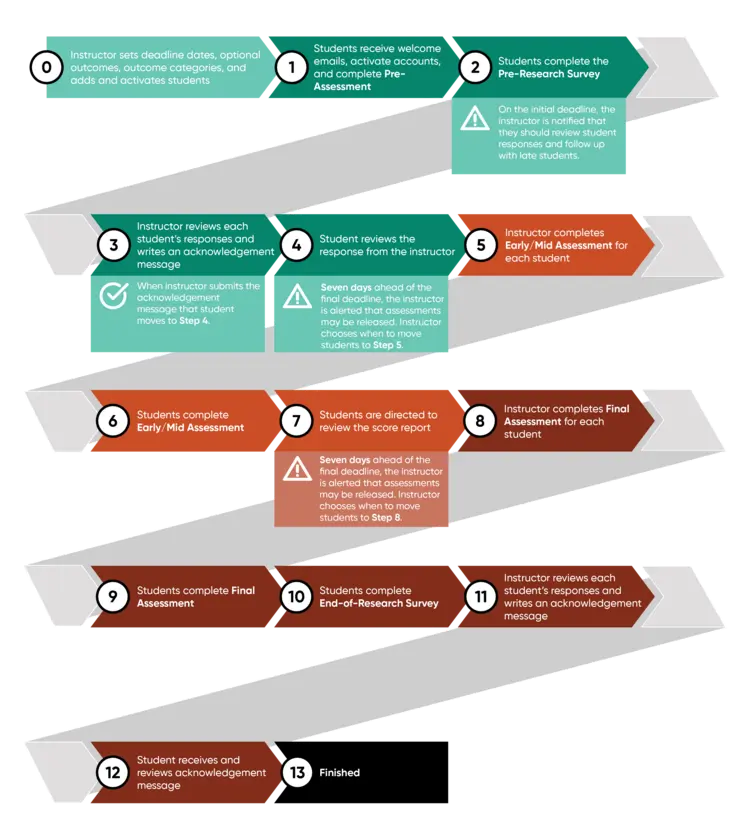
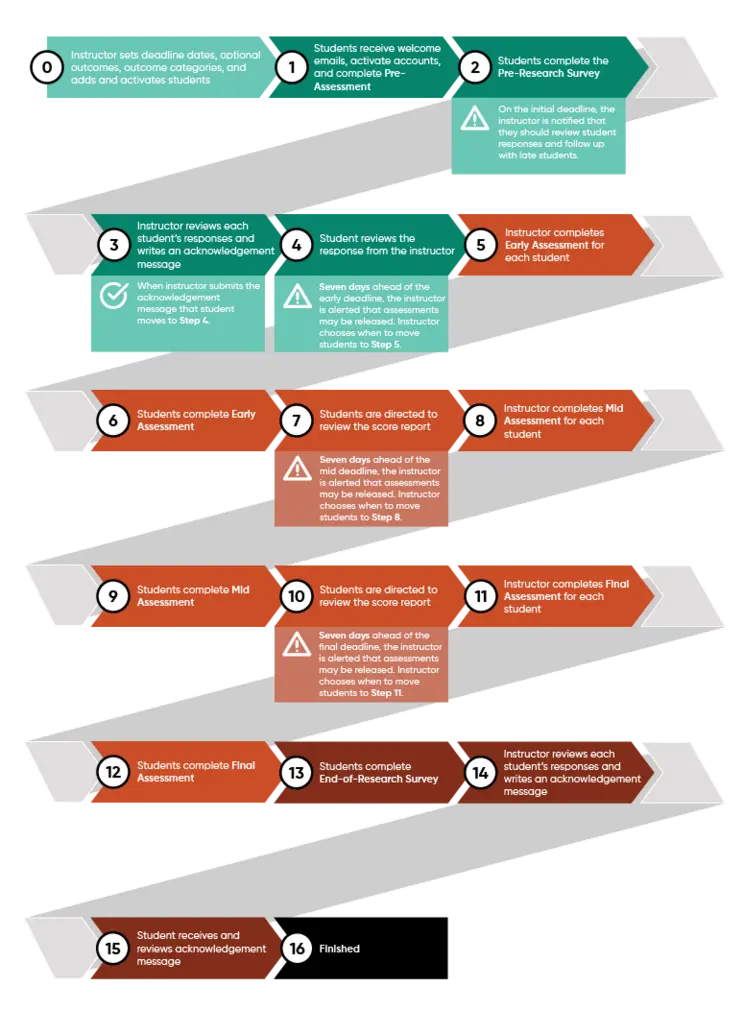
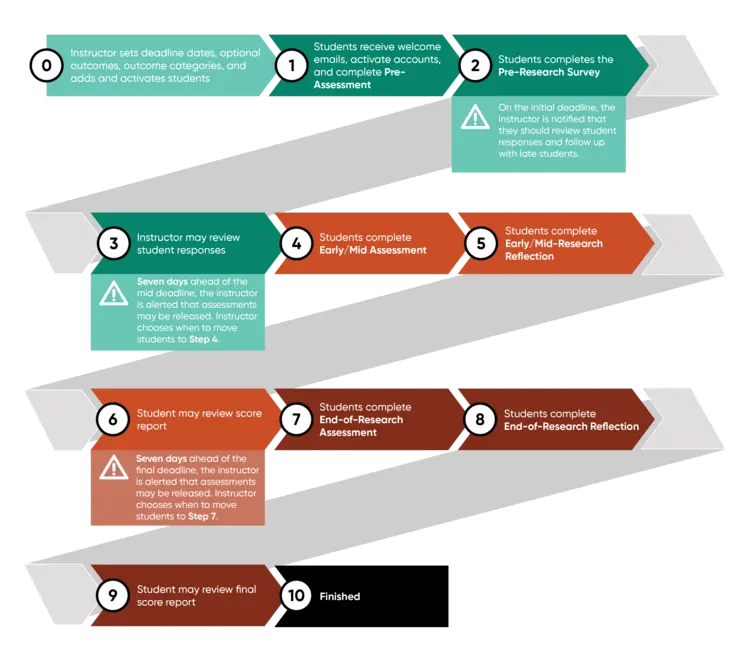
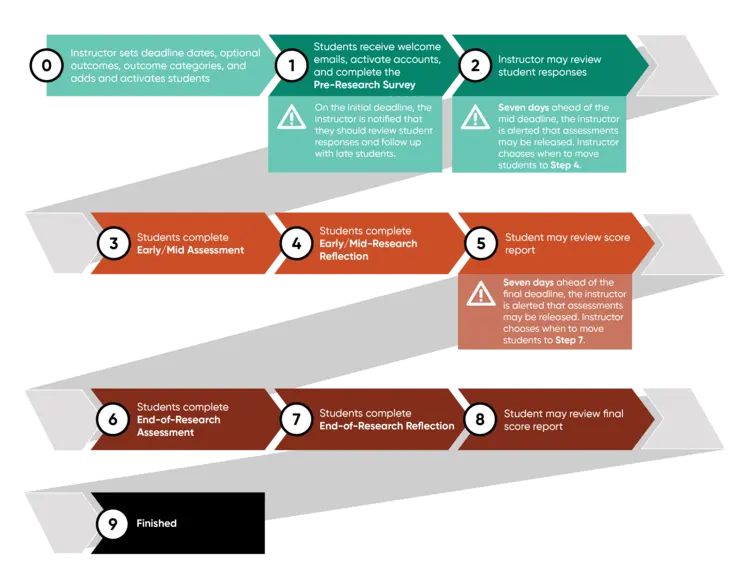
Note: The description below applies to the option of E-CURE where the assessments are scored by the students and the CURE instructor. Differences between this option and the student-only scored option will be noted. The option of E-CURE for shorter duration/smaller scale research projects differs from the other two options because it only includes two assessments; the first one is completed 2-3 weeks after the research begins and the second assessment scheduled near the end of the semester/quarter. In most other aspects, the short option of E-CURE is similar to the steps for the student-only scored option. However, it is highly recommended that the CURE instructor download/print the flowchart for the E-CURE option being used. This is the most complete explanation of the steps and actions for the E-CURE option.
Getting Started
Timing: before the course begins
- CURE instructor completes onboarding steps to learn and prepare for implementation of E-CURE, including setting up the course dashboard, choosing dates for Pre-Research Deadline, Mid-Research Deadline, and End-of Research, and entering student names and emails, and activating students.
Timing: first week of course
- CURE instructor introduces E-CURE to students: what it is, how it can help them, and most importantly, to make it clear that the scores assigned to outcome components are not used in any way in determining the course grade. CURE Instructors might want to provide an opportunity for students to view the video especially for students (coming soon).
Pre-Research
Timing: first/second week of course
- Set Pre-Research deadline for completion of all Pre-Research steps.
- Students receive automated emails instructing them to set up an account and complete both the Pre-Research Assessment, which includes the set of outcome categories selected by the instructor, and the Pre-Research Open-Ended Questions.
- Students complete the Pre-Research Open-Ended Questions and the Pre-Research Assessment. Only students complete the initial assessment.
- Note: for the short version of E-CURE, students answer the open-ended questions before the research starts and the first assessment 2-3 weeks after the research has started.
- CURE instructor reviews student responses.
- CURE instructor holds class conversation(s) (recommended).
- For the initial conversation, CURE instructors might want to review responses to open-ended questions and encourage a discussion about anything that stands out, such as misunderstandings about the research process, concerns raised by students, and what defines success in conducting research, among other topics of interest.
Mid-Research
Timing: just before the research mid-point
- The CURE instructor completes the Early/Mid-Research Assessment.
- There is flexibility in the timing of this, but it should occur after the CURE instructor has had sufficient time to observe and interact with the students. In the student-only scored option and short option of E-CURE, CURE instructors do not score assessments but do review student responses.
- Students complete the Early/Mid-Research Assessment.
- Students and CURE instructor receive and review Score Reports.
- For the student-only scored and short versions, instructors can easily view the responses provided by students – refer to 'using score reports'.
- Conversations with the whole class or in smaller groups (whatever makes sense given the size of the CURE and other factors). The idea in the post-assessment conversation(s) is to reinforce the value of using E-CURE in helping students self-reflect and a way to provide students with helpful feedback about their progress and any areas that might need further improvement.
End of Research
Timing: ~1 week prior to end of research
- CURE instructor completes the End-of-Research Assessment for each student in the course.
- This is not done for student-only scored option and short option.
- Students complete the End-of-Research Assessment and Post-Research Open-ended Questions.
- Students and CURE instructor access and review Score Reports.
- Conversations (see notes above)