Initial Publication Date: February 20, 2026
DOIThis page currently has no DOI, but you may request a DOI be assigned. |
Cite thisDAISE Materials Development Rubric
The data analysis for investigating the solid Earth (DAISE) modules to be developed as part of this project are designed with the goal of developing students' data analysis skills for graduate school and the geoscience workforce. To accomplish this, these modules aim to engage students in engaging, hands-on learning of solid Earth geoscience content and skills that require use and practice with data analysis techniques and approaches.
This rubric is designed to guide DAISE materials developers as they create modules to support students' quantitative reasoning and data analysis skills in the context of solid Earth geoscience questions. The elements of the rubric are drawn from the GETSI and InTeGrate rubrics. The rubric incorporates the goals of the DAISE project and researched guidelines for best practices in materials development and geoscience education. The assessment is divided into five sub-areas:
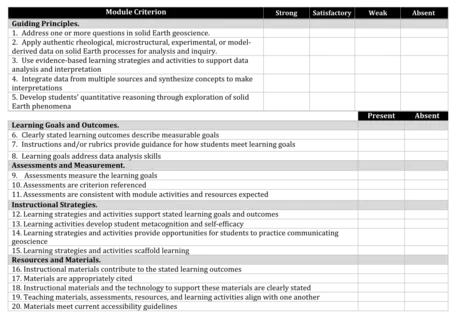
DAISE Module Development Rubric. Click to enlarge.
- Guiding principles
- Learning goals and outcomes
- Assessment and measurement
- Instructional strategies
- Resources and materials
DAISE rubric with editable table (Microsoft Word 2007 (.docx) 23kB Feb13 26)
Rubric Sub-Areas
Guiding Principles
The guiding principles are scored as strong, satisfactory, weak, or absent.
- Address one or more questions in solid Earth geoscience. The module must be framed around a question that is relevant to the field of solid Earth geoscience, such as tectonics, mantle convection, lithospheric stress, deformation, earthquake and fault systems, or stress in granular materials.
- Apply authentic rheological, microstructural, experimental, or model-derived data on solid Earth processes for analysis and inquiry. Instructional materials should use real data that solid Earth geoscientists employ to understand the behavior of Earth's interior. The data may be from physical experiments, modeling, and/or natural samples. Datasets and/or references to data sources are provided as needed. The use of authentic data encourages students to think critically about how mechanical processes are inferred from measurements.
- Use evidence-based learning strategies and activities to support data analysis and interpretation.The design of the teaching activities must actively promote skills necessary for a solid Earth geoscientist. Activities should scaffold techniques for data processing, visualization, and error analysis. The materials promote mastery of data analysis techniques that are central to engaging with authentic geoscience questions and assist students in recognizing when those techniques are likely to be applicable to a question.
- Integrate data from multiple sources and synthesize concepts to make interpretations. Solid Earth problems rarely rely on a single data type. The teaching modules will require students to compare and reconcile information from disparate sources to develop a reasonable interpretation.
- Develop students' quantitative reasoning through exploration of solid Earth phenomena. Quantitative reasoning is critical to analyzing solid Earth processes. The module should embed activities that require students to apply mathematical and computational skills directly to solid Earth phenomena. Examples may include analyzing experimental or observational data, applying physical equations to quantify geological processes, or interpreting graphical and numerical data to make predictions about the Earth.
Learning Goals and Outcomes
These elements are scored as present or absent
- Clearly stated learning outcomes describe measurable goals. Learning outcomes are clear statements that describe the desired goals of the instruction. Learning outcomes are directly stated as specific competencies, skills and/or knowledge that students are to master or demonstrate.
- Instructions and/or rubrics provide guidance for how students meet learning goals. Instructions and/or rubrics are developed that provide the student with a clear indication of the performance conditions and standards necessary to meet learning goals. If this specificity is not possible (e.g. internal cognition, affective changes), metrics used to measure indications of such change must be described for the student.
- Learning goals address data analysis skills. There are numerous data analysis skills that may be addressed by the learning goals. Each module must include at least one data analysis skill such as addressing uncertainty, propagating error, evaluating data quality, visualizing data, and data model comparisons.
Assessments and Measurement
These elements are scored as present or absent
- Assessments measure the learning goals. Embedded formative assessments and summative assessments and assignments will provide logical tools to determine the extent to which students have met the module goals. These activities must match module content such that they help the student achieve the goals (and thus be able to do the assignments).
- Assessments are criterion referenced. Assessments include a clear and meaningful list of criteria used to evaluate student work and participation including all the information students need to know how a grade will be calculated. This could be accomplished with a formal rubric or with a more informally structured description of what each grade looks like. This could involve a rubric for each type of assignment, a list of criteria and associated point values for specific assignments, or a sample of acceptable or unacceptable student work such as examples of excellent or poor papers or projects.
- Assessments are consistent with module activities and resources expected. Assessments and assignments support module activities and are designed to measure the extent to which the student has accomplished one or more of the goals. Every assignment references the learning goals assessed. Resources needed for activities and assessments are clearly stated.
Instructional Strategies
These elements are scored as present or absent
- Learning strategies and activities support stated learning goals and outcomes. Students will be able to meet the stated goals using the learning activities provided. These actively engage students with the module content using a variety of different types of activities. Activities are designed to support reinforcement and mastery in multiple ways.
- Learning activities develop student metacognition and self-efficacy. The activities provide opportunities for students to iterate and improve their understanding incrementally, while also promoting a growth mindset and increasing confidence. Activities include an appropriate balance of guidance versus exploration and opportunities for reflection, discussion, and synthesis. Students will be able to assess their own learning and confirm they are on the right track through reflective activities.
- Learning strategies and activities provide opportunities for students to practice communicating geoscience. Students will be engaged in independent thinking, problem-solving, and communicating their understanding. Activities challenge misconceptions (where necessary), provide opportunities for students to practice judging what constitutes credible evidence, and provide opportunities for students to practice communicating geoscience concepts verbally, in writing, and/or with visualizations.
- Learning strategies and activities scaffold learning. Activities promote deep learning by stimulating student intellectual growth from novice to more advanced levels. Activities are structured to allow students to first note obvious connections and then grasp the significance of those connections. At higher levels, students are challenged to appreciate the significance of the parts as related to the larger concept and eventually extend those concepts to general principles outside the discipline.
Resources and Materials
These elements are scored as present or absent
- Instructional materials contribute to the stated learning outcomes. Module materials such as textbooks, articles, lecture notes, audio or video recordings, games, or websites directly support one or more guiding principles, literacy goals, or core concepts embedded in learning goals and outcomes.
- Materials are appropriately cited. All learning materials, software, and learning resources must conform to copyright law and proper citation protocols unless there is a specific statement attached to the materials stating that they are in the public domain.
- Instructional materials and the technology to support these materials are clearly stated. If specific technology is needed, what is required is clearly stated, e.g. geophysical instruments for data acquisition or computer lab operating system and/or licenses for a specific software application. Information is included about how any provided dataset was collected, as well as information about how to collect one's own data if instruments are available. Where possible, this should include tutorials for the use of the equipment.
- Teaching materials, assessments, resources, and learning activities align with one another. A constructive alignment approach suggests that goals, learning activities, and assessments within each section of the module align with one another and directly with the stated learning goals. A curriculum map that identifies core skills and content, learning strategies and resources can be used as an effective way to ensure alignment.
- Materials meet current accessibility guidelines, including at a minimum fully meeting the WCAG 2.1 AA standard. Following a soon-to-take-effect update to ADA Title II affecting higher ed organizations, all materials and websites must conform to the Web Content Accessibility Guidelines (WCAG) 2.1 standard at least at the AA level of conformance. Please be sure to reference the SERC accessibility guidelines, with particular care towards using accessibility checker tools in software like PowerPoint, Word, Acrobat Reader, etc. for any uploaded documents, contrast checking colors in any diagrams created or added, and writing useful alt text for inserted images.

 Show the elements within this sub-area
 Hide
Hide