
Module Development Timeline
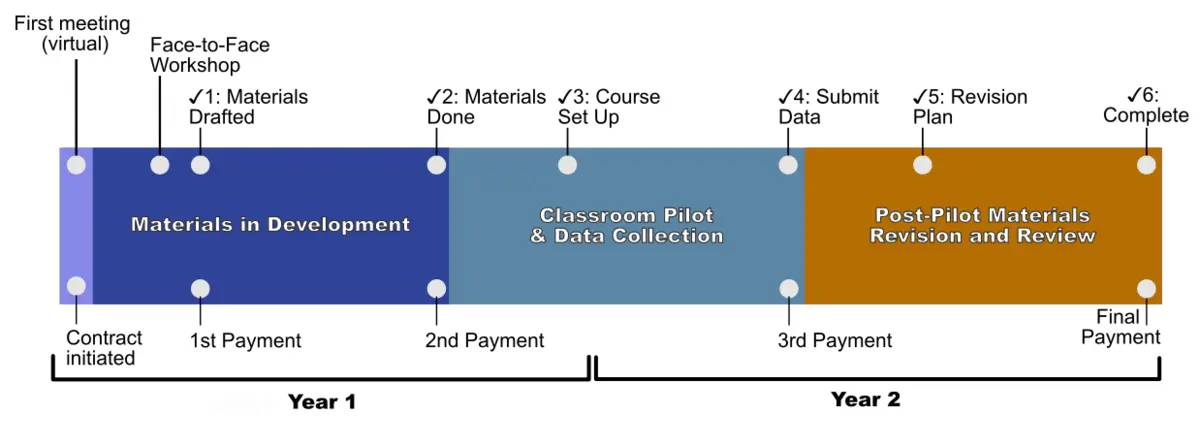
Overview of the Materials Development Timeline
Each module/course development team will follow a series of steps and checkpoints designed to 1) align the materials development process with project goals and timeline and 2) allow for timely interaction among the materials development teams, DAISE leadership, and SERC staff. There will be three major phases of developing, testing, and revising materials.
Phase 1: Materials in Development (as a team)
Each team's authors work together to create detailed descriptions of materials for faculty use and student versions of the materials when necessary. The DAISE Materials Development Rubric describes the types of materials the project is creating. At the end of Phase 1, the materials will need to pass the rubric, demonstrating that they have all the desired attributes. In Phase 2, student data will be collected, so authors must prepare by obtaining IRB approval from their institutions.Phase 2: Classroom Pilot (individually)
During the classroom pilot phase, module authors take their newly developed materials and try it out in their own classroom. Authors collect data that supports the evaluation of the team's materials and of the project's overall goals. Piloting allows authors to understand and document the learning that is taking place in the classroom. This helps ensure that the desired level of learning is being achieved and demonstrates pieces of the curriculum that may need revisions. Since each team member individually pilots the materials, there will be multiple sets of data to inform the material revisions.Phase 3: Post-Pilot Materials Revision (as a team)
The materials development team uses data collected during their classroom pilot along with leadership feedback from the rubric review to guide the team toward meaningful revisions. Authors create individual case studies based on experiences and reflections from implementing the materials, and finalize the information that supports other faculty in using the materials. By the end of the process, the teaching materials and case studies will become publicly-available web pages that other faculty may access and implement in their own classes.
Phase 1: Materials In Development
As the team develops materials, they will reach various checkpoints where feedback will be given from DAISE leaders. The purpose of the checkpoints is to ensure that the team has adequate input and support to develop successful materials as described by the DAISE Materials Development Rubric and is moving toward successfully passing rubric-based review at Checkpoint 2. By checking the work against the rubric several times throughout development, there is a much smaller chance of having to make major revisions once the module/course is complete.
Getting Started
As part of the initial activities of the project, each team will succinctly summarize their module content and outline all the parts that need to be developed. At this point, each team will also establish a development timeline including at least 2 additional synchronous meetings prior to the March in-person workshop.
- Initial Virtual Author Meeting
- At least 2 synchronous meetings to move the module design forward
- Materials Development Workshop - March 6-7, 2026 - Northfield, MN
By the end of the March in-person Materials Development Workshop, each team will hopefully make significant progress in outlining the module they will develop.
Checkpoint 1: Materials Drafted
Teams will pass the first check point when they have made significant progress in drafting their module. Successfully passing Checkpoint 1 will include:
- A complete module outline page that shows the breadth of the module, including unit descriptions, pedagogic strategies, planned assessment strategies, and descriptions of any materials that will be developed for students.
- At least one complete unit that includes faculty materials, student materials, and formative and summative assessments with rubrics to display the depth of your materials
- Complete example(s) of a summative assessment(s) that will address the module-level goals
When your team feels you have reached Checkpoint 1 you will need to:
- Contact the Project Lead (rmcfadden@carleton.edu) to review the new content on your webspace. At this point, we are checking that the scope and organization of the materials match critical aspects of the DAISE Materials Development Rubric prior to further development and testing. We will either make suggestions for revisions or pass your module/course to the Evaluator for review.
- Contact the SERC Implementation Team (iTeam) (jmcdaris@carleton.edu) and have a conversation about the structure of your module. This will allow them to create the necessary 'empty spaces' to hold your planned activity sheets (for instructions to the faculty) and student materials.
- Begin investigating the Institutional Review Board (IRB) approval process for your institution. This process is highly varied at each institution and can take a long time.
Materials Team receives first payment upon completing Checkpoint 1
Checkpoint 2: Materials Complete
The materials development team enters the checkpoint when the materials are fully available in SERCkit pages. Student worksheets are uploaded as needed, activity descriptions are completed, and the overview of the materials on the module overview page are sufficient for another instructor to understand how the parts of the module build upon one another to create a cohesive module. Once complete, the materials are reviewed by the Project Lead. The team may be asked to make revisions or additions. When the Project Leader has determined that the materials are ready for review, they initiate the review by contacting the Evaluator. The materials are reviewed using the DAISE Materials Development Rubric.
Timing for this checkpoint:
- This checkpoint should be completed by June 30, 2026 to allow time for reviews and revisions.
- Following completion, each author will review one other module in the set for scientific accuracy and completeness. This review should be finished by July 15, 2026.
Materials team responsibilities:
- Ensure your team has responded to any prior feedback ; if you choose not to change materials based on feedback, make sure you clarify the reasoning for this decision and communicate this to Project Leadership.
- Be sure that formatting is similar on all module pages and will support easy use and review of all of your materials. Ask for iTeam assistance as needed.
- After review is complete, revise materials as needed by August 15, 2026. You may need to create a plan with project staff to complete revisions.
Materials Team receives second payment upon completing Checkpoint 2
Phase 2: Classroom Pilot and Data Collection
During Phase 2 you will teach with your materials and collect data that your team will use to improve the materials. These data are also used to evaluate the project as a whole.
Because the student assessment data is being used for research, we need to consider how human research guidelines apply. Most institutions have Institutional Review Boards (IRB) that oversee this sort of data collection. Carleton College has approved the DAISE student data and faculty survey data collection project as EXEMPT and is acting as the IRB of record for the project. (The Approval Letter and IRB Application materials are available on the Forms & Documents page.)
More information on this Phase will be provided later in Year 1.
Checkpoint 3: Course Setup and Data Collection
Pilot testing steps occur for each individual author (not as a team). Please note that there are data collection steps that will need to be addressed prior to the start of the semester in which you plan to pilot the module/course in your class.
We anticipate a short pre-survey for students with a longer post-survey. These instruments will gather information students' attitudes, experiences, and content knowledge.
Checkpoint 4: Submit Data
To pass Checkpoint 4, all student assessment data is submitted.
Materials Team receives third payment upon completing Checkpoint 4
Phase 3: Post-Pilot Materials Revision and Review
During this phase of the materials development process, the team will revise the materials based on the information gathered during the pilot testing, including the experiences of the team in teaching with the materials and the assessment results. Authors will complete the materials that support other faculty in using the materials, which include the instructor testimonials that describe the adaptation of the materials for each author's class. At the end of phase 3, the materials will be published on the project website.
Checkpoint 5: Post-Pilot Revisions
Pedagogic Review
DAISE will conduct a pedagogic review of the developed teaching modules. The review will be conducted by Jen Wenner, Prof. Emerita of the University of Wisconsin Oshkosh. This review will likely take several weeks and any recommendations for revisions will be provided to module authors for integration into their revision plans.
Revision Plan
This work begins with the development of a revision plan by the team. This revision plan is based on the classroom pilot tests, and is informed by the data collected, reflections, case studies, and an intimate knowledge of what worked/didn't work with the module or course. Comparing and contrasting challenges and successes with team members will help create a strong coordinated revision plan. Each team will need to define changes as either:
- Global: changes to be applied to the module/course as a whole.
- Individual: changes that may help individual teaching scenarios.
Authors will work together to develop the plan, including a timeline and assignment of specific responsibilities.
Individual Instructor Stories
Each author should write about their experience developing and implementing the module. The primary audience for this writing is a high education colleague who is exploring using the materials in their own class. These instructor stories should speak to questions such a colleague is likely to have about using the materials. More details on these instructor stories and a submission form for creating them will be shared with you later in the project.
Finalizing Materials
Materials Checklist
- All necessary student materials are available online in proper format(s).
- All necessary instructor materials are available online in proper format(s).
- Writing style and tone are appropriate for the material. Teaching materials should follow best practices for web writing and present an accessible and compelling case for their use. Materials directed at students should have a voice and presentation appropriate for use in a broad range of classrooms.
- Spelling and grammar are correct.
- Navigation within the web pages follows DAISE conventions and is complete and consistent.
- All links are functional.
- Appropriate attribution is given and sources cited throughout.
- All teacher-only materials are identified and communicated to the team iTeam member so they can be placed in a protected space (only accessible to instructors).
- Work with the iTeam to select an appropriate image for the front page.
- All downloadable materials:
- Are provided in formats appropriate for their intended use.
- Appropriately cite their sources.
- Figures and images have captions including attribution and references as appropriate.
- All included materials (including photos), both online and downloadable, have accurate licensing information and can be legally redistributed by DAISE.
- Individual instructor stories are finished.
When the author team determines that they are finished with revisions, they should email the Project Lead and cc the iTeam.
The SERC iTeam will conduct a technical review of each module when authors indicate they are finished. This process will generate a list of any remaining things that need attention from the authors: broken links, major formatting problems, provenance/reuse info that is incomplete or seems incorrect. iTeam personnel will also conduct a copy edit of each module and its materials to ensure that everything is in place.
Checkpoint 6: Final Assessment and Final Revisions
- The authors review the final materials ready for publication.
- Materials go live (publicly available).
- Authors complete the finished revising reflection survey.
Materials published on DAISE site and become freely available for use
Materials Team receives final payment upon completing publishing.