Why Use Interactive Lectures?
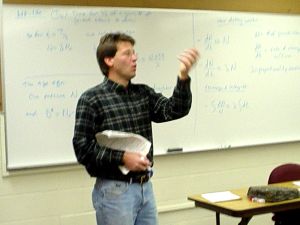
Lecturing, a time-honored teaching technique, offers an efficient method to present information to a large number of students but may result in students who listen passively. Making lectures interactive by including interactive techniques such as think-pair-share, demonstrations, and role playing, can:
- foster active engagement and accountability;
- promote student retention and learning of the material presented during lecture;
- give students practice in developing critical-thinking skills; and
- enable instructors to assess how well the class is learning that day.
Interactive Lectures Promote Deep Learning
Looking at students' reading strategies, Marton and Saljo (1976) identified deep and surface approaches to learning. They discovered that students preparing for a test take two different approaches: (1) deep learners read for overall understanding and meaning; (2) surface learners focus on stand-alone, disconnected facts and rote memorization. Deep learning leads to a genuine understanding that promotes long-term retention of the learned material and as important, the ability to retrieve it and apply it to new problems in unfamiliar concepts. Surface learning, on the other hand, focuses on the uncritical acceptance of knowledge with an emphasis on memorization of unquestioned, unrelated facts. Retention is fleeting and there is little long-term retention and less.
Leammson (2002) notes: "What is often called 'deep learning,' the kind that demands both understanding and remembering of relationships, causes, effects and implications for new or different situations simply cannot be made easy. Such learning depends on students actually restructuring their brains and that demands effort," (p.7). Incorporating activities into lectures is one way to get students to start making that effort and research shows it pays off. For example:
- Hake (1998) compared pre- and post-course test results for 6000 students from high school and university physics courses, and found significantly more improvement in students in courses that used interactive-engagement methods (including classes over 100 students) than in those that did not.
- Wenzel (1999) reviewed research on college lectures and reported that the longer the lecture, the less of the material ended up in the students' notes. Interactive classes commonly involve breaking up the lecture, effectively giving multiple short lectures, presumably with a higher percentage of material being retained from each. He also reported that a class that used a think-pair-share technique for two-three minutes for every 12-18 minutes of lecture remembered more of the lecture material directly after the class and twelve days later than the control class that heard the same lecture without the think-pair-share breaks.
- Crouch and Mazur (2001) and Rao and DiCarol (2000) document how using clickers deepens students' retention and understanding.
Interactive Lectures Fosters Student Engagement
Getting students involved, rather than sitting passively, also increases student interest and student perception of their own learning:- Saroyan and Snell (1997) find that students rate a more interactive and student-centered lecturing style as more likely to imply a higher degree of learning (compared to more traditional, teacher-centered styles).
- Peterson and Miller (2004) compare the experiences of college students during periods of cooperative learning to times when students were engaged in large-group instruction. Students were interrupted during both types of lecture to try to measure perception of their experiences. Overall quality of experience was greater during cooperative learning as measured by ability to "think on task," student engagement, perceptions of task importance, and optimal levels of challenge and skill usage..
-
Watts and Becker (2008) in a 2005 survey of post-secondary institutions, find that the median portion of class time spent lecturing in economics courses is 83 percent. In a post-graduation survey of approximately 2,000 students,
-
Allgood et al.(2004) find that students are much more likely to report that their economics instructors utilized lectures more than alternative teaching strategies, especially relative to other disciplines. This might suggest that instructors in other disciplines utilize non-lecture teaching strategies more often than do economics instructors.
-
Yet in an extensive survey of the economic education research literature, Miller and Rebelein (2011) report numerous empirical findings that demonstrate improved student learning and engagement in economics courses resulting from interactive pedagogies such as cooperative learning, experiments, case studies, experiential learning and student research.