
Undergraduate Research
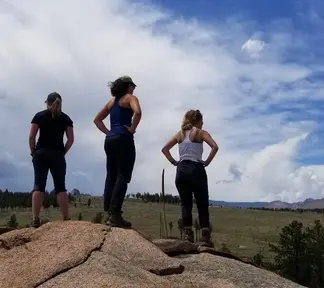 Undergraduate researchers look out over a 20 year old burn scar after completing field research.
- Your home institution may offer research opportunities. Check professors' websites to see if anything piques your interest! If so, reach out!
- Research Experience for Undergraduates (REU) programs are sponsored by the National Science Foundation. These programs typically run for 8-10 weeks at universities all over the U.S., in nearly every scientific discipline.
- Summer research opportunities at universities and/or with research scientists are often posted on discipline-specific listservs. Subscribe or go to the website & browse listings.
- Many federal laboratories and private-sector companies also offer summer research opportunities.
Below, learn about:
- The WHY & HOW behind applying to undergraduate research opportunities – resume help and tips
- Lists of typical Research Experience for Undergraduates (REU) and summer programs – search by settings or disciplines
- Amazing role models
Applying to undergraduate research opportunities
How to apply for an REU
Watch Dr. Melissa Burt's (Colorado State University) webinar on how to apply for REU programs!
Learn about:
- Types of research opportunities available to students
- What to expect during a summer research experience
- How to put together a strong and convincing application package.
Writing a resume
Need resume help? Dr. Manda Adams (National Science Foundation) provides guidance on building your resume to best sell yourself & tailor it for each opportunity.
Additional advice:
- Explore AGU career center's resume guide and tips for early careers
- Check out ORISE's 'How to build the perfect STEM resume or CV'
- Check out this article written by a professor after reading too many poor applications
- Read some candid advice from an anonymous research scientist in the life sciences
Tips for attaining an REU
REU participant slots can be highly desirable and sometimes extremely competitive; each hosting organization or school has only a limited number of available positions. These applications should be taken seriously. Jonathan Hodge at Grand Valley State University in Michigan has created a list of excellent tips for attaining an REU:
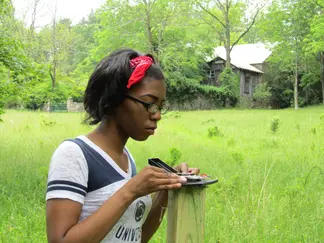 Kimmie Bowen checks on a field instrument as part of a research project at Penn State University
- Read and follow directions... The application form will ask for specific information from you. Make sure to provide exactly what is requested. If you have questions about any part of the application, contact the program director and ask for clarification.
- Demonstrate specific knowledge and interest in the program to which you are applying... Don't just say that you're interested in doing an REU. Tell the reader exactly why you are interested in the specific REU to which you are applying. Do your research before you complete your application. Browse the program's web site, and use this knowledge to highlight specific aspects of the program that are particularly appealing to you. Don't use the same application essay for every program you apply to. Show the reader that you spent some time researching and applying specifically to their REU.
- Choose good references... What your references write about you can make a big difference in distinguishing your application from others. Choose references who know you well and who will take the time to write a thorough and detailed letter of recommendation. It's okay to ask a reference, "Do you think that you will be able to write a strong and detailed letter for me?" Make sure your references understand what is expected of them. Some REUs provide detailed instructions for references; if such instructions are available, make sure that your references have a copy of them. Also give your references a copy of your application essay and any other information that would help them to write a strong letter for you.
- Share what makes you different from other applicants... Summer programs such as REUs are highly competitive. It is not unusual for a program with 8-10 participants to receive 100-200 applications. If you have unique experiences that set you apart from other applicants, make sure to mention these. What you write needs to convince the reader that you have unique traits and abilities that will contribute to your success in an REU. Of course, your academic preparation is important, but it is also important to demonstrate that you have the social and emotional maturity to function well in an intense research environment, working with people from all different backgrounds. Extracurricular and co-curricular activities often speak well to these characteristics.
- Be authentic... Don't oversell yourself. Provide an honest account of your background and experiences, but don't be boastful or arrogant. Don't name-drop or use obscure mathematical terms to try to impress the readers.
- Apply to multiple programs... It's important to remember that REUs are extremely competitive, and even the very best students do not get accepted by every program to which they apply. Do some research, and choose a variety of programs (perhaps 3-10) that suit your interests and abilities.
REU and summer research opportunities
Below is a listing of typical REU (Research Experience for Undergraduates) and summer programs that are regularly offered, but the actual offerings vary from year to year depending on NSF funding (COVID-19, etc.). Be sure to read each listing carefully for eligibility, application guidelines, and deadlines. Please note that the lists are not complete, but they can provide you with a good place to start. You should also check out the National Science Foundation (NSF) REU website and the Pathways to Science website regularly for updates.
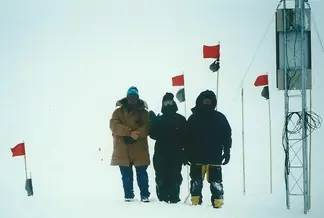 REU participant Elaine Godfrey (center) and teammates at the top of the Greenland ice cap after successfully repairing a magnetometer
REUs by setting
 Federal Laboratories and Agencies
 Hide
HideREUs by discipline and audience
Check out the University of South Carolina's searchable database for domestic and international opportunities!
Amazing role models
Watch one or more of these inspirational videos of women in the geosciences and learn how they are using their science & their humanity to make the world a better place.
- Dr. Karletta Chief: Bitter Water
- Dr. Dawn Wright: Let Science Speak
- Dr. Lydia Jennings: Run to Be Visible
- Dr. Asmeret Asefaw Berhe: A climate change solution that's right under our feet
- Dr. Kayla Iacovino: The Volcano Trekker
- Dr. Jacqueline Gill: Let Science Speak
- Dr. Africa Flores-Anderson: The Lake Sentinel
- Dr. Burçin Mutlu-Pakdil: The Galaxy Hunter