Unknown #1
Download and view the crystal structure data
- Right click on Unknown_1.amc ( 935bytes Dec29 04) to download the crystal structure to your computer. (This file was modified from an AMC file in the American Mineralogist Crystal Structure Database).
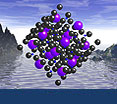
- Once the file has downloaded to your computer, click on it to automatically start XtalDraw and open the file for viewing. You should see something like this...

- Try to resist looking at the mineral chemical formula (Edit > Chemical Formula) as this will probably be too big of a hint right off the bat.
Determine the identity of the unknown
Using your knowledge of crystallography and systematic mineralogy, and manipulating the downloaded structure in XtalDraw, answer the following questions to deduce the identity of the unknown. Check your answers by clicking on the "show answer" tabs which appear with each question.
What crystal system does this mineral belong to?
Is this mineral a silicate or non-silicate?
Are the silica tetrahedra isolated or connected in some way? If connected, how?
The silica tetrahedra are isolated from one another.
Based on the arrangement of silica tetrahedra, what class of silicate is this mineral?
Nesosilicate (or Orthosilicate)
What is the coordination of Al in this mineral?
What is the coordination of Mg in this mineral? Is this the "normal" coordination for Mg exhibited by most other rock-forming minerals? What might this be telling you about the conditions under which this mineral forms (low/med/high P or T)?
Mg is in 8-fold (dodecahedral) coordination. In most other minerals, Mg is in 6-fold (octahedral) coordination. Coordination number tends to increase with increasing pressure, hence this mineral was probably formed at rather high pressures (i.e., in metamorphic rocks).
...so what mineral is this?
Pyrope Garnet - Mg
3Al
2Si
3O
12 Pyrope
The structure is from Hazen, RM and Finger, LW (1989) High-pressure crystal chemistry of andradite and pyrope: Revised procedures for high-pressure diffraction experiments. American Mineralogist 74:352-359
Pyrope is the Mg-endmember in the "Pyralspite" group of garnets.
 Show question #1
 Hide
Hide