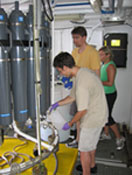
Environmental Sampling
Collecting samples involves the isolation and careful gathering of specimens of interest in a given environmental study. Important environmental parameters such as pH, dissolved oxygen, electrical conductivity, and hydrological conditions aid in classifying the collection environment. Methodologies employed to measure such parameters can be as involved and diverse as the studies themselves.
Methods
Environmental characteristics are vital for putting scientific research in context. These pages provide techniques for measuring several diverse methods for measuring environmental characteristics. Technique Sheets are available for the following environmental sampling methods:
- Hydrological Tracers
- Measuring pH and Electrical Conductivity
- Stable Isotope Primer and Some Hydrological Applications
- Stream Gaging
- Measuring Turbidity Using a Secchi Disk
- Winkler Method for Measuring Dissolved Oxygen
- Conductivity, Temperature, and Depth (CTD) rosette

 Show Credits
 Hide
Hide