When last checked this resource was offline Our automated link checker has alerted the folks responsible for the part of our site where this problematic link is referenced.
If you have further information about the link (e.g. a new location where the information can be found) please let us know.
You may be able to find previous versions at the Internet Archive.
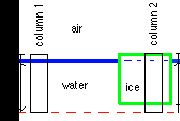
These lecture notes discuss the role of buoyancy, flexure, and erosion in the earth's topography and the lifetime of mountain ranges. It recalls Pascal's law that pressure of a material overlying a fluid is equal everywhere at a given depth and Archimedes' principle that a body in a fluid is buoyed up with a force equal to the weight (mass x volume) of the displaced fluid. Continents are buoyant crust floating on denser mantle, so a 4 km high mountain range must have a 20 km deep root. According to Archimedes' principle, when mountain ranges erode, pressure is released from the surface and the mountain root is bouyed up to equalize the pressure. Continental crust is about 40 km thick, so it is strong enough to support smaller topographic loads, like small volcanoes, without the aid of a buoyant root.
This description of a site outside SERC has not been vetted by SERC staff and may be incomplete or incorrect. If you
have information we can use to flesh out or correct this record let us know.
Part of the Cutting Edge collection. The NAGT/DLESE On the Cutting Edge project helps geoscience faculty stay up-to-date with both geoscience research and teaching methods.