
SMaRT Course2006

 Show caption
 Hide
HideThis intensive, project-oriented course is taught at the Center of Marine Biotechnology (COMB), University of Maryland Biotechnology Institute, Baltimore, with participation by scientists from Indiana University.
The course is for Undergraduate Students with a strong interest and some familiarity with microbiology. This NSF-funded course is targeted to students from groups traditionally underrepresented in science.
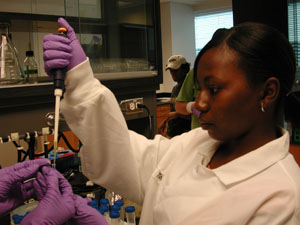
Ten day intensive training in microbiology and molecular microbial ecology will be given. Teaching and hands-on research will focus on microbes in sponges although the principles and skills covered are generally applicable in microbiology. Students isolate microbes from sponges, identify isolates by 16S ribosomal RNA gene (rDNA) sequencing, extract total DNA from sponges and perform PCR on this DNA to amplify microbial genes. Microscopy, fluorescence in situ hybridization and detection of signaling compounds from microbes are covered.
The course is for Undergraduate Students with a strong interest and some familiarity with microbiology. This NSF-funded course is targeted to students from groups traditionally underrepresented in science.
Ten day intensive training in microbiology and molecular microbial ecology will be given. Teaching and hands-on research will focus on microbes in sponges although the principles and skills covered are generally applicable in microbiology. Students isolate microbes from sponges, identify isolates by 16S ribosomal RNA gene (rDNA) sequencing, extract total DNA from sponges and perform PCR on this DNA to amplify microbial genes. Microscopy, fluorescence in situ hybridization and detection of signaling compounds from microbes are covered.


Copyright on all images and material by Russell Hill, 2006.