 About Profiles
 Hide
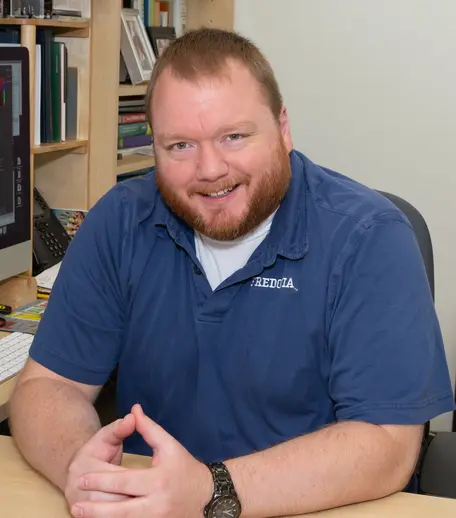
Thomas Hegna
SUNY at Fredonia
Dr. Thomas Hegna grew up in western Iowa and attended the University of Iowa where he fell in love with invertebrate paleontology. He graduated in the spring of 2004 with honors and high distinction in Geoscience (B.S.) with minors in English and Philosophy. Dr. Hegna stayed at the University of Iowa for his M.S., graduating in the fall of 2006 after completing a project on the systematics and phylogeny of a fauna of upper Cambrian trilobites. He then moved on to Yale University where he completed his thesis on branchiopod crustacean phylogeny and their fossil record in the spring of 2012. He taught at Western Illinois University from the fall of 2011 to the spring of 2019. In 2016, he was awarded the WIU Provost’s Excellence Award for Teaching with Technology.
During the summer of 2019, he moved to Fredonia to teach in the Geology & Environmental Sciences Department at SUNY Fredonia. In the spring of 2022, he was awarded the William T. and Charlotte N. Hagen Young Scholar/Artist award at SUNY Fredonia for his outstanding record of scholarship. In the spring of 2024, he was the SUNY Fredonia awardee for the Chancellor's award for excellence in scholarship. In the spring of 2025, he was awarded the Robert W. Kasling Lecture Award for his excellence in scholarship. He has led two separate teams (one at WIU and another at SUNY Fredonia) that have received National Science Foundation grants for scanning electron microscopes. He has over 50 published peer-reviewed papers and book chapters and over 125 conference presentations. He has mentored the research projects of 40 students. He continues to study both the fossil record of trilobites and early crustaceans.
https://www.fredonia.edu/academics/colleges-schools/college-liberal-arts-sciences/geology-environmental-sciences/faculty/Thomas-Hegna
https://sites.google.com/view/thehegnalab/home
Website Content Contributions
Essay (1)

Teaching Critical Thinking in a Large Lecture Class part of NAGT:Our Resources:In the Trenches:Articles
Critical thinking is a daunting topic to teach, even more so within the confines of a large lecture class. This article describes an approach for teaching critical thinking that uses an examination of flat Earth ...
