http://www.sencer.net/index.cfm

The Course

A major priority in the design of this course is the engagement of students as scientists and citizens. This is accomplished through the variety of techniques described below.

Syllabus (Acrobat (PDF) 232kB Feb25 08)


Course Format | Lecture Meetings | Lab Meetings | Pedagogical Methodologies | Concept Maps | Case Studies | Understanding Context | E-Text


Course Design

Course Format

In order for the POW course to parallel its sister Goal 6 courses, it is taught in a traditional 4-credit lecture-lab course format: students meet for 3 lecture hours and 2 lab hours each week. The physical meeting space is also traditional: lecture meetings take place in a 96-seat auditorium in which all students meet together and smaller lab sections meet in a 24-seat teaching laboratory. Enrollments in the course vary depending on the primary faculty member's other teaching responsibilities, however all sections offered are usually filled to capacity. Four sections (three 24-student sections and one 15-student honors section) have typically been offered in the fall, and in 2006 the course was added to spring course offerings for the first time.

Lecture meetings

As a result of the way the course is structured, the lecture meeting brings together all of the lab sections and includes between 60 and 90 students. While not a "large lecture" by large campus standards, it is at the upper end of class sizes on our campus. A variety of techniques are used to make this meeting as student-focused and interactive as possible.

In the first course offering, the Personal Response System (PRS, a.k.a. student "clickers") was used to engage students in a series of questions spaced throughout the lecture. This provided feedback to students and instructors regarding understanding of the content of the day.

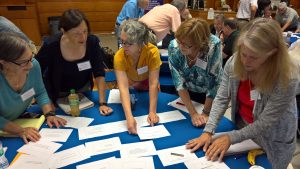
While use of the PRS was discontinued after that first offering, the lecture meetings are still structured around student engagement and learning. Lectures are constructed as a series of conceptual questions followed by content needed to understand and address the questions. Students are active participants in the lecture meetings, not just through responses to the questions, but also through small group work and brief writing assignments. Throughout the course the goal of understanding is emphasized, and, each day, students are presented with several opportunities to assess their own understanding and to clarify issues that are unclear.

The course is structured with 75-minute lecture meetings on Tuesday and Thursday. Each Thursday students are required to come to class with the "Science" section from Tuesday's New York Times. Working in small groups and as a whole group, articles are discussed based on their relevance to class material, our lives as educated citizens, and pure novelty and interest. These structured discussions are intended to model the "life of the mind" that we hope students will live throughout their lives as curious, educated, learning citizens.

Lab meetings

Laboratory activities are varied but largely fall into four categories: research, skill development, field experiences, and case studies. The research project that is designed and set up during lab meetings is described below, as are the case studies related to water privatization and dam projects.

Related to the research project as well as other course goals, lab meetings are used as an opportunity for students to develop, practice, and hopefully master skills related to quantitative techniques (including basic descriptive statistics as well as Geographic Information Systems use), presentation of data (including the development of graphs and figures and understanding the relationships therein), experimental design, and library research. In several semesters students were challenged to design a microhydropower turbine (using materials available through http://users.rcn.com/handson/hydro/contest.html) that might be scaled up and used by a rural village to generate modest amounts of electricity. This design challenge required the application of basic concepts from physics and proved to be an engaging problem for student teams. At the end of the design period, turbines from each student team were tested to see which performed the best, and the experience ended with a discussion of a key question: you can build it-but should you?

Field experiences are an important way for students to develop an appreciation of local water resources, and all students in the course visit local waterways and municipal facilities that safeguard water quality. Field trips to two local water treatment facilities not only relate to class discussions of water quality but also provide students with a sense of the community context in which the campus resides (discussed further below). Two additional trips focus on sampling of local waterways, including impacted sites in the town of Farmville, as well as a forested creek in a local state forest. During these trips, students see water quality impacts first hand. Students often cite these trips as a highlight of the course.

E-text

While the use of a custom e-text is hardly innovative, it does solve a major issue that was encountered in the first offering of the course. As there are few good texts for interdisciplinary science courses and none that fits the needs of this course, a custom etext was developed using McGraw-Hill's Primis service. The text was built with chapters from a number of different McGraw-Hill books, and it provided students with a much needed reference.

Pedagogical Methodologies

These methodologies are what set the Power of Water course apart from biology courses taught in standard formats. They represent innovative tools for linking biology with real world contexts and civic issues.

Concept maps

While the connections among science topics and social issues come readily to faculty, early feedback indicated that students had difficulty making these connections. The concept map assignment requires students to develop a concept map every two weeks using a user-friendly software program (http://www.inspiration.com/). In developing their maps (samples included in Appendix 1), students must identify the key concepts from class and explicitly make connections among them. Additionally, they must incorporate articles from The New York Times and describe how those news items relate to our work in class. Finally, they must incorporate other connections, such as work from other courses, issues in our local community, etc. While the final map is in itself quite interesting and provides insight into student understanding of the relationships among course topics, it is the process of thinking through the connections that is most beneficial to the students. In fact, this assignment is frequently cited in Student Assessment of Learning Gains (SALG) results as the course activity that helped students learn the most.

Student Created Concept Map (Acrobat (PDF) 110kB Apr13 08)

Case studies

Two films are used to frame case studies on water privatization (Thirst) and dam projects (Drowned Out). Both films clearly relate to basic course content: water resource management, water quality, dams as water control structures, etc. However, they frame that content in its social context. Water resource management is steeped in very difficult questions related to who controls the resource, who has rights to it, who ensures its safety, and who is responsible for delivering it. With respect to the dam issue, the film makes a very simple point: humans can build these structures in the name of nation building and renewable energy. However, the makers of both films go well beyond the simple points by exploring the ways in which we are changing a resource that has been in place for millennia and what costs are borne by the people. What is the cost of the major dam projects? What is the cost of privatizing water resource? Very importantly, how do citizens engage these issues in their own communities? The films include many examples of civic engagement that cross economic and cultural boundaries. Students are shocked to see footage of the Bolivian army turning its weapons on its own people-all over the issue of water privatization. They are then equally surprised to learn the story of Stockton, California, and its citizens' fight to block sale of its water treatment facilities to a private corporation. Through discussions and an informal writing assignment, students reflect on the relationships of the scientific and social issues as well as parallels between these distant geographic locations and places close to home.

An opportunistic addition in Fall 2006 was an assignment focused on An Inconvenient Truth, a film that a local theater showed at the request of the Longwood faculty. The relationship of the film's content to the POW unit on global climate is clear, and, in future semesters, this film is likely to return to the course syllabus.

Understanding context

As part of this course, we take field trips to our local drinking water filtration and waste water treatment plants. While this is a very simple activity, with few exceptions students cite it as one of great impact in their understanding of our local water resources and our campus' impact on them. We are part of a community and our activities on campus affect that community. Students are frequently shocked to learn that the demands on the water and waste water treatment plants double when they return to campus in August. After these trips, students openly discuss their impressions of these facilities (i.e., rather dated and old) and the people who manage them (i.e., dedicated stewards of a critical community service). These trips provide wonderful connections to our case study of privatization of water resources, both in terms of our country's aging infrastructure for water processing and the role of municipal workers in providing for the public good. Students identify Kathy and Chuck of our local plants with key individuals in the Thirst film, thereby connecting our local context to important national issues.