The Course

Cluster & Course Learning Goals


Context:


The University of North Carolina at Asheville (UNCA) has adopted a curriculum, called the Integrative Liberal Studies (ILS) program, in which students take their general education distribution in natural science, social science, and humanities or arts in topical clusters centered around a common theme. The ILS approach utilizes the SENCER philosophy of a multidisciplinary platform for science and general education for all students by learning through a civically-engaging topic.


Cluster Mission:


The Food for Thought cluster focuses on developing the student as an informed consumer of food by providing a platform for discussion of what we eat, why we eat, where our food comes from and its journey from production to consumption, and how food affects our bodies and health. Across the semesters of participation in the cluster, students gain insight into the often hidden ways that food consumption impacts us on both the individual and collective levels. As human beings, our bodies and our societies are interlinked by numerous processes, many of which can be understood by investigating the dynamics of food in chemical, biological, and social systems. Our primary goal for students is an enhanced, interdisciplinary understanding of the interplay of these systems and a more attuned sense of how food is a civic issue. More information is available at (Food For Thought Website).


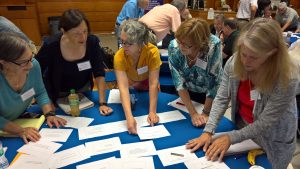
To achieve this mission, students enroll in various Food for Thought cluster courses throughout their undergraduate career. Each course has course learning goals within the individual discipline and within the mission of the cluster. Cluster courses draw from disciplines in Chemistry, Biology, Nutrition, Economics and Sociology. Students from a variety of courses learn about science and social science issues of a common theme by participating in and working on common projects - students learn intellectual context of their discipline by being exposed to the practices and frameworks of different disciplines as presented to them by peers in other courses.

Course Table Part One

Course Table Part Two

Course Table Part Three

The Courses


CHEM 174 Live, Learn and Eat: The Food of Chemistry


Format: Food of Chemistry is a fully-integrated lecture and laboratory course geared for students who would normally never take a chemistry course and satisfies the cluster natural science or the laboratory science requirement of UNCA's general education requirement. The class has an enrollment of 16 students and is organized as a separate lecture and laboratory: lecture meets once per week in a 3-hour timeslot in a classroom with a sink and large demonstration bench and laboratory meets once per week in a separate 3-hour timeslot with available space in both a chemical laboratory (for traditional labs) and food-safe classroom (for cooking labs). Course material draws from that in a typical General Chemistry course, but is presented in a nontraditional order.


Pedagogies: Food of Chemistry is taught through the SENCER models of students learning science through civic engagement. It is geared for nonscience majors with limited mathematical background who would normally never take a chemistry course by tying the relevance of fundamental chemical principles to the topics of food and cooking. Each week, the class material is delivered (whenever possible) as a lecture topic integrated with lecture demonstrations and laboratory experiments so that students can experience a direct "daily-life" application to the scientific content. The goal is for students to finish the course with an appreciation of chemical theories and the scientific method and how they apply to everyday life, the direct application of chemistry and science to non-science issues, and the importance of and ways in which scientists and nonscientists communicate. Course content and chemical applications is learned by independent student work (instructor lectures, homework and writing assignments), visual demonstrations in class, field trips, laboratory experimentation and group projects, and multi-course cluster activities and projects.


BIOL 110 Plants and Humans (Clarke)


Format: Plants and Humans typically has an enrollment of twenty students across a wide range of majors. Students range from entering freshmen to graduating seniors. Lectures (3/week) are the primary format, but outdoor activities and in-class discussion frequently substitute for these lectures.


Pedagogies: Teaching emphasizes the students' gaining breadth and depth of content in the subject area, but not at the expense of an understanding of theory. Students achieve an understanding of basic natural science through an appreciation of its relevance to social and environmental issues in both a contemporary and historical sense and across different cultures. Successful students read both the textbook and other assigned readings before lectures.


HWP 225 Nutrition and Lifestyle: Eating to Live Well (Lanou)


Format: Nutrition and Lifestyle is a required sophomore level course in the Health and Wellness Promotion major with no prerequisites. It is frequently also taken for personal interest by students from other disciplines from all levels. Typically 30 to 40 students are enrolled per semester. Course is largely lecture- and large group discussion-based with individual and group projects and opportunities for oral presentations.


Pedagogies: In this applied nutrition course, targeted to the individual students learn basic nutritional science through reading, lecture, and discussion. Through written assignments, class projects, and exams students are encouraged to apply these nutrition principles to their own lifestyles. For example, students do a 3 part nutritional assessment assignment in which they evaluate their eating habits strengths and weaknesses, calculate their expected total energy need and macronutrient needs, they then keep a detailed 3-day food and activity diary and calculate their actual energy and nutrient intake as well as their energy use. Finally, they evaluate how well their habits match their needs, and then write a set of personal dietary guidelines for themselves.


HWP 325 Pathophysiology of Chronic Conditions and Illnesses (Lanou)

Format: Pathophysiology is a required upper-division course in the Health and Wellness Promotion major. Junior standing and HWP 225 Nutrition and Lifestyle and an Anatomy course are prerequisites. It is occasionally also taken by students in the sciences, psychology, and the pre-health professions. Twice a week meetings are used for lectures, group discussions, small group work, and role plays.


Pedagogies: Students in Pathophysiology have the dual tasks of learning about up-to-date information about disease states and lifestyle choices that can be used to help manage them and becoming familiar with reading, critiquing, and utilizing health and disease-related original research articles for use in education, lifestyle counseling, and research papers. Students also learn about and practice writing health-related opinion editorials, critical reviews articles, lifestyle care plans, and educational materials. As part of their learning process, they are applying the disease specific information they are learning to field specific outcomes.


HWP 373 Food Politics and Nutrition Policy: How Government and Industry Impact Health (Lanou)

Format: Nutrition Policy is an elective course offered by the department of Health and Wellness. It is has no prerequisites and typically enrolls about 15 students from across a variety of disciplines. Class time is used largely for reading discussion and group work. Some lecture and discussion with guest lecturers are utilized.


Pedagogies: Nutrition policy is reading and writing intensive. Students read everything from government policy documents to a popular non-fiction book about local food ways "Animal, vegetable, miracle" by Barbara Kingsolver. They also read and watch controversial and sometimes challenging information which we use class time to consider, discuss, and critique. An emphasis is on understanding policy and how to influence, change or make it.


SOC 385 Science and Technology: Engaging the Citizen in a World of Experts (Peterson)

Format: Science and Technology is an elective in the Sociology major with no prerequisites. Suited to students at the sophomore level or higher, typically enrolls 15-25 students. The course is a combination of lecture, readings and class-based discussion, and interactive "labs".


Pedagogies: The course combines recent research and theory in the field of the Social Studies of Science and Technology. The course emphasizes a social constructionist framework and emphasizes both the historical development of technological artifacts and the relationships between users and technological artifacts. In combination with this framework, the course adopts an inquiry-based model of learning that asks students to investigate their own relationships with technological artifacts. In addition, students are asked to develop their ethnographic/interviewing skills and to study how experts and lay people relate to technology. Because of the dual emphasis on theory and inquiry, approximately one-half of class time is devoted to lecture, discussion and readings, and the other half is devoted to hands-on activities, including building erector set models, origami construction, examination of flawed designs in everyday technologies, and observation of others using technologies.


ECON 245 Land Economics: Connecting Land with People (Mathews)

Format: Land Economics typically enrolls twenty-five students a year from majors such as Environmental Studies, Economics, History, and Management. Since there is a prerequisite of Principles of Microeconomics, students are sophomore through senior level. The course is taught using a combination of lectures, case studies, and class discussions.


Pedagogy: Land Economics is interdisciplinary in nature, as the primary focus is on applying tools from multiple disciplines to understand the links between land and people. As a result, several disciplines are used in application to provide students with multiple examples of the pedagogies used to study Land Economics just as students use multiple pedagogies to learn it. Students are responsible for not only preparing for each class session by reading the assigned material, but also for presenting material to the rest of the class at various points in the semester, both as individuals and as groups. Because there are multiple flows and sources of knowledge that require active student involvement, students are provided flexibility and decision-making opportunities related to their learning throughout the class.

Individual Course Learning Goals


Learning Goals (Acrobat (PDF) 46kB Nov10 08)

Disciplinary and Cluster Learning Goals


Disciplinary Learning Goals (Acrobat (PDF) 26kB Nov10 08)