Unknown #5
Download and view the crystal structure data
- Right click on Unknown_5.cmdf ( 16kB Dec16 09) to download the crystal structure to your computer. (This file was modified from a CIF file in the Crystal Structure Library provided in CrystalMaker).
- Start the CrystalMaker program.
- Choose the File > Open command, and select the file you just downloaded to view in CrystalMaker.
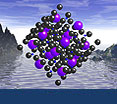
- Click on OK to generate the crystal structure for viewing. You should see something like this...

Determine the identity of the unknown
Using your knowledge of crystallography and systematic mineralogy, and manipulating the downloaded structure in CrystalMaker, answer the following questions to deduce the identity of the unknown. Check your answers by clicking on the "show answer" tabs which appear with each question.
-
What is the crystal system of this mineral?
-
Hexagonal (trigonal sub-system)
-
Is this mineral a silicate or non-silicate?
-
-
Click on
Edit > Bonding to draw the Si-O bonds. Click on
Add and choose "Si" under
From and "O" under
To. Clicking on the box under
Info will give you information about coordination. Finally, click on
OK to draw the bonds. The window should look like this...
Are the silica tetrahedra isolated or connected in some way? If connected, how? (hint: to highlight the silica tetrahedra, use the
Model > Polyhedral command to plot the structure as a polyhedral model).
The silica tetrahedra form rings.

-
Keeping the
Edit > Bonding window open, add the following bonds to the structure: Fe-O, Al-O, B-O, Na-O, and H-O. Then examine at the polyhedral model for the entire structure.
What is the largest site in this structure? (i.e., what element does it contain?)
-
-
Based on the arrangement of silica tetrahedra, what class of silicate is this mineral?
-
Cyclosilicate (ring silicate).
-
Based on the mineral's composition, do you think this mineral is strongly colored or not?
-
It contains Fe, which is one of the dominant causes of color in most minerals. In fact, this mineral is so strongly colored, it is jet black.
...so what mineral is this? (extra credit if you can guess the variety name)
-
Tourmaline (var. schorl) - (Na,Ca)(Li,Mg,Al)
3(Al,Fe,Mn)
6(BO
3)
3(Si
6O
18)(OH)
4
 Schorl
Image courtesy of Amethyst Galleries. The structure is from Zhang L, Ahsbahs H, Hafner SS, Kutoglu A (1997) Single-crystal compression and crystal structure of clinopyroxene up to 10GPa. American Mineralogist 82:245-258.
Schorl is the variety of tourmaline that has mostly Fe in the (Al,Fe,Mn) site.
 Show question #1
 Hide
Hide