Teaching Mineralogy with Crystal Structure Databases and Visualization Software
Integrating Research and Education > Crystallography > Identifying Minerals Using Chemical and Crystallographic Data > Directions for CrystalMaker Users > Unknown #3

Unknown #3

Download and view the crystal structure data

  1. Right click on Unknown_3.cif ( 2kB Dec14 04) to download the crystal structure to your computer. (This file was modified from a CIF file in the Crystal Structure Library provided in CrystalMaker).
  2. Start the CrystalMaker program.
  3. Choose the File > Open command, and select the file you just downloaded to view in CrystalMaker.
  4. Click on OK to generate the crystal structure for viewing. You should see something like this...

Determine the identity of the unknown

Using your knowledge of crystallography and systematic mineralogy, and manipulating the downloaded structure in CrystalMaker, answer the following questions to deduce the identity of the unknown. Check your answers by clicking on the "show answer" tabs which appear with each question.
What class of non-silicate minerals does this mineral belong to?
Oxide
showShow question #2
What crystal system does this mineral belong to?
showShow answer
Isometric (cubic)
showShow question #3
What cleavage form would be exhibited by this mineral?
showShow answer
Octahedral
showShow question #4
To see an adequate portion of the structure (not just the unit cell), choose Transform > Set Range, and click on Expand 2 times to extend the structure along all axes by 20%. Click OK.

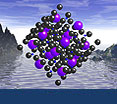
Next, draw the Fe-O bonds by choosing Edit > Bonding. Click on Add and choose "Fe" under From and "O" under To. Clicking on the box under Info will give you information about coordination. Finally, click on OK to draw the bonds. The window should look like this...
Is the coordination of all Fe's in this mineral the same, or is there more than one crystallographic site that accepts Fe?
showShow answer
There are two Fe sites: one tetrahedral and the other octahedral.
showShow question #5
What do the two sites for Fe imply about the oxidation state of Fe in this mineral?
showShow answer
Ferrous (Fe2+) and ferric (Fe3+) iron are present.

...so what mineral is this?
Magnetite - Fe3O4
Magnetite
Image courtesy of Amethyst Galleries.

The structure is from Fleet, M.E. (1986) Journal of Solid State Chemistry 62:75.

You should have realized that the mineral was not hematite because of the isometric crystal structure (hematite is hexagonal) and because of the multiple valences of Fe (hematite only has Fe3+).

« Previous Page      Next Page »